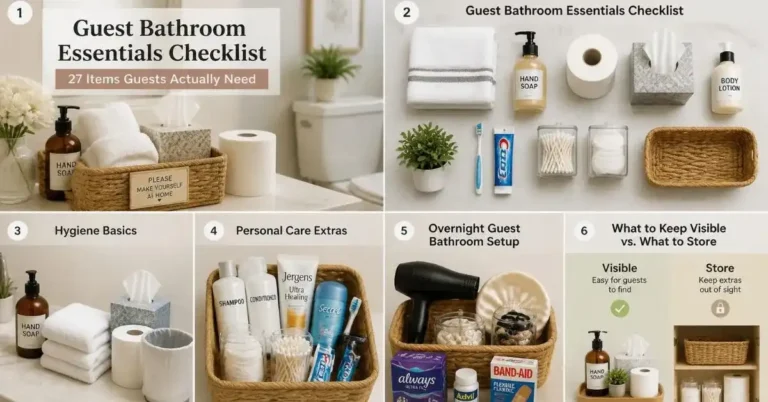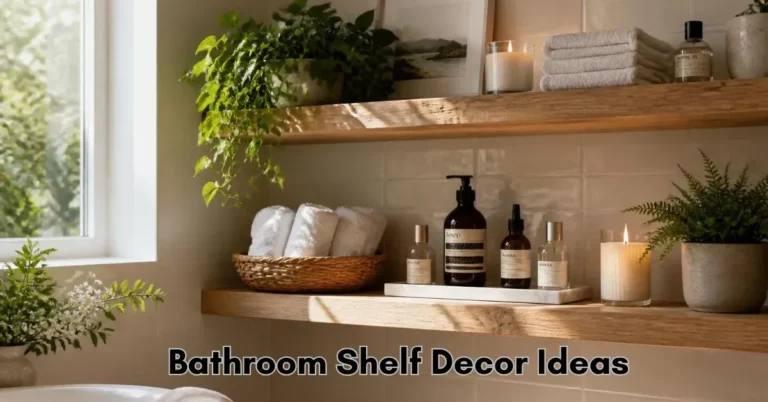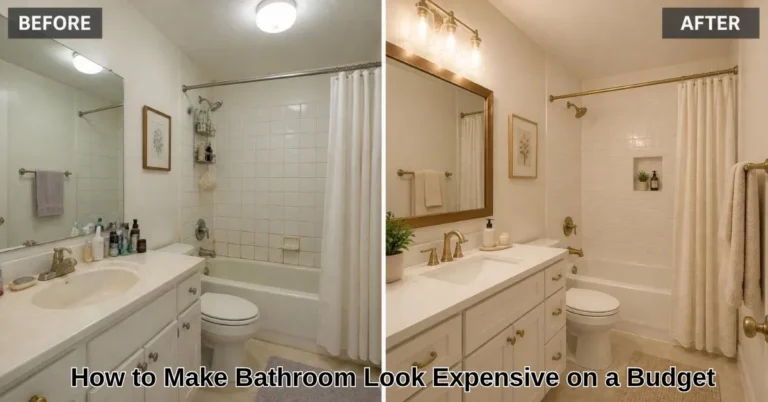
Rental bathrooms come with a built-in handicap. You get a medicine cabinet, a single towel bar, and maybe a shallow vanity, and that’s the full package. No built-in shelving, no permission to drill, and no realistic storage for anyone with more than three toiletries.
Small bathroom storage ideas for renters work differently from homeowner solutions. The goal isn’t installation. It’s activation, finding the floor space beside the toilet, the wall above it, and the back of every door, and filling those zones without touching a single surface permanently. This guide covers 15 deposit-safe solutions, a no-drill zone framework, and the one mistake I see in almost every rental bathroom I’ve styled.
Key takeaways:
- Freestanding units, tension rods, and removable adhesive strips form the core toolkit for rental bathrooms
- Three vertical zones hold the most untapped storage potential in any rental bathroom
- An over-toilet étagère and an over-door organizer together rival a full linen closet in capacity
- Adhesive solutions on tile remove without residue when you follow the removal instructions exactly
- A functional storage overhaul runs $50 to $80; a fully styled result lands at $120 to $200
- The back of the bathroom door is the single most underused surface in any rental
Why bathroom storage is harder when you rent
Renters face a constraint homeowners don’t: every storage addition carries deposit risk. Screws, wall anchors, and adhesives that damage paint all count as property damage under most leases. In most markets, a security deposit equals one to two months’ rent. That’s too much to risk on a shelf you picked up for $25.
The reassuring part is that “no drilling” doesn’t mean “no storage.” It means choosing the right tools.
The deposit risk spectrum
Think of every solution in one of three tiers before you buy anything:
- Zero-risk: Rolling carts, freestanding shelves, ladder shelves, countertop organizers. Nothing touches a wall permanently.
- Low-risk: Removable adhesive strips (such as 3M Command products) and suction cups on tile or glass. These remove cleanly when you pull the release tab straight down, slowly, not outward.
- Use caution on painted drywall: Adhesive strips can sometimes lift flat paint on removal. Test in a hidden spot before mounting anything visible.
The 3-Zone Vertical Method for rental bathrooms
Small bathroom storage ideas for renters become much cleaner to plan when you divide the room into three vertical zones. This is the framework I apply every time I organize a rental bathroom, and it consistently turns up storage space that renters had written off as unusable.
Zone 1, floor level (0 to 36 inches): Freestanding pieces live here. Rolling carts, corner shelves, and ladder shelves handle heavy items and carry the most weight.
Zone 2, counter and mid-height (36 to 60 inches): Countertop organizers, door pocket organizers, and adhesive hooks. Everything in this zone sits at eye level and arm’s reach, ideal for daily-use items.
Zone 3, vertical overhead (60 inches and above): Over-toilet étagères, the top shelves of freestanding units, and high hooks for robes or large towels. Reserve this zone for things you reach for weekly rather than daily — bulk supplies, spare rolls, guest towels.
| Zone | Height range | Best solutions | Best for |
|---|---|---|---|
| Floor | 0 to 36 in | Rolling cart, corner shelf, ladder shelf | Towels, cleaning products, heavy items |
| Mid-height | 36 to 60 in | Countertop tray, door organizer, hooks | Daily toiletries, tools, small bags |
| Overhead | 60 in and above | Over-toilet étagère, high hooks | Bulk supplies, spare towels, guest items |
Pro tip: Before buying anything, photograph the bathroom from the doorway. Identify which zones are empty. One targeted piece per zone beats three redundant ones competing for the same shelf.
15 small bathroom storage ideas for renters
These solutions cover all three vertical zones and every budget range. Some stand alone; some combine. The strongest setups layer at least one piece per zone, which is where the real change happens. Mixing two or three pieces from different zones typically runs under $150 and solves problems no single piece can.
1. Over-toilet étagère
An over-toilet étagère wraps around the toilet tank on two floor-standing posts, with shelves spanning the width above. It rests entirely on the floor and doesn’t touch any wall. Choose a unit with a base spread of at least 14 inches and non-slip rubber feet. Narrow models wobble on smooth tile. This is the highest-return purchase in a renter’s bathroom and the fastest way to activate Zone 3.
2. Freestanding ladder shelf
A bamboo or metal ladder shelf leans against the wall with no permanent contact. It holds rolled towels, small baskets, and a plant or two. Look for a height between 60 and 65 inches, enough to reach Zone 3 without blocking most bathroom windows. A wide, weighted base keeps it upright without wall anchors.
3. Narrow rolling cart
A 10 to 12-inch rolling cart fits in the gap beside a toilet or vanity that would otherwise stay empty. Wire carts clean easily; solid-surface carts look more finished. Lock the wheels when it’s in position. Roll it out when you need plumbing access beneath the sink.
4. Tension rod under the sink
One horizontal tension rod installed inside the cabinet under your sink, pressed against the interior side walls with no screws, creates a second hanging position for spray bottles by their trigger handles. This doubles vertical storage inside an existing cabinet in roughly 90 seconds and costs under $10.
5. Over-door pocket organizer
A 24-pocket over-door organizer hooks over any standard door without screws. It holds hair tools, cotton rounds, skincare bottles, and accessories, often with more capacity than a medicine cabinet. Budget versions cost under $20. Full-size product bottles fit in the larger lower pockets without stretching the fabric.
6. Removable adhesive hooks
3M Command hooks on tile hold robes, towels, and bags without residue when removed correctly. On painted drywall, test a hidden spot first. Position hooks at 66 to 70 inches from the floor for adult reach. A row of three on the back of the door handles a robe, a hand towel, and a bag simultaneously.
7. Tension floor-to-ceiling shower caddy
A tension caddy presses floor-to-ceiling inside a shower stall with no wall contact at all. It holds far more than a hanging caddy and doesn’t swing when you grab products. Look for adjustable shelf heights; shampoo, conditioner, and body wash vary more in height than you’d expect.
8. Suction cup caddy for glass showers
On glass enclosures where tension caddies won’t work, choose models with locking lever suction mechanisms rather than basic push-on designs. They hold substantially better on smooth glass. Replace suction cups every 12 to 18 months; the rubber degrades in warm, humid conditions even when it still appears fine.
9. Acrylic stackable bins
Clear acrylic bins on the counter keep small items visible without excavation. Stack no more than three high so the top bin stays reachable. One set handles cotton pads, hair ties, and daily skincare. Because they’re transparent, there’s no digging through anything to find what you need.
10. Bamboo countertop organizer
A divided bamboo tray collects daily items — soap dispenser, toothbrush holder, cotton jar — into a single defined footprint on the counter. It reduces visual clutter more than item count, and in a small room, those are different problems. Bamboo handles bathroom humidity better than most unfinished or lightly sealed woods.
11. Magnetic strip on tile
A magnetic bar adhered to tile with its included pad holds metal tools: tweezers, nail scissors, bobby pins, clippers. A six-inch strip clears a full drawer’s worth of small items. Mount one inside a cabinet door for a completely hidden version that adds zero visual weight to the room.
12. Freestanding corner shelf
A tiered corner shelf, three to five tiers at roughly 12 inches per side, fills the dead zone that no other piece reaches. A wide-base design stays stable on flat tile. Store spare soaps, rolled hand towels, and small plants here. It’s particularly useful in oddly proportioned layouts where the floor plan wastes corner space.
13. Inside-cabinet-door organizer
An adhesive or over-door organizer inside an existing cabinet keeps cleaning products, toilet paper rolls, and extra toiletries out of sight. It’s invisible when the door is closed, which matters in shared bathrooms or small spaces where visual clutter changes how spacious the room feels.
14. Wicker or wire baskets on shelves
Baskets on any freestanding shelf organize without requiring itemization. A 12-by-8-inch wicker basket holds towels rolled vertically, which uses less footprint than flat stacks. Wicker brings warmth into a room that’s otherwise all hard surfaces; wire reads cleaner in modern or industrial-leaning interiors.
15. Adhesive shower shelf for wet tile
Several brands make small shelves designed specifically for wet tile, using waterproof adhesive rated for humid surfaces. They hold four to five pounds — enough for shampoo and conditioner — and remove cleanly when you warm the adhesive backing before peeling. Let them cure for 48 to 72 hours before loading.
Cost and deposit risk at a glance
Before buying, check both columns. A zero-risk solution carries no deposit liability. A low-risk one is still safe when removed correctly, but requires you to follow the removal steps carefully. Mixing a few of each gives you the most storage for the least financial risk overall.
| Solution | Approximate cost | Deposit risk |
|---|---|---|
| Over-toilet étagère | $30 to $80 | Zero |
| Freestanding ladder shelf | $40 to $120 | Zero |
| Narrow rolling cart | $20 to $60 | Zero |
| Over-door pocket organizer | $10 to $25 | Zero |
| Command adhesive hooks | $5 to $15 | Low |
| Tension rod (under-sink) | $5 to $15 | Zero |
| Tension floor-to-ceiling caddy | $25 to $60 | Zero |
| Suction cup caddy | $15 to $40 | Zero |
| Adhesive shower shelf (tile) | $10 to $30 | Low |
| Acrylic stackable bins | $15 to $40 | Zero |
A functional result — rolling cart, over-door organizer, and countertop tray — runs $50 to $80. A fully styled setup with a ladder shelf, étagère, and shower caddy typically costs $150 to $200.
The 3-Zone Method in practice
Seeing the framework applied to a real space makes it click in a way a general recommendation doesn’t. The numbers below come from a real rental bathroom, not a staged one. A single afternoon and a modest budget can do more than most renters expect, once you know which zones to fill.
A colleague renting a studio apartment had a bathroom just under 50 square feet, small enough that the door hit the toilet when fully opened. She had one medicine cabinet, a single towel bar, and no under-sink storage. Toiletries sat on the toilet tank. Hair tools tangled on the counter. Two shampoo bottles stood on the shower floor.
I applied the 3-Zone Method over four hours for $54 in new purchases. Zone 1: a narrow rolling cart ($28) fit exactly in the six-inch gap beside the toilet. Zone 2: a bamboo countertop tray ($14) consolidated daily items into one footprint; a 24-pocket over-door organizer ($12) handled tools and bags on the door. Zone 3: an over-toilet étagère she already owned, previously stored in a closet because it “looked cluttered,” was restyled with folded baskets and rolled towels on the shelves.
The counter cleared completely. The shower floor cleared completely. A bathroom that had felt too small to organize now held more usable storage than her previous apartment’s larger bathroom ever had — not because anything shrank, but because all three vertical zones were working instead of just one.
Common mistakes renters make with bathroom storage
Most rental bathroom storage problems trace back to the same three errors. Each has a direct fix. Two reader concerns that often stop people from acting at all get honest answers here rather than generic reassurances.
Mistake 1: One piece and done
A single over-toilet shelf solves about 20% of a rental bathroom’s storage problem. Layering across three zones solves it completely. Without that distribution, one piece just relocates clutter into a slightly more contained area. It doesn’t resolve anything.
Fix: Choose at least one piece per zone before ordering anything.
Mistake 2: Ignoring the back of the door
A bathroom door holds 15 to 20 pounds with a basic over-door organizer. In a room where every inch counts, that’s an entire functional wall most renters leave completely empty.
Fix: A $15 over-door pocket organizer delivers the best value per square inch of anything on this list.
Mistake 3: Assuming no drilling means no wall storage
Reader objection: “My lease says absolutely no holes in the walls.” No holes doesn’t rule out wall-mounted storage. Command strips rated for five or more pounds hold small shelves and hooks on tile and smooth-painted walls with no drilling at all. The critical step is the removal method: pull the tab straight down, slowly, not outward. Done that way, they leave no trace. I’ve used Command strips in three different rentals over four years without losing any part of a deposit.
Reader objection: “Won’t the over-toilet unit wobble?” Narrow units under 18 inches wide with a small base do wobble on tile. Look for a base spread of at least 14 inches and an assembled weight over 15 pounds. Non-slip rubber feet make an additional, meaningful difference. A unit with those specs stays stable without wall contact.
Renter’s pre-purchase checklist
Before buying any bathroom storage piece:
- Does it attach permanently to any surface? If so, adhesive or screw-based?
- Have you measured the specific gap or zone you’re targeting?
- Does it have rubber feet or a non-slip base that grips smooth tile?
- Can you remove it in under five minutes without tools?
- Does the finish match existing hardware — matte black, brushed nickel, or natural bamboo?
FAQs
How do I organize a small bathroom with no storage at all? Start with one piece per zone: a rolling cart in the floor zone, an over-door organizer in the mid-height zone, and an over-toilet étagère in the overhead zone. Those three pieces together add the equivalent of a full linen closet’s capacity with no drilling and no deposit risk.
Can I add shelves to a rental bathroom without losing my deposit? Yes. Freestanding shelves sit on the floor with no wall contact. Adhesive shelves designed for tile remove cleanly when you warm the adhesive backing before peeling. On smooth painted walls, Command strips rated for five or more pounds hold small shelves safely — pull the tab straight down, slowly, and they leave no mark.
What is the best over-toilet storage for a small rental bathroom? An over-toilet étagère with two to three shelves and a base spread of at least 14 inches gives the most storage per dollar with zero deposit risk. Choose metal or bamboo over plastic for long-term stability. Avoid any unit that rests part of its frame on the toilet tank — they’re less stable and can scratch porcelain over time.
How do I add bathroom storage with no drilling at all? Tension rods, Command adhesive hooks on tile, suction cup caddies, freestanding shelves, over-door organizers, and rolling carts all require no drilling. The National Kitchen and Bath Association recommends keeping at least 30 inches of clear floor circulation in bathroom layouts; freestanding units fill dead zones without blocking those pathways.
How much does it realistically cost to organize a rental bathroom? A functional result runs $50 to $80 using a rolling cart, over-door organizer, and countertop tray. A fully styled result with a ladder shelf, étagère, and shower caddy typically lands at $120 to $200. The cost and deposit-risk table above breaks down per-item estimates.
Where to start
Small bathroom storage ideas for renters don’t require tools, a truck, or a weekend of patching. The 3-Zone Vertical Method turns any rental bathroom into an organized space by using the room’s full height rather than ignoring two-thirds of it.
Pick one piece per zone. Measure the exact gap before ordering. A rolling cart, an over-door organizer, and a bamboo countertop tray solve most of the problem in most rental bathrooms for under $70, and you can set it all up in a single afternoon.
Looking for answers? Find them right here on our home of trusted insights built for curious minds.