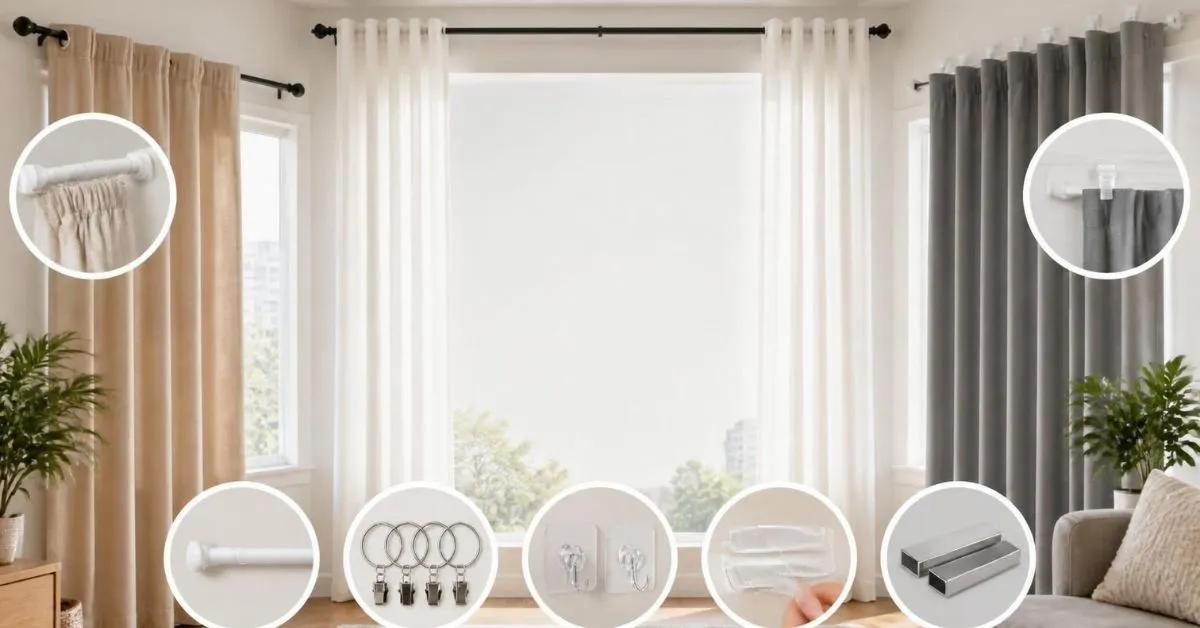
Bare windows or landlord-beige blinds — that’s the default in most rentals, and it drags down every room that has them. Custom drapes would fix it, but drilling risks your deposit, and sewing your own panels sounds like a project for someone with a different Tuesday.
No sew curtain ideas for renters solve this directly. With the right fabric, the right clips, and the right hanging method, you can have window treatments that look intentional without a single stitch or wall anchor. The biggest mistake, though, is in the hanging step — and it’s the one that makes even expensive curtains look wrong.
Key takeaways:
- Curtain clips and tension rods are the two fastest no-sew, no-drill hanging methods for renters
- Flat sheets and canvas drop cloths make workable panels for a fraction of ready-made curtain prices
- Iron-on hem tape creates a permanent-looking hem without sewing — just fabric, tape, and an iron
- Hang your rod 4 to 6 inches above the window frame and 6 to 12 inches beyond each side — this makes the window look significantly larger
- Tension rods fit inside the window frame; adhesive hooks support a thin rod wall-to-wall without drilling
- The hanging height, not the fabric, is what separates budget curtains that look high-end from ones that look homemade
What makes a curtain truly renter-friendly
A renter-friendly curtain does three things: installs without permanent damage, comes down cleanly when you leave, and doesn’t violate your lease. No sew curtain ideas for renters hit all three when you pair damage-free hanging hardware with panels that need no stitching to assemble.
The no-sew part covers how you prepare the fabric. The no-drill part covers how you hang it. These are separate decisions, and both matter.
The two panel approaches
Ready fabric with curtain clips: Use any flat piece of fabric — a sheet, a tablecloth, a drop cloth — and hang it using clip rings that grip the top edge. No rod pocket, no grommets, no sewing. The clips do the work.
Fabric finished with hem tape: Take fabric or a sheet that’s too long, fold the bottom edge, iron in a strip of fusible hem tape, and press. The heat bonds the fold permanently. Nobody can tell the difference from a sewn hem.
9 no sew curtain ideas for renters
1. Flat sheet panels with clip rings
A twin flat sheet (typically 66 inches wide by 96 inches long) cut down the center gives two panels — enough for a standard window with some gather. Add curtain clip rings every 5 to 6 inches along the top, hang on a tension rod or command-hook-supported rod, and you’re done in fifteen minutes. White sateen sheets diffuse afternoon light softly; a patterned sheet in a bold print can anchor a plain room the way a proper curtain would.
2. Canvas drop cloth panels
A painter’s canvas drop cloth has a weight and natural texture similar to Belgian linen — the kind of drape that makes curtains look substantial and considered. Cut to width, clip along the top, hang. No hemming needed if the raw edge sits at the top under the clips. Drop cloths have a warm cream tone rather than stark white, which works well alongside wood floors or warm-toned walls.
3. Curtain clip rings on any ready-made panel
Clip rings bypass the rod pocket or grommet on any ready-made curtain. Clip across the top every 5 to 6 inches and hang on any rod. This is also how you create subtle pinch pleating without sewing: group two or three clips closer together at intervals, and the fabric gathers between them into soft folds. It’s a trick that makes inexpensive panels look custom.
4. Iron-on hem tape for clean edges
Fusible hem tape (also sold as hemming tape or iron-on webbing) bonds two fabric layers together under heat. For curtains that are too long: fold the bottom edge to the correct length, tuck tape inside the fold, press firmly for 8 to 10 seconds per section. The adhesive holds through machine washing on a gentle cycle. This is the most polished finish available without a sewing machine.
Pro tip: Always hang the panel first and mark the hem length with chalk, then take it down to apply the tape. Measuring flat on a table without checking hang first produces uneven lengths.
5. Tablecloth as curtain panel
A large tablecloth — embroidered linen, checkered cotton, or a lace-edged vintage piece — makes an excellent café curtain or single-window panel with zero alteration needed. The hems are already done. Clip along the top the same way as any panel. For a kitchen window, a 60×90 inch tablecloth folded to the right length gives a neat café-style look that takes under ten minutes to hang.
6. Inside-mount tension rod
A tension rod fits inside the window frame rather than on the wall, so nothing touches plaster or drywall. The rubber-tipped ends press against the inner frame sides and hold by friction. Suitable for lightweight fabrics — sheers, flat sheets, lightweight cotton. Not reliable for blackout-weight or velvet. The visual result is minimal and clean, which works especially well in bathrooms and smaller windows.
7. Adhesive hooks with a thin curtain rod
Adhesive hooks rated for at least 5 pounds each hold a lightweight curtain rod spanning a standard window — two hooks, one per side, at your desired height. The panels hang from the rod normally. Clean the wall with isopropyl alcohol before pressing the hook adhesive on; this step significantly improves hold. For rooms without wall-mounting issues, this method gives the most conventional curtain look of any no-drill option.
8. No-sew fabric shade over existing blinds
You don’t have to remove the landlord’s blinds at all. A piece of fabric glued (with fabric-safe adhesive) to the front of an existing roller blind creates the appearance of a fabric shade without replacing anything. Roll the blind up and the fabric goes with it. Choose a fabric with some body — cotton canvas or a stiff woven cotton — so it rolls without bunching. Keep the fabric panel slightly narrower than the blind on each side.
9. Peel-and-stick Velcro header
A strip of peel-and-stick Velcro along the flat top edge of the window frame holds a corresponding strip on the curtain. The curtain presses into place, peels away for washing. This works best with lightweight sheers on windows that have a flat wooden top frame. It’s the most genuinely renter-safe installation of any method — leaves no mark on the wood if removed carefully.
Cost and effort comparison
| Method | Material cost per window | Setup time | Reversible | Best for |
| Flat sheet + clip rings | Low | 15–20 min | Yes | Any room, flexible sizing |
| Drop cloth + clips | Low | 20–30 min | Yes | Living rooms, natural look |
| Ready-made panel + clips | Low-medium | 10 min | Yes | Quick results |
| Iron-on hem tape | Low (supplies) | 30–45 min | No (permanent) | Polished finished edge |
| Tablecloth panel | Low-medium | 10–15 min | Yes | Kitchens, small windows |
| Inside-mount tension rod | Low (rod only) | 5 min | Yes | Lightweight fabric, bathrooms |
| Adhesive hooks + rod | Low-medium | 15 min | Yes | Most windows, medium-weight |
| No-sew Roman shade | Low-medium | 45–60 min | Partial | Over existing blinds |
| Velcro header | Low | 20–30 min | Yes | Sheers, seasonal swaps |
The height-and-width rule: what makes budget curtains look expensive
Most budget curtains look cheap for one reason — not the fabric, but the placement. Hanging curtains right on the window frame, as wide as the glass, flattens the room and makes every panel look unfinished.
The rule: mount your rod 4 to 6 inches above the window frame, and extend it 6 to 12 inches beyond the frame on each side. For rooms with taller ceilings, mounting 8 to 10 inches above the frame (or near the ceiling) makes the window read much larger than it actually is.
For renters, this creates one challenge: the higher placement often requires wall hardware you’re not supposed to install. The workarounds:
- Use the highest-rated adhesive hooks available and hang only lightweight panels to stay within weight limits
- Use an inside-mount tension rod for sheers, then hang lightweight decorative panels outside the frame on adhesive hooks at the higher position
- If the rod needs to span wider than adhesive hooks can reliably hold, a freestanding curtain rod floor stand works for rooms where you need more weight capacity
Curtains should reach to just above the floor — about a half-inch break, or 1 to 2 inches puddled. Panels that stop 3 to 4 inches above the floor look like they didn’t fit, not like a design choice.
The R.A.P. system for rental window treatments
Most no-sew curtain guides stop at “use clips and a tension rod.” But for renters, the real question is whether a method still makes sense when you move, change rooms, or have a landlord walk-through. The R.A.P. system (Reversible, Affordable, Portable) filters any curtain idea through a renter’s lens before you commit.
Reversible: Can you remove it completely without marks in under ten minutes? Clip-based installations and tension rods pass. Hem tape is permanent on the fabric — fine if you’re using a sheet you own, a concern if you’re altering a tablecloth you want back intact.
Affordable: Choose hardware that travels. A set of quality curtain clip rings works on whatever fabric you choose in the next apartment. The hardware persists; the fabric is swappable.
Portable: Does the installation come with you? Drop cloth panels clip to any rod anywhere. A fabric shade glued to your landlord’s roller blind does not.
In a six-window apartment, I ran this filter over one weekend: tension rods in the two bathroom windows with lightweight sheer cotton, adhesive hooks for two bedroom windows with flat sheet panels, and clip rings on a standard rod for the living room using drop cloths I already owned. Material spend was modest; setup took about three hours. The whole thing came down in under forty minutes when I moved.
Common mistakes — and the fix for each one
Hanging the rod right on the window frame
This makes windows look smaller and ceilings lower. Fix: raise the rod 4 to 6 inches above the frame at minimum, even if that means using adhesive hooks higher on the wall. The visual difference is immediate.
Using a tension rod with heavy fabric
Tension rods hold by friction. A heavy linen or a drop cloth freshly out of the wash can shift the rod out of position. Fix: keep tension rod fabric under about 1 pound per panel, and check the rod is snug weekly. For heavier fabric, switch to adhesive hooks with a supported rod.
Panels that are too narrow
A curtain that just covers the glass looks skimpy even with nice fabric. Curtains need fullness — aim for 1.5 to 2 times the window width across both panels combined, plus the rod extending well beyond the frame on each side.
Objection: “Won’t using sheets as curtains just look like sheets?” Not with correct placement. What reads as cheap is low hanging and narrow width — not the material. A cotton flat sheet in a warm neutral, hung near the ceiling with a slight floor break, looks like a linen panel. The same sheet clipped dead-center on the window at a low height reads as a sheet.
Objection: “Adhesive hooks always fall eventually, don’t they?” The ones that fail are usually on textured walls, freshly painted surfaces (paint needs at least seven days to fully cure before adhesive grips reliably), or in humid rooms. Clean the wall with isopropyl alcohol, press the hook for thirty seconds, then let it sit for an hour before loading any weight. In bathrooms, use a tension rod instead — humidity and adhesive hooks are a poor combination.
FAQs
Can I make no-sew curtains without an iron?
Yes. Curtain clip rings need no iron — just clip the top edge of any fabric and hang. Fabric glue also bonds a folded hem without heat, though it’s less precise than hem tape and isn’t always machine-washable. Check the label before washing anything made with fabric glue.
What fabric works best for no-sew curtains in a rental?
Flat cotton sheets and canvas drop cloths are the most practical starting points. Cotton is easy to work with, drapes predictably, and comes in a range of weights. Avoid stiff synthetic fabrics — they don’t hang well and catch light awkwardly. For a softer, diffused look in a bedroom, a lightweight linen-cotton blend works well with clip rings.
How do I get a clean bottom edge on no-sew curtain panels?
Iron-on hem tape is the most reliable method. Fold the bottom edge to the correct length, tuck tape inside the fold, and press firmly for 8 to 10 seconds per section with a hot iron and a damp pressing cloth between the iron and the fabric. The bond survives machine washing on a gentle cycle.
Can I hang curtains without any holes in my rental?
Yes — tension rods (inside the frame), adhesive hooks rated for the weight of your panels, and magnetic curtain rods (for metal window frames) all require no screws. For heavier curtains, adhesive-backed curtain rod brackets rated for higher weights are available and work without drilling when applied correctly to a clean, smooth wall surface.
Do I need to hem the top edge of no-sew curtain panels?
No. Clip rings grip the raw or folded top edge directly. The clips cover any unfinished edge. Only the bottom hem and side edges (on raw fabric that frays) need attention. Canvas drop cloth, for example, has a fairly stable weave that doesn’t require hemming the sides for typical window curtain use.
Getting started
No sew curtain ideas for renters work best when you match the method to your window size and setup time. Tension rods are the fastest and most reversible. Clip rings with a flat sheet take slightly longer but give more design control. Hem tape produces the most polished result for the least skill.
Start with one window. Hang the panel high and wide. See how much the room changes with properly placed fabric at the glass. The shift is usually bigger than expected.
For what comes after — area rug sizing, lighting, furniture arrangement that works alongside a proper window treatment — the HomeDecorIdeas.it.com rental apartment section covers each step with the same damage-free approach.