Open shelves in a bathroom can look like a considered design decision or a break-room shelf that nobody claimed. The problem isn’t the shelf. It’s the approach. Most bathroom shelf decor ideas or advice circles back to “add a candle and a plant,” which gives you a shelf with both of those things that still looks wrong.
Bathroom shelf decor ideas work when they follow a system, not a mood board. This page covers 9 specific ideas, a material guide for humid environments, and the 3-Layer Shelf Method — a framework that turns any open shelf into a real design moment. The mistake I see on almost every bathroom shelf shows up in the last section, and it’s not the one you’d expect.
Key takeaways:
- The odd-number rule (groups of three or five) improves visual balance on any shelf immediately
- Steam ruins certain materials faster than most people expect; teak, powder-coated steel, and glazed ceramic are the reliable choices
- Leaving one-third of a shelf deliberately empty makes the rest of it look intentional
- The 3-Layer Shelf Method (functional base, textural middle, living accent) takes under 25 minutes and rarely requires buying anything new
- Trailing plants like pothos or string of pearls soften a shelf edge better than upright plants do
What makes Bathroom Shelf Decor Ideas work
A bathroom shelf works when it balances three things at once: function (items you actually use), visual weight (objects at different heights and densities), and breath (enough open surface for the eye to settle). When all three are off, the shelf reads as clutter. When function disappears entirely, it looks like a display nobody lives near.
Bathrooms are unforgiving in this regard. A shelf here sits at close range in an enclosed space. You read every object on it — and that’s what makes the styling decisions matter more than in almost any other room.
Why material choice changes everything in a bathroom
I’ve watched untreated pine shelves warp and discolor in six months in a bathroom without good ventilation. MDF does worse, swelling at the edges and bubbling at the paint surface before the year is out. The reliable materials for bathroom shelving: teak (high natural oil content resists water absorption), powder-coated steel, aluminum, tempered glass, glazed ceramic, and solid surface composites. Sealed solid bamboo works well as a budget option. Anything MDF, particleboard, or unsealed stone belongs somewhere drier.
9 bathroom shelf decor ideas
Whether you have a single narrow ledge or a full wall of open shelving, these ideas give you something concrete to work with. They range from a quick rearrangement to a fuller restyle, and none of them requires a renovation or a larger bathroom.
1. Apply the odd-number rule
Group items in threes or fives, never fours or sixes. Even numbers read as “complete” to the eye and stop engaging it. Three objects at different heights — a tall bottle, a medium plant pot, a low dish — create a natural visual triangle that draws and holds attention. This applies on every shelf I’ve styled, regardless of its size or what’s currently on it.
2. Lead with a living element
A plant signals life in a way ceramic and glass can’t match. Good choices for low-light bathrooms: pothos, ZZ plant, air plants (Tillandsia), and ferns. Succulents need dry air and direct sun, the opposite of what most bathrooms offer, so skip them here. Place the plant at one end of the shelf rather than the center to avoid rigid symmetry.
3. Mix matte and glossy finishes
A shelf lined entirely with matte objects reads flat and a little lifeless. A matte ceramic jar absorbs light; a glass bottle next to it bounces it back. That contrast is what gives a shelf visual depth. My guideline: no more than 30% of visible surfaces should be glossy. More than that and the shelf becomes noisy rather than varied.
4. Decant daily items into matching containers
Cotton buds, hair ties, and loose product packets look like clutter. The same items in three matching apothecary jars look like a deliberate choice.Decanting everyday products into neutral, uniform containers is the single fastest upgrade available to any open bathroom shelf. Clear glass jars, matte white ceramic pots, and brushed metal tins all work well at a budget-friendly cost.
5. Float one shelf above the toilet
The space above a toilet is one of the most overlooked surfaces in a small bathroom. A single floating shelf at around 66 inches from the floor sits at standing eye level and clears the cistern by a comfortable 4 to 6 inches. Style it with three to five items maximum. Its purpose is a visual moment, not storage — and that distinction matters.
6. Anchor the composition with a tray
A small tray — even an inexpensive white ceramic one — gives a shelf a visual boundary. Items inside it read as a deliberate group; items outside it read as additions to that group. That distinction separates a styled shelf from scattered objects on a plank. Keep the tray to roughly one-third of the shelf’s total width so it defines one area without taking over the whole surface.
7. Leave one section completely empty
Negative space is not wasted space. A deliberately bare third of the shelf makes the items around it look intentional rather than accidental. I tested this after noticing my own bathroom shelf looked cluttered regardless of what I rearranged. Removing four items and leaving one clear section changed the visual noise level more than any previous addition had managed. The shelf needed less, not more.
8. Distribute visual weight, not categories
Most people sort bathroom shelves by type: all skincare together, all towels together. Try distributing visual weight instead. One heavy item, one medium-density piece, one light element — regardless of category — balance better than three objects of similar weight and density. A thick candle, a folded hand towel, and a narrow glass bottle work together even though they serve entirely different purposes.
9. Limit the shelf to three surface materials
On any single shelf, use no more than three different materials. Rattan, glass, and matte ceramic hold together well. Add polished chrome, woven cotton, and raw jute and the shelf starts to look like a market stall where everything is for sale separately. Three materials is the constraint that forces actual curation, and the discipline of that editing is what shows in the result.
Materials that survive bathroom humidity
The wrong shelf material means replacing it sooner than expected — usually after visible warping, edge swelling, or finish failure. Bathrooms combine steam, occasional splash exposure, and daily temperature swings in ways that reveal cheap choices fast. Here’s how the common options compare under those real conditions, based on what actually holds up and what fails.
| Material | Humidity resistance | Maintenance | Approximate cost | Best use |
| Teak wood | Excellent | Low (oil once a year) | Mid-range to premium | Wet zones, shower-adjacent shelves |
| Powder-coated steel | Excellent | Very low | Budget to mid | Floating shelves, wall brackets |
| Sealed solid bamboo | Good | Medium | Budget | Dry bathroom zones |
| Aluminum | Excellent | Very low | Mid-range | Modern, minimal bathrooms |
| Tempered glass | Excellent | Medium (water spots) | Mid-range | Small bathrooms, lighter look |
| Glazed ceramic | Excellent | Very low | Budget to mid | Decorative ledges, small shelves |
| Untreated pine | Poor | High | Budget | Avoid in bathrooms |
| MDF or particleboard | Very poor | N/A — warps | Budget | Avoid in bathrooms |
Pro tip: Sealed solid bamboo is the best budget alternative to teak. It handles humidity better than most softwoods, its tight grain takes stain evenly, and it costs considerably less. It’s what I’d specify in any bathroom where a teak shelf isn’t in the budget but lasting more than two years still is.
The 3-Layer Shelf Method
Most Bathroom Shelf Decor ideas or advice focuses on what to place on a shelf. The 3-Layer Shelf Method focuses on where — and that structural logic is what separates a shelf that looks styled from one that merely has things arranged on it. Each layer does a distinct job, and all three need to be present.
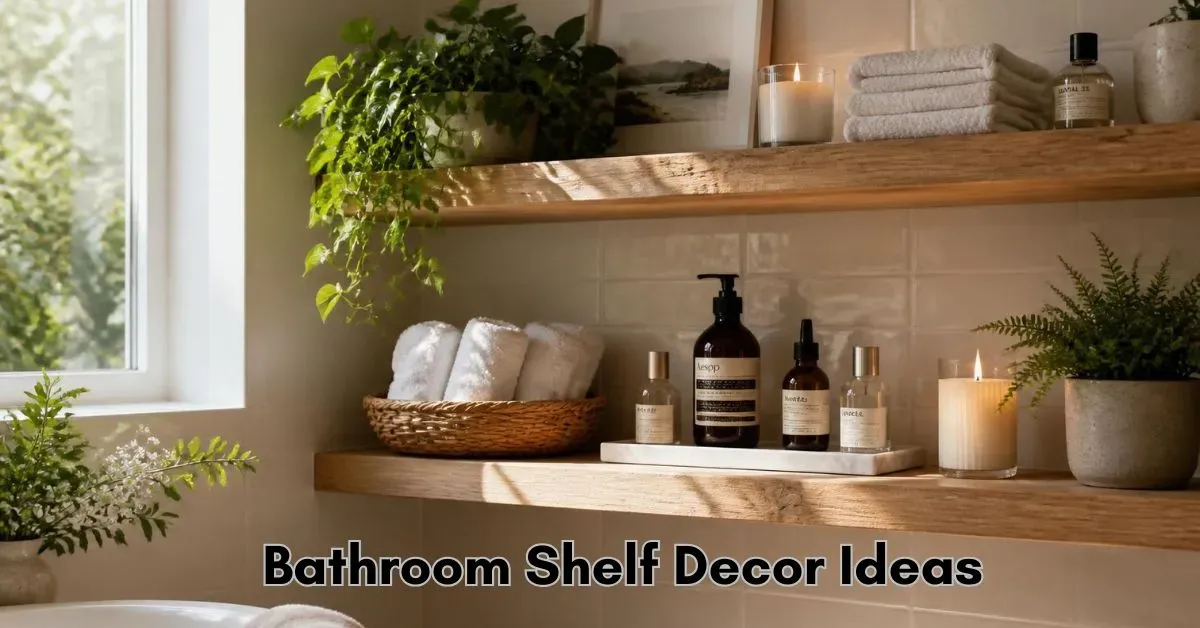
Layer 1 (functional base): Your daily-use items, in matching containers where possible. These are your grounded, stable objects: a soap dispenser, a jar of cotton rounds, a low tray. Without Layer 1, the shelf reads like a showroom where nobody lives.
Layer 2 (textural middle): One element that contrasts with Layer 1 in material, finish, or density. A woven rattan basket beside a smooth ceramic jar. A folded linen cloth beside a glass bottle. Linen softens what ceramic and glass can’t. That contrast is what makes a shelf feel intentional rather than assembled.
Layer 3 (living accent): One organic or living element — a trailing plant, dried botanical stems, a natural sponge, a piece of driftwood. This layer signals to anyone looking at the shelf that a person thought about it. Without Layer 3, even a well-arranged shelf reads as sterile.
How to apply it in five steps
- Clear everything off the shelf completely
- Place Layer 1 first: daily-use products in matching containers, positioned for actual reach and use
- Add one Layer 2 item that contrasts with Layer 1 in texture or material finish
- Add one Layer 3 element at one end of the shelf, not the center
- Remove anything that breaks the rule of three distinct heights or pushes the item count above five
Mini case study: I restyled a single 36-inch floating shelf in a rental bathroom using this method. Before: 11 items in no order, three materials competing. After: 5 items across three layers, one trailing pothos at the left end, one ceramic tray on the right. The restyle took 25 minutes. Nothing was bought. The shelf went from looking like a storage surface to looking like a decision.
Common bathroom shelf mistakes
Most bathroom shelves that look wrong share the same few problems — and they’re not about budget or the items themselves. The issues below appear across all price points and all bathroom sizes. Each one has a specific, actionable fix.
Treating open shelving as storage
Every inch covered tells the eye “not enough space here.” Every inch deliberately left clear tells it “design choice.” If you can’t see the shelf surface at all, no styling decision will fix it — the problem is volume, not arrangement. Fix: remove one-third of what’s on the shelf. You can always put one item back later. Almost nobody does.
Using materials that can’t handle the environment
MDF in a humid bathroom doesn’t fail gradually. It swells at the edges, the finish bubbles, and within a year it’s a visible problem that no arrangement can hide. The fix isn’t a better paint on the MDF; it’s a different material. Teak, sealed bamboo, tempered glass, and powder-coated steel all hold up. The cost difference is small relative to replacing a shelf that failed early.
Ignoring height variation
A row of same-height objects reads as a row, not a composition. Any styled shelf needs at least three distinct heights: something tall (12 or more inches), something mid-range (6 to 8 inches), something low (under 4 inches). This applies even on a narrow 6-inch-deep shelf. The height of the objects on the surface matters far more than the depth of the surface itself.
Quick bathroom shelf audit checklist:
- [ ] Items grouped in odd numbers (three or five)
- [ ] At least three distinct heights visible across the shelf
- [ ] No more than three different surface materials in use
- [ ] One-third of the shelf surface left deliberately clear
- [ ] One living or organic element included
- [ ] Daily-use items decanted into matching containers
- [ ] No MDF or untreated wood in a steamy bathroom
“Won’t plants die on a bathroom shelf without a window?” Some will, yes. But pothos, ZZ plants, and air plants (Tillandsia) tolerate low-light conditions that would kill most houseplants. Air plants need only a monthly soak in a bowl of water. If there’s no natural light at all, dried botanicals — eucalyptus, dried pampas, dried cotton stems — give you the organic quality of a plant without any light requirement.
“My bathroom is too small for shelf decor. Won’t it just look cramped?” A single shelf with three to five items doesn’t add bulk; it adds visual focus. The mistake is loading up multiple shelves, or overcrowding the one you have. One well-styled shelf in a small bathroom draws the eye upward and makes the room read taller. Light-colored, reflective items (glass, white ceramic) amplify that effect in tight spaces.
FAQs
What do you put on bathroom shelves for decoration?
A mix of functional containers (apothecary jars, soap dispensers), one textural element (a folded towel or small candle), and one living item (a plant or dried botanical) covers the bases. Group things in threes or fives and leave roughly one-third of the shelf surface deliberately clear.
How do I make my bathroom shelves look nice without spending much?
Decanting what you already own into matching containers is the highest-impact, lowest-cost move available. Three matching matte white ceramic pots cost under $20 and immediately make a shelf read as coordinated. Beyond that, removing items you don’t use daily is free — and usually more effective than adding anything new.
What plants work best on a bathroom shelf?
Pothos, ZZ plants, ferns, and air plants (Tillandsia) are the most forgiving choices. Pothos and ZZ plants handle low light and irregular watering well. Ferns love the humidity but need some indirect light to stay healthy. Avoid succulents on bathroom shelves; they need dry air and bright light, which most bathrooms don’t offer.
How many items should go on a bathroom shelf?
On a standard 24 to 36-inch shelf, three to five items is the reliable range. Fewer than three can feel sparse unless one strong anchor object holds the space. More than seven almost always reads as crowded on a shelf this size, regardless of how carefully the items are chosen.
Can floating shelves safely hold bathroom products?
Standard floating shelves installed with proper wall anchors — into studs, or with drywall anchors rated for the load — handle typical bathroom items without difficulty. Styling items (ceramics, small plant pots, glass bottles) rarely exceed 10 to 15 pounds combined. Most floating shelves are rated between 20 and 50 pounds; check the manufacturer’s specification before installation.
Conclusion
A bathroom shelf that looks good isn’t the result of buying the right things. It comes from following a method: materials that hold up in humidity, items arranged by visual weight rather than category, height variation built into every composition, and enough clear space for the eye to settle.
Start with what you already have. Clear the shelf, apply the three layers in order, keep the item count at five or under, and see if anything genuinely needs to be added. It usually doesn’t.
For more room-by-room approaches to small-space styling, HomeDecorIdeas covers the same principles applied across the rest of the home.