Most living room rugs fail within a year in high-traffic homes. Not because they were cheap — sometimes they weren’t — but because the buyer chose style over construction. The best rugs for high traffic living rooms share three traits: low pile, dense fiber, and a pattern that disguises wear.
This guide covers every material, construction type, and buying decision worth understanding, so you choose once and live with it for years. And that mistake in the last section? It’s the one I see shortening good rugs’ lives in almost every busy home I’ve worked with.
Key takeaways:
- Low pile (under ½ inch) outperforms shag or high pile in every heavy-use zone
- Polypropylene and nylon are the strongest synthetic choices for durability and stain resistance
- Wool costs more upfront but often wins the cost-per-year comparison over a decade
- Mid-tone colors and geometric or abstract patterns hide daily dirt and wear best
- A quality rug pad protects the backing in high-traffic rooms and meaningfully extends rug life
- Fiber density matters more than brand name — a tightly woven mid-range rug beats a loosely woven premium one
What makes a rug durable enough for a busy living room
A durable rug for a high-traffic living room comes down to three interlocking factors: pile height, fiber type, and construction method. Getting all three right matters more than any brand name or price tag. These factors can each be checked in under a minute before any purchase.
A high-traffic living room rug sits in any zone receiving consistent daily foot traffic — main walkways, seating areas, and transition points used by everyone in the household multiple times a day. Unlike a decorative rug in a quieter room, these need construction built for wear, not just a fiber that resists stains.
Pile height: the single biggest factor
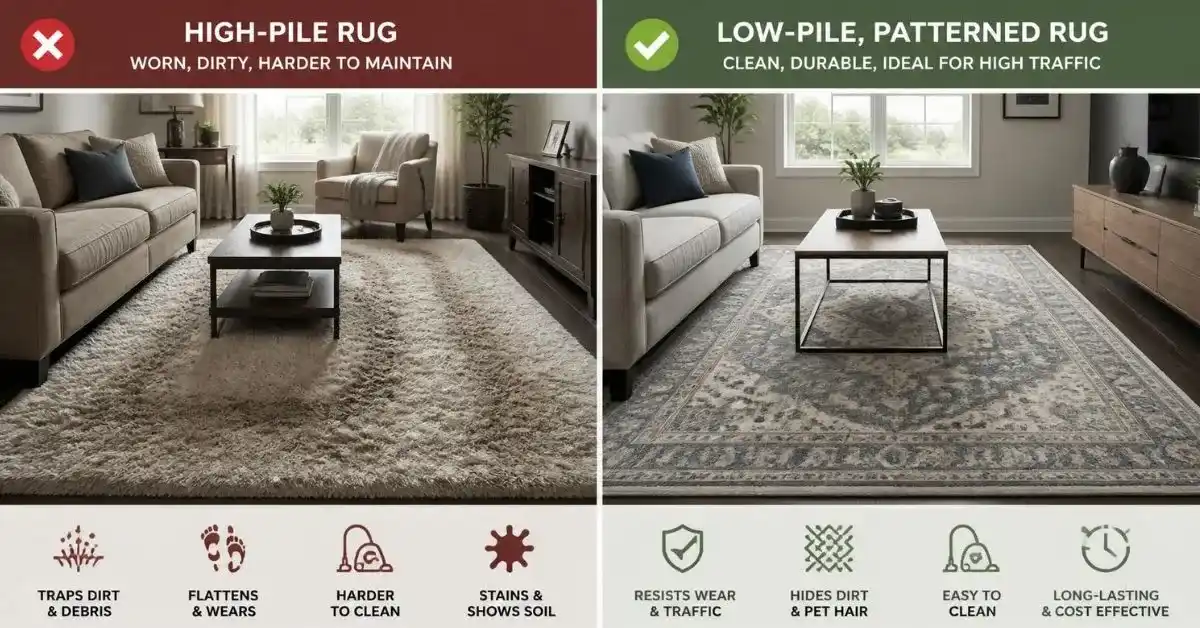
Low-pile rugs — under half an inch — resist crushing and matting under daily foot traffic. High-pile and shag rugs feel good initially, but the fibers compress and separate permanently with regular use. In a living room with consistent traffic, furniture movement, or pets on the floor, anything over ¾ inch will show visible matting within months. Flatweave rugs, with zero pile, are the most resilient option and the easiest to clean of all rug types.
Fiber density: what the label doesn’t tell you
Fiber density separates a rug that lasts from one that looks tired within a year. Fold a corner of any rug back on itself: the harder it is to see the backing through the pile, the better the weave. A sparse, thin construction is a warning sign regardless of what the fiber is. Nylon and wool both spring back from compression better than polyester or cotton, with polypropylene sitting in between — strong on stain resistance, weaker on long-term resilience under sustained pressure.
Construction: tufted versus woven
Tufted rugs — the most common type in retail — have fibers punched through a backing and held with adhesive latex. Woven rugs, including kilims and dhurries, have the structure built into the fabric itself. In high-traffic rooms, woven constructions outlast tufted ones because there’s no adhesive layer to eventually fail. If budget limits you to tufted, choose a secondary backing of jute or cotton rather than synthetic mesh, which degrades faster under sustained daily use.
best rugs for high traffic living room – Rug Material
Choosing the right material for a busy living room depends on how heavy your traffic is, who’s using the room, and your real maintenance habits. No single material wins in every situation, but each has a clear sweet spot and an honest limitation. The guide below covers both.
Polypropylene (olefin)
Polypropylene is the most common material in high-traffic rugs for practical reasons. It resists stains, repels moisture, and the color is solution-dyed directly into the fiber — meaning it holds up against fading better than surface-dyed alternatives. Most spills wipe up with a damp cloth. The limitation: polypropylene fibers flatten under sustained pressure and don’t recover the way nylon or wool does. Stick to low pile or flatweave in this material and it’s a strong, low-maintenance performer. Choose a high-pile polypropylene rug and you’ll be replacing it within a year.
Nylon
Nylon is the most resilient synthetic fiber for residential rugs. It handles compression better than polypropylene, and the fibers recover after use rather than staying flattened. It costs slightly more and isn’t quite as moisture-resistant, but the durability difference earns its keep in rooms with extreme daily traffic — households where shoes stay on indoors, homes with multiple pets, or spaces where children use the floor constantly. I’d pick nylon over polypropylene every time in a shoes-on household: the resilience difference becomes visible within the first year, and the higher price recovers quickly in a longer replacement cycle.
Wool and wool blends
Wool is the long-term investment. It typically costs two to three times a comparable synthetic, but it’s naturally resilient, doesn’t mat permanently under traffic, and has a lanolin coating that repels dirt before it sets. Wool also has a visual depth — the fibers catch light differently at different angles, giving it a warmth that flat synthetic surfaces don’t replicate. The honest caveat: wool needs periodic professional cleaning and doesn’t tolerate prolonged moisture. A wool blend — typically 80% wool, 20% nylon — delivers most of the performance at a lower price point and handles busy households well.
PET polyester
Polyester is soft, affordable, and visually rich in color. But the fibers crush easily and mat permanently in high-use zones, making it a poor choice for a main-traffic living room. It works reasonably well in a sitting room or secondary lounge with moderate foot traffic — not under consistent daily pressure from kids, pets, or a shoes-on household.
Flatweave cotton and jute
Flatweave cotton rugs are machine-washable — a genuine advantage in spill-prone homes — and hold up decently in medium-traffic rooms. Jute has a beautiful natural texture and a slightly acoustic quality that softens a room’s feel, but it absorbs moisture rather than repelling it and shows wear quickly in busy zones. Use jute in a low-traffic adjacent space, not underfoot in the primary walkway.
Buying guide: sizes, patterns, and budget tiers
Choosing the right material is only half the job. Rug size, pattern, and color determine how long it looks good in daily use — and a durable rug in the wrong size or tone fails visually long before the fibers show any wear. These decisions are often afterthoughts, and they shouldn’t be.
Getting the size right
The most common sizing mistake is going too small. In a standard living room, the front legs of all major seating pieces should rest on the rug — this anchors the seating arrangement and prevents the rug from looking like a mat dropped in the room’s center. For most living rooms, that means an 8×10-foot or 9×12-foot rug. In smaller rooms, a 6×9 works if the front-leg rule still holds. Measure the seating arrangement first, then shop for the rug.
Pattern and color: what hides traffic and dirt
Light solid rugs show every footprint, crumb, and hair. Very dark solids reveal dust and pet fur in direct daylight. Mid-tone rugs — warm taupes, terracotta, soft navy, muted olive — perform best for hiding everyday wear. A geometric, tribal, or abstract pattern breaks up the visual evidence of daily life better than any solid surface can.
Pro tip: Look for rugs described as “varied pile” or “carved texture” — the contrast between cut and loop pile at different heights makes wear patterns nearly invisible compared to a uniform-pile surface in the same color.
Material comparison by durability and budget
| Material | Typical price (8×10) | Durability | Easy to clean | Best household fit |
| Polypropylene | Budget | High (stain) / Med (resilience) | Yes | Spill-heavy, low-maintenance homes |
| Nylon | Mid-range | Very high | Yes | Heavy traffic, shoes-on households |
| Wool blend | Mid to premium | Very high | With care | Families, pets, long-term investment |
| 100% wool | Premium | Exceptional | With care | Adult-primary, lower-kid rooms |
| PET polyester | Budget to mid | Medium | Yes | Light-to-moderate traffic only |
| Jute / sisal | Budget to mid | Low–medium | No | Adult rooms, low-traffic zones |
Quick checklist before you buy
- Pile height is under ½ inch for the main traffic zone
- The fold-back test: backing is barely visible through the pile
- Secondary backing is jute, cotton, or felt — not synthetic mesh
- Pattern is multi-toned, geometric, or abstract
- Size puts the front legs of all major seating on the rug
- A rug pad is ordered at the same time as the rug
The Traffic Profile Method
Not every high-traffic living room is the same, and treating them as identical consistently leads to poor material choices. The Traffic Profile Method takes three factors from your specific household and maps them to the right rug — rather than relying on a generic traffic label that tells you almost nothing without context.
Factor 1: who uses the room. Adults only, shoes off = medium wear. Adults and children = heavy wear. Kids, pets, and shoes indoors = extreme wear.
Factor 2: how the floor actually gets used. Foot traffic is one type of stress. Pets dragging toys, children playing on the floor, furniture moved regularly — all of these add mechanical stress that shortens rug life faster than simple walking does.
Factor 3: your real cleaning commitment. A wool rug handled properly lasts a decade. One that goes uncleaned for months looks spent in two years. If your honest answer is occasional vacuuming and no professional cleaning, a low-maintenance polypropylene flatweave will serve you better than a neglected wool rug every time.
The cost-per-year case:
In a 14×16-foot living room with two dogs and two school-age children, I tracked the replacement cycle of mid-pile synthetic rugs over four years. The household replaced three rugs at around $180 each — spending $540 total and dealing with the disruption three separate times. Switching to a tightly woven nylon rug at $420 ended that pattern. Two years in, with weekly vacuuming and two professional cleans, it shows no meaningful wear. The cheaper rug cost more.
Common mistakes that shorten a rug’s life
Even the right rug fails early when the decisions around it are wrong. The mistakes below aren’t about choosing bad materials — they’re about surrounding choices that cut a good rug’s lifespan short, often by years. Each one has a straightforward fix.
Skipping the rug pad
A rug pad protects the backing from abrasion against the hard floor below. Without one, the adhesive in tufted rugs degrades under every footfall, eventually causing fiber loss at the surface. In high-traffic rooms, a quality felt-and-rubber pad can add meaningful years to a rug’s life. Use one that sits slightly smaller than the rug on all sides so it stays hidden. As a secondary benefit, it reduces the acoustic hardness of bare floors in open-plan rooms.
Choosing high pile in main traffic zones
Shag and high-pile rugs belong in bedrooms and low-traffic corners, not in a main living room walkway. The fibers mat, the texture becomes uneven, and the look that sold you on the rug disappears within months. If softness matters, place a low-pile rug in the primary zone and a softer piece in a lower-traffic corner of the same room — you get both without sacrificing durability where it counts.
Won’t a low-pile rug feel cold or look too minimal? Not with the right color and pattern. A low-pile rug in warm terracotta with a tribal print — or a deep navy flatweave with an abstract design — reads as richly textured because of the design, not the pile height. Visual warmth comes from color and pattern. The rooms that feel cold are using the wrong tones, not the wrong pile.
Are synthetic rugs really as durable as wool? Nylon handles mechanical pressure better than wool and is harder to damage through foot traffic alone. Wool is more naturally forgiving of spills, ages more gracefully, and looks better over a decade with proper care. A well-maintained wool rug outlasts most synthetics long-term. A neglected one doesn’t — so maintenance habits matter as much as the material itself.
| Do | Don’t |
| Choose low pile (under ½ inch) for traffic zones | Use shag or high pile in main walkways |
| Use a rug pad on all hard floors | Lay rugs directly on hardwood or tile |
| Pick mid-tone, patterned designs | Choose solid light colors in heavy-use rooms |
| Let front furniture legs sit on the rug | Use a rug so small it floats in the center |
| Vacuum weekly in heavy-use rooms | Wait for visible dirt before cleaning |
FAQs
What is the best rug material for a high-traffic living room?
Nylon and wool blends lead the field for heavy-use rooms. Nylon offers superior resilience and moisture resistance at a mid-range price. Wool costs more upfront but holds its appearance considerably longer with proper care. Polypropylene is the strongest budget option when kept to a low pile height.
What pile height is best for high-traffic areas?
Stick to half an inch or less for any main-traffic zone. Flatweave rugs with zero pile are the most durable and the easiest to clean. Anything over ¾ inch will mat and show wear significantly faster in a busy living room, regardless of fiber type.
Are wool rugs good for high-traffic areas?
Yes — wool’s natural resilience and lanolin coating make it a strong performer in high-use rooms with regular maintenance. A wool blend with added nylon delivers similar durability at a lower price. The caveat: wool needs periodic professional cleaning and doesn’t do well with prolonged moisture exposure.
What color rug hides dirt best in a busy living room?
Mid-tone rugs in warm taupes, terracotta, muted olive, or soft navy outperform very light and very dark solids in traffic-heavy rooms. A multi-toned or patterned design — geometric or abstract — is the most forgiving choice in homes with children, pets, or frequent visitors.
How often should a high-traffic living room rug be cleaned?
Vacuum at least once a week; twice weekly in homes with pets. Plan on professional cleaning once a year for most households, or every six months in extreme-traffic situations. Spot-treat spills immediately — letting them set makes them considerably harder to lift completely.
Do I need a rug pad for a high-traffic area?
Yes — it’s not optional in high-traffic rooms. A rug pad protects the backing from abrasion, prevents slipping, and reduces fiber stress from below. A felt-and-rubber pad sized slightly smaller than the rug on all sides is the right choice for most hard-floor living rooms.
Conclusion
The best rugs for high traffic living rooms last when material, construction, and household reality all align. Low pile, dense fiber, and a pattern that works with your traffic are the three decisions that carry the most weight. Nylon and wool blends lead on durability; polypropylene is the practical budget workhorse. And the rug pad is never optional.
Run through the Traffic Profile Method before buying: who uses the room, how they use it, and how much maintenance you’ll realistically commit to. Those three answers narrow the field quickly.
HomeDecorIdeas covers rug placement, sizing rules, and practical design decisions for every room in the home — browse the full guide collection for more guidance that holds up in real life.