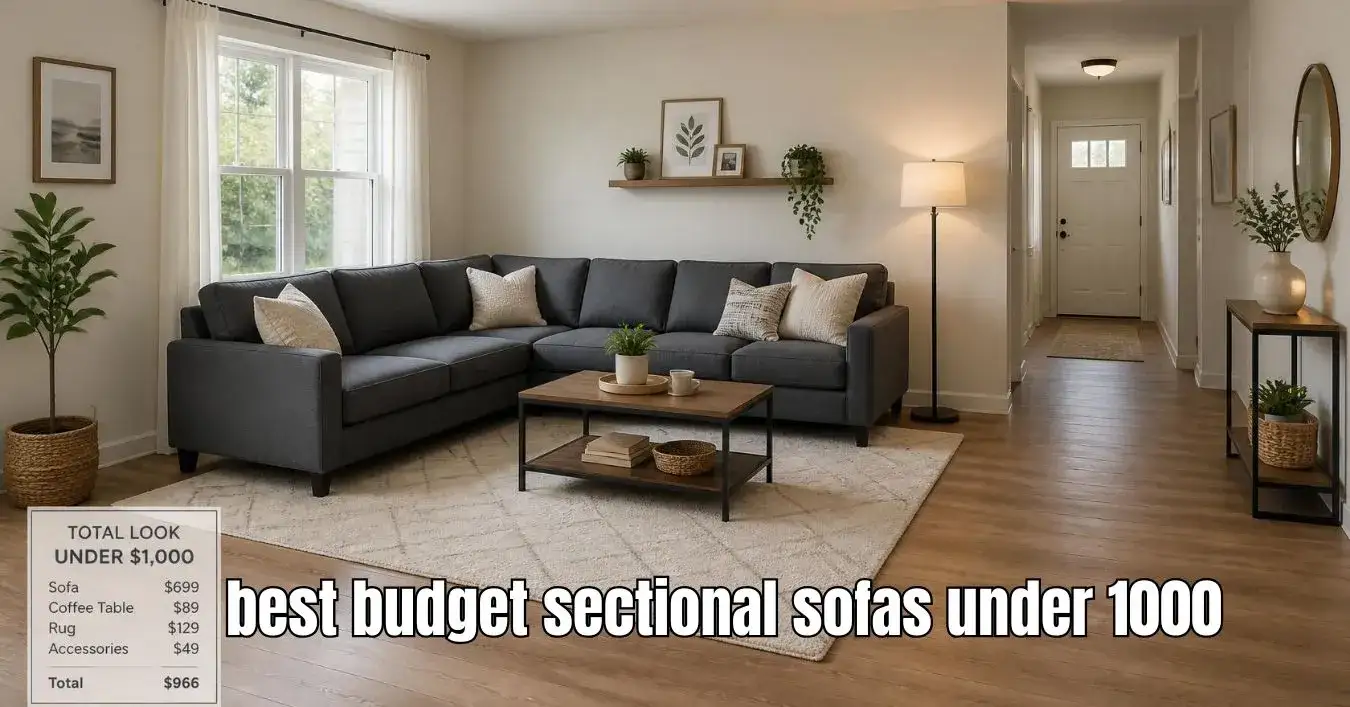
You’re trying to find a best budget sectional sofas under 1000 dollars, that don’t fall apart in three years. That’s the whole problem. At this price point, manufacturers cut corners somewhere — and if you don’t know where to look, you’ll pick the wrong sofa, in the wrong configuration, with the wrong fabric, and regret it by year two.
This guide covers exactly what holds up at this budget, what doesn’t, and how to find the sectionals that punch above their price. The mistake in the last section is the one I see in almost every budget sofa purchase — and it’s not about price, it’s about reading a spec sheet.
Key takeaways:
- Foam density is the single biggest predictor of how long a budget sectional lasts — look for 1.8 lb per cubic foot or higher
- L-shaped sectionals fit most rooms under 14×16 ft; U-shapes need at least 15×15 ft of clear space
- Performance fabric and polyester-blend chenille outlast plain polyester weaves at this price
- Always measure your doorways before ordering — assembled sections can still be large even in multi-box deliveries
- Modular configurations let you spread cost over time and reconfigure when you move
- Left-facing vs. right-facing matters enormously — get this wrong and the sofa will block your main traffic lane
What “under $1,000” actually gets you
At the under-$1,000 mark, you’re buying an entry-level sectional — and that’s fine, as long as you know what you’re getting. Most pieces in this tier use engineered wood or particleboard frames, sinuous spring systems rather than eight-way hand-tied coils, and foam with densities between 1.5 and 2.0 lb per cubic foot. That translates to a lifespan of roughly three to five years with daily heavy use, or five to seven years in a lower-traffic room.
That’s not a condemnation — it’s the honest baseline. Plenty of renters, first-time homeowners, and people in transitional housing get excellent value from a well-chosen budget sectional. The key is matching the sofa to how you actually use the space, not how you imagine using it.
The one spec that separates the decent options from the ones you’ll replace in eighteen months is foam density. Cheap sectionals use quick-fill foam with lots of air and little material; it softens fast and develops permanent impressions within a year of regular use. When a product page lists foam density at all, anything at or above 1.8 lb/ft³ is a meaningful quality signal for this price tier.
Pro tip: If a listing doesn’t mention foam density anywhere, that omission is usually a red flag. Brands that put quality foam in their sofas tend to say so.
The four configurations and which rooms they fit
Choosing the wrong shape is a more expensive mistake than choosing the wrong fabric. A sectional that doesn’t fit your room’s traffic flow will feel like a wall you walk around every day.
L-shaped sectionals
The L-shape is the right choice for most rooms under 14×16 feet. A standard three-seat sofa section — roughly 84 inches wide — with a chaise extending another 60 to 72 inches gives a total footprint of 100 to 130 inches on the long side. L-shapes sit neatly in corners, define a seating zone without closing off the room, and work well when one wall is clearly the “TV wall.”
At the under-$1,000 price point, L-shapes are also where you’ll find the most options. Budget manufacturers concentrate production here because it’s the highest-demand configuration.
Modular sectionals
Modular sofas are built from individual pieces — corner units, armless chairs, chaise ends — that connect and can be rearranged. For renters or anyone who moves frequently, modulars are worth prioritizing even when individual modules push the per-piece cost slightly higher. You can start with four modules under $800, add a chaise a year later, and reconfigure entirely when you move from a corner apartment to a rectangular one.
One thing to check: modular pieces need strong connectors to stay put. Look for descriptions that mention alligator clips or slide-in brackets at the connection points. If connectors aren’t mentioned at all, the modules likely just sit adjacent to each other and will drift apart during normal use.
Chaise sectionals
A chaise sectional is a standard sofa with one extended lounging end attached. It’s the most compact entry into the sectional category — bigger than a standalone sofa, smaller than a full L-shape. It’s the right fit for apartments under 700 square feet where a full L would overwhelm the room or block a doorway.
U-shaped sectionals
U-shapes wrap seating around three sides of a central space and require serious square footage — at least 15×15 feet of clear floor. They’re genuinely hard to find in acceptable quality under $1,000 because more material at the same cost means thinner foam and lighter framing. If a U-shape is your goal, buy an L-shape first and add a return piece later.
How to get left-facing vs. right-facing right the first time
This trips up more buyers than almost any other decision. Getting it wrong means returning 180 pounds of furniture.
The rule is simple once you know it: stand in front of the sofa, facing it. If the chaise (the long extending section) is on your left, you’re looking at a left-arm facing (LAF) sectional. If it’s on your right, it’s right-arm facing (RAF). This is always assessed from standing in front of the piece, not sitting on it.
To apply this to your room: stand at the main entry point and face your TV wall. Which side carries the most foot traffic — the path people walk to reach the kitchen, hallway, or other rooms? Place the chaise on the opposite side.The chaise should extend toward the quieter edge of the room, not block the path people use all day.
If you’re genuinely unsure, choose a modular or reversible-chaise configuration. These let you live with the placement for a week and switch orientation if your first guess doesn’t work.
The FCQT framework: four specs that predict whether a budget sectional lasts
Most buyers focus on looks first, price second, and construction specs last — or not at all. After helping style a handful of rentals and starter homes over two years, I noticed one consistent pattern: the sectionals that held up were chosen by spec, not by photo. Here’s the four-point check I use now.
F — Frame material. Kiln-dried hardwood is the gold standard. At under $1,000, you’ll more often encounter engineered wood, plywood, or particleboard. Plywood is acceptable; particleboard is the weakest option and tends to crack at screw joints over time. A quick hands-on test: lift one corner of the assembled sofa. If the frame twists, the joinery is weak.
C — Cushion density. Foam at 1.8 lb/ft³ or above holds its shape meaningfully longer than lower-density alternatives. Seat cushions are where density matters most; backs can use softer fill. Loose, removable cushions with zippers are also a good sign — it means the manufacturer expects the sofa to last long enough that you’d want to refluff or replace inserts.
Q — Quality of upholstery. Performance fabric and chenille blends (polyester-based) are the two most practical choices at this price. Both handle spills better than untreated linen or plain cotton. Faux leather wipes clean easily but cracks after five to seven years of heavy use and doesn’t breathe in warm rooms.
T — Traffic flow test. Does the configuration leave at least 36 inches of clear walkway on the main path through your room? A sofa that fits by the numbers but blocks movement creates daily friction that no cushion firmness can compensate for.
In three rentals I helped style — a 10×14 living room, a narrow 9×16 room, and an open-plan studio — running this checklist before ordering eliminated two out of three return situations that would otherwise have happened.
Fabrics compared: what actually holds up under daily use
The fabric choice on a budget sectional matters more than it does on an expensive one, because cheaper construction elsewhere means upholstery has less margin for error.
| Fabric type | Feel | Durability at this price | Best for | Watch out for |
| Performance fabric | Smooth, structured | High — resists stains and spills | Families, pets, renters | Less visually soft than textured weaves |
| Polyester-blend chenille | Soft, textured | Medium-high (7–10 yrs with quality yarn) | Cozy living rooms | Low-quality chenille pills within 2–3 yrs |
| Flat polyester weave | Smooth, basic | Medium (3–5 yrs, heavy use) | Low-traffic guest rooms | Looks worn quickly under UV light |
| Faux leather (PU) | Sleek, easy to wipe | Medium — cracks after 5–7 yrs | High-spill households without pets | Doesn’t breathe; runs warm |
| Pure linen | Natural, airy | Lower — absorbs spills; abrades at edges | Formal, low-use spaces | Not practical for daily family use |
Performance fabric is the most practical pick for households with kids or animals. Polyester-blend chenille is the best choice if softness matters — it reads far more expensive than plain polyester at the same price, and the looped texture hides crumbs and pet hair between cleans better than a flat weave.
Room-size guide and sectional sizing
| Room size | Best configuration | Target long-side length | Min. walkway clearance |
| Under 10×12 ft | Chaise sectional | Under 100 inches | 30 inches |
| 10×14 – 12×16 ft | L-shaped | 100–115 inches | 36 inches |
| 12×16 – 14×18 ft | L-shaped or large modular | 110–130 inches | 36–42 inches |
| 15×15 ft and above | U-shaped or large modular | 130–160 inches wide | 42 inches+ |
| Open-plan studio | Small L or sofa + chaise | Under 108 inches | Define zone; don’t block entry |
Leave 16–18 inches between the front of the sectional seat and your coffee table — enough to reach it without stretching, not so much that the table feels marooned in the center of the room. For TV viewing distance, multiply your screen’s diagonal measurement by 1.25 to get the minimum comfortable distance from screen to seat edge.
Common mistakes — and how to fix each one
Buying on dimensions without taping the floor
Measuring listed dimensions and assuming a sofa fits is different from seeing that footprint in your actual room. Lay painter’s tape on the floor in the exact shape of the sectional you’re considering — including the chaise — and live with it for two days. I’ve seen a 110×80-inch L-shape look fine on paper and feel completely suffocating once the tape was down in a 12×14 room. The tape test costs nothing and prevents a return shipment of 180 pounds of furniture.
Prioritizing looks over foam density
A sofa that looks beautiful in ivory chenille but uses 1.4 lb/ft³ foam will still look beautiful in the listing photo after it’s pancaked flat at fourteen months. Find the configurations with acceptable foam density first, then choose the nicest-looking one from that filtered list.
Getting the chaise direction wrong
Many budget sectionals come in left-facing or right-facing only, with no reversible option. Ordering the wrong orientation means either living with a sofa that blocks your main walkway or absorbing return shipping fees. Double-check orientation before checkout, and if the listing doesn’t specify clearly, contact the retailer directly before ordering.
Objection: “Won’t a dark-colored sectional make my small room feel smaller?” Not necessarily. A dark sofa reads as an anchor in a small room, not a wall — when it’s correctly sized and there’s adequate clear space around it. What makes small rooms feel cramped is scale and placement, not color. A correctly sized charcoal sectional in a 12×14 room often feels more intentional than an oversized cream one jammed against three walls.
Objection: “Budget sofas always sag — isn’t it better to just save up for something more expensive?” Sometimes, yes. But the answer depends on your situation. If you’re in transitional housing for two to three years, a well-chosen budget sectional — plywood framing, 1.8 lb foam — is the smarter financial move than spending $2,500 on a sofa that may not fit your next home. If this is a ten-year piece, spend more. If it’s a three-year sofa, spend wisely at this tier.
FAQs
Can I get a sectional sofa under $1,000 that fits through a standard apartment door?
Yes — most budget sectionals ship in separate boxes and are designed for narrow doorways. Standard interior doors are 30–32 inches wide; check that each individual assembled section fits through your entry point. Most L-shaped budget sectionals have sofa sections 84–90 inches long, which still need to go in at an angle — measure the diagonal of the doorway opening, not just its width.
How long will a sectional under $1,000 realistically last?
With daily use in a family home, expect three to five years. In a lower-traffic room or a single-person household, five to seven years is achievable. The biggest variable is foam density — 1.8 lb/ft³ or higher meaningfully extends the lifespan compared to what most entry-level listings use.
Is a modular sectional better than a fixed L-shape at this budget?
For renters or people who move often, modular wins for flexibility. For a stable home, a fixed L-shape at the same price often delivers slightly better frame construction because no budget goes toward connector hardware. The best modular sectionals at this price have strong clip-lock connectors; weaker ones drift apart over time.
What’s the minimum room size for a sectional?
A chaise sectional can work in rooms as small as 10×12 feet if it stays under 100 inches on the long side and you maintain a 30-inch walkway. A standard L-shape needs at least a 10×14 room to avoid feeling cramped, with 36 inches of clear walkway on the main traffic path.
Does performance fabric feel different from regular polyester?
Performance fabric has a tighter, denser weave and a slightly stiffer hand than flat polyester — less soft initially but significantly better at resisting staining and pilling. If softness is a priority, look for performance fabric blended with microfiber or chenille; some budget options at this price now combine both.
Wrapping up
The best budget sectional sofa under $1,000 is the one that passes the FCQT check — frame, cushion density, quality of upholstery, and traffic flow — before it passes the style test. Get the configuration right for your room size, get the chaise facing right for your layout, and choose a fabric that matches how you actually live in the space. At this price tier, that combination is entirely achievable.
Once your sectional is in place, the surrounding pieces shift significantly — throw pillow scale, coffee table proportions, and area rug sizing all change. The Home Decor Ideas living room ideas section is a solid next stop for getting those decisions right.