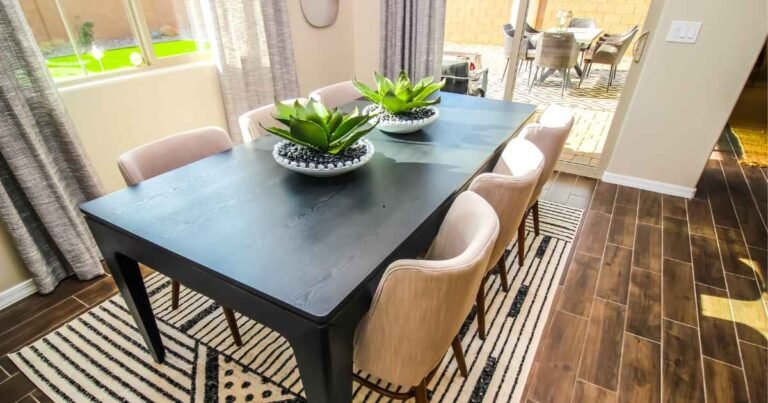
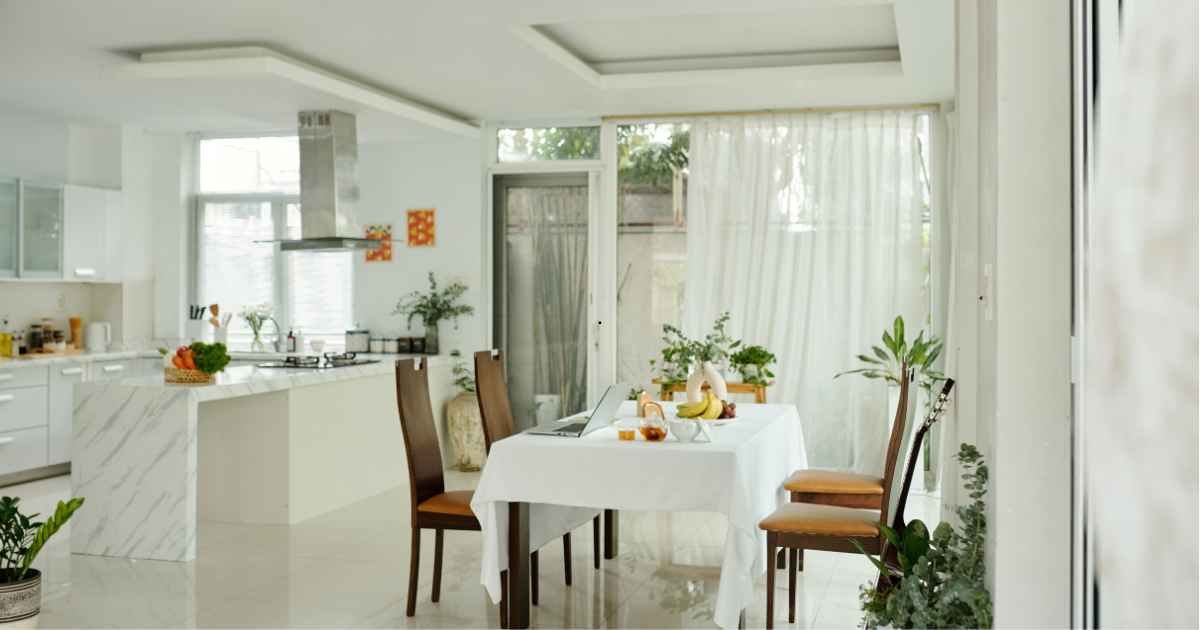
Most dining tables are built for houses, not apartments. A standard 60-inch rectangle with four chairs eats 40 square feet before anyone sits down, which is a quarter of a small studio’s floor plan. The best small dining tables for apartments fix this by rethinking shape, footprint, and function. A 36-inch round pedestal seats four in less space than a rectangle seats two. A drop-leaf shrinks to a 12-inch console against a wall when it’s not in use.
This guide covers seven table types that actually fit apartment living, the three measurements that decide whether a table works in your space, and the sizing mistake almost every first-time renter makes.
Key takeaways:
- Round tables seat more people in less floor space than rectangular tables of the same width
- Drop-leaf and gate-leg tables shrink to a fraction of their open footprint against a wall
- You need at least 30 inches of clearance around a dining table for chairs to pull out
- Solid wood tables hold up in rentals; particleboard and cheap veneers chip within a year
- Extension leaves add capacity for guests without dominating the room daily
- Counter-height tables free up leg room in tight spaces and double as workspace
What makes a dining table apartment-friendly
A dining table works in an apartment when its footprint leaves at least 30 inches of clearance on all sides for chairs, its shape matches the room’s proportions, and its material survives rental use. Anything wider than 42 inches struggles in most apartments under 800 square feet. Round shapes almost always beat rectangular ones for tight rooms.
The 3 measurements that decide fit
Three numbers make or break a small dining table in an apartment. Table width (edge to edge). Chair clearance (30 to 36 inches around all sides for pull-out room). Walkway clearance (24 inches minimum for anyone passing behind seated diners). Measure the smallest of the three against your floor plan before you buy anything.
Rectangular tables need clearance on all four sides, which multiplies fast in a small room. Round and oval tables need clearance around the perimeter, but total footprint is usually smaller because there are no corners to clear.
Materials that survive rentals
Solid wood tabletops (oak, ash, walnut, rubberwood) handle spills, heat, and moving day. Real wood veneer over hardwood ply comes second. Melamine and MDF finishes chip along the edges within a year, especially at chair height where knees hit. Metal frames outlast wood frames in cheap tables because joints stay tight when the whole thing gets carried up three flights of stairs.
Glass tabletops look bigger visually but scratch easily and show every fingerprint. Skip glass in a rental unless you enjoy cleaning it daily.
7 best small dining tables for apartments
Seven small dining table types work in most apartments: round pedestals, drop-leaf tables, gate-leg tables, extendable rectangles, wall-mounted flip-downs, counter-height bistro tables, and space-saving ovals. Each fits a different apartment layout. Round pedestal is the most versatile. Wall-mounted is the smallest. Extendable rectangles are best if you host.
1. The round pedestal table
A 36-inch round pedestal seats four comfortably and takes less floor space than a 48-inch rectangle. No leg splay at the corners means chairs pull out cleanly from any position, so you don’t need a fixed seating orientation. Look for a base at least 18 inches wide for stability. Cast-iron and stone bases add weight (which prevents wobble) without adding footprint. Works especially well in square or L-shaped rooms.
2. The drop-leaf table
Drop-leaf tables have two hinged flaps that fold down against the sides. Fully open, a drop-leaf seats four to six. Folded, it becomes a 12- to 15-inch-wide console you push against a wall. Solid wood versions age better than veneered ones because hinge screws hold better in real wood. Best for apartments where dining space doubles as workspace during the day.
3. The gate-leg table
Gate-leg tables use hinged legs that swing out to support drop leaves. They fold flatter than standard drop-leaf tables (some go down to 8 inches wide) but hold less weight when open. A gate-leg seats two to four when extended. Ideal for studios where the table lives against a wall all week and gets pulled out for weekend meals.
4. The extendable rectangular table
Extension tables solve the “usually two people, occasionally six” problem. A 36×36 square opens to a 36×60 rectangle with a leaf, which handles four everyday and six when needed. Butterfly leaf mechanisms store the extension inside the table, so you never lose a leaf in a closet. Check the extension track quality; cheap tracks bind after a year.
5. The wall-mounted flip-down table
Wall-mounted tables fold flat against the wall when not in use, dropping down like a Murphy bed for meals. They save the entire floor footprint when closed. Best for studios under 400 square feet where every inch counts. Requires drilling into a stud, so check your lease first. Expect to seat two, occasionally three.
6. The counter-height bistro table
Counter-height tables (36 inches tall versus 30 inches standard) free up leg room underneath and double as a workspace or bar. A 24- to 30-inch round bistro table fits in a corner most standard tables can’t reach. Pair with counter stools (25-inch seat height) for the right proportion. Not great if you have small kids or older relatives who struggle with high seats.
7. The oval space-saver
Oval tables give you rectangular seating capacity without the sharp corners that pinch walkways. A 48×32 oval seats four with more clearance than a 48×32 rectangle. Curved edges mean you can push it closer to walls or walkways without knee bruises. Solid wood ovals are pricey, but veneer-topped versions run mid-tier.
How to choose the right small dining table
Start with the room, not the table. Measure the available floor area, subtract 30 inches on all sides for chair clearance, and only then look at table dimensions. Match shape to room shape (round for square rooms, oval for narrow ones). Then pick the material based on how much you’ll actually use it.
Match table shape to room shape
Square rooms take round or square tables best. Long narrow rooms need oval or rectangular tables. Round tables in narrow rooms waste the length; rectangular tables in square rooms leave awkward triangles of empty space at the corners.
If the dining area sits inside an open-plan living room, a round table blurs the boundary between zones better than a rectangle, which creates a visual break.
Seating clearance basics
Every dining chair needs 24 inches of width to seat one person comfortably. Behind that chair, you need 30 inches minimum for pull-out room. Behind the pulled-out chair, another 24 inches lets someone walk past. A dining spot needs 54 to 78 inches of clearance from table edge to opposite wall, depending on traffic.
If your room can’t give you that clearance, you don’t have room for a full-size table. Go smaller or drop-leaf.
The dining table sizing table
| Table type | Footprint (closed/open) | Seats | Best room shape |
|---|---|---|---|
| 36″ round pedestal | 36″ diameter | 4 | Square or open-plan |
| Drop-leaf oval | 15″×36″ / 42″×36″ | 2 / 4 | Narrow galley kitchen |
| Gate-leg | 8″×36″ / 48″×36″ | 2 / 4 | Studio apartments |
| 36×36 extendable | 36″×36″ / 36″×60″ | 4 / 6 | Square dining nook |
| Wall-mounted flip-down | 0″ / 32″×24″ | 2 | Studios under 400 sq ft |
| Counter-height bistro | 24″–30″ round | 2 | Corners, kitchens |
| 48×32 oval | 48″×32″ | 4 | Narrow rectangular rooms |
Pro tip: Tape out the table’s footprint on your floor with painter’s tape before buying. Sit in a chair at the taped edge and push back like you’re leaving the table. If you hit a wall, sofa, or cabinet, the table is too big for the space.
The 30-inch clearance method
The 30-inch clearance method is the fastest way to check if a table fits your apartment before buying. Measure 30 inches out from every edge of the table’s footprint. That’s your total space requirement, including chair pull-out room. If your available floor space is smaller than that number, the table won’t work no matter how good the price is.
The 30-inch rule explained
Standard dining chairs are 18 inches deep. Pulled out for someone to sit down or stand up, they need 30 inches from the table edge (18 inches for the chair plus 12 inches for legs and clearance).
For a 36-inch round table, that means a clear 96-inch (8-foot) circle of floor space (36 inches for the table plus 30 inches on each side).
For a 60×36 rectangle, you need 120×96 inches (10×8 feet) for chairs on both long sides. Measure your dining zone. If it’s smaller than this, drop down a size or go drop-leaf.
The 30-inch rule in a 400 sq ft studio
I fit a proper dining setup into a 400 square foot studio using a 36-inch round pedestal and four spindle chairs. Dining zone measured 8×8 feet, tucked between the kitchen counter and the sofa. Total floor space eaten: 64 square feet, or 16% of the apartment. I could pull chairs out fully without hitting the sofa or the fridge door. That’s the win.
Previous tenant had tried a 60-inch rectangle with six chairs in the same space. Two chairs stayed permanently trapped against the wall. Three sat on the traffic path. Result: a dining table nobody ate at. Same room, wrong shape.
Common mistakes to avoid
Most small dining table regrets come down to five mistakes: buying by seating count instead of footprint, forgetting chair overhang, picking glass in a rental, skipping the extension test, and assuming round is always smaller than rectangular. Each has a fix that costs nothing but attention before you order.
Buying by seating count instead of footprint
A “seats 4” label means a table has four chair positions, not that it fits in a room where four people can eat. Fix: Ignore seating count. Measure the table’s footprint plus 30 inches on all sides. That’s the number that matters.
Ignoring chair overhang
Chairs sit under the table when pushed in, which means chair backs stick out past the table edge by 6 to 8 inches. Fix: Add chair overhang to your total footprint calculation, especially in rooms where a wall or sofa sits close to a table edge.
Choosing glass in a rental
Glass tables look bigger visually because they’re transparent. They also scratch, chip, and show every water ring. In a rental with hardwood floors, a glass tabletop that cracks during move-out can cost your security deposit. Fix: Skip glass. Solid wood or wood veneer holds up.
Skipping the extension test
Extension mechanisms fail on cheap tables. Tracks bind, leaves drop crooked, or the two halves separate under any weight. Fix: If buying online, check reviews specifically for extension complaints after six months. If in-store, open and close the table three times before buying.
Assuming round is always smaller
A 48-inch round table has a larger footprint than a 42×30 rectangle, but seats the same four people. Fix: Round wins in small spaces up to 42 inches diameter. Above that, rectangles start to catch up on efficiency.
Aren’t round tables too small for actual meals? A 36-inch round comfortably fits four dinner plates, a bread basket, and two serving bowls in the center. That’s a full family meal. Round tables feel smaller than rectangles at the same seating count because the corners of a rectangle usually stay empty anyway. If you regularly host six or more, you’ll need extension leaves. For everyday meals with two to four people, round is almost always the better choice.
Doesn’t a drop-leaf table look cheap when folded? Only if the design is cheap. Well-made drop-leaf tables have solid wood hinges, matched grain across the leaves, and clean joinery at the fold. Look for tables where the folded profile looks like an intentional console piece. A quality drop-leaf reads as a design choice, not a space-saving apology.
FAQs
What’s the smallest dining table that seats four?
A 36-inch round pedestal seats four adults comfortably for everyday meals. A 30-inch round works for two adults or a couple with a young child. Rectangular tables need at least 42×30 inches to seat four with any comfort, and even then the corner seats feel tight compared to a round table of the same width.
Is a round or rectangular table better for an apartment?
Round almost always beats rectangular in apartments under 800 square feet. Round tables eliminate corner-clearance requirements, blur the line between dining and living zones in open-plan spaces, and seat more people per square foot of footprint. Rectangular tables only win in long, narrow rooms where the shape mirrors the room’s proportions.
Can I use a counter-height table for regular meals?
Yes, and it works especially well in small apartments where a standard table would dominate the floor space. Counter-height (36 inches) frees up leg room underneath and turns the table into a functional workspace between meals. Pair it with 25-inch stools for the right proportion. Skip it if you have young children who can’t safely climb up.
How much clearance do I need around a small dining table?
Minimum 30 inches on every side where someone will sit. That’s enough for a standard chair to pull out and someone to stand. If a walkway runs behind seated diners, add another 24 inches. In tight apartments, 30 inches works but feels tight. If you can get 36 inches, take it.
Are extendable tables worth the extra cost?
Worth it if you host more than three times a year. Extension leaves add 12 to 24 inches of table without changing the daily footprint. Mechanism matters, though. Cheap extension tracks bind and fail within a couple of years. Look for butterfly leaf mechanisms with metal glides, not plastic.
Final thoughts
Best small dining tables for apartments trade seating count for shape smarts. Round pedestals win in most square rooms. Drop-leaf and gate-leg tables handle studios where dining space doubles as work or living space. Wall-mounted tables save the most floor space if your lease allows drilling. Measure first, buy second. The 30-inch rule catches most sizing mistakes before they cost you.
For more room-by-room furniture picks that respect small-space constraints, keep exploring HomeDecorIdeas.