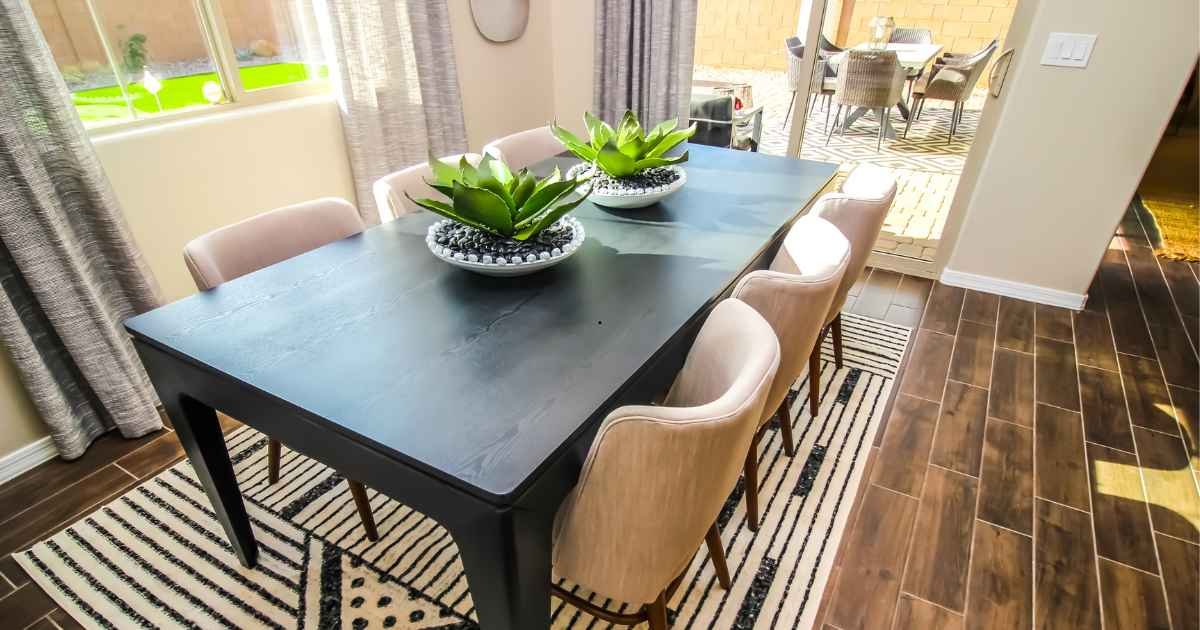
Rug size under a dining table is where most dining rooms go wrong. A rug that ends flush with the table legs looks fine when nobody’s sitting down, but the second someone pulls out a chair, the back legs slide off the rug edge and scrape the hardwood underneath. Then there’s the material problem. Wool shag traps food crumbs. Jute holds every drop of red wine. Cotton shrinks after the first spill.
The best area rugs under dining table use share a short list of specs: low pile under half an inch, stain-resistant fibers, a size at least 24 inches wider than the table on all sides, and a shape that mirrors the table. This guide covers seven types that actually survive dining rooms, plus the sizing mistake almost every household makes.
Key takeaways:
- Rug should extend 24 to 30 inches past the table edge on all sides so chairs stay on it when pulled out
- Low-pile rugs under half an inch let chairs move smoothly without snagging or bunching
- Flatweave, indoor-outdoor, and machine-washable rugs handle food spills better than wool or jute
- Round rugs work under round tables; rectangular rugs work under rectangular ones
- A rug pad prevents slipping, protects the floor, and extends rug life by three to five years
- Natural fibers like sisal and jute look great but stain permanently from wine and grease
What makes an area rug work under a dining table
An area rug works under a dining table when it’s larger than the table plus 24 inches on all sides, its pile is under half an inch so chairs move freely, and its material shrugs off food spills. Miss any of the three and the rug fails within a year. Standard living room rugs almost never work under dining tables.
Pile height rules
Pile height (the thickness of the rug’s surface) decides whether chairs pull out smoothly or catch on the fibers. Anything over half an inch snags chair legs and bunches under the front feet. Flatweave rugs (no pile, just the flat weave) work best. Low-pile rugs at a quarter to half an inch work if the fibers are dense enough to stay flat under chair weight.
Shag, hand-knotted wool with tall pile, and any rug over three-quarter-inch pile fails under dining chairs regardless of quality.
Material durability rules
Material sets the ceiling on how much abuse the rug survives. Dining rooms face four constant threats: food stains (grease, wine, sauce), water rings from condensation, chair leg dragging, and daily foot traffic under the table.
Synthetic materials (polypropylene, polyester, nylon) resist stains and clean easily. Wool resists stains too but costs more. Natural plant fibers (jute, sisal, seagrass) trap stains permanently and can’t be steam cleaned. Cotton shrinks after the first serious spill.
7 best area rugs under dining table types
Seven rug types work under dining tables in most homes: flatweave wool, indoor-outdoor polypropylene, sisal or jute (with care), low-pile synthetic, cotton flatweave, low-pile vintage Persian, and round rugs for round tables. Each fits a different budget and style. Indoor-outdoor is the most stain-resistant. Wool flatweave lasts the longest.
1. Flatweave wool
Flatweave wool has no pile, so chairs slide across cleanly. Wool naturally resists stains because of lanolin, which lets liquids bead up for 30 seconds before soaking in. That’s usually enough time to blot spilled wine or coffee. Expect $200 to $600 for an 8×10 at mid-tier price. Best pick for households that want a natural material that actually survives adult dining use.
2. Indoor-outdoor polypropylene
Polypropylene indoor-outdoor rugs (labeled UV-stable or all-weather) are the most stain-resistant option, full stop. They clean with a garden hose. Low pile at a quarter inch keeps chairs moving. Style options have improved dramatically; you can find neutral geometric patterns and even faux-vintage designs. Best for households with kids, pets, or messy adults.
3. Sisal or jute (with care)
Sisal and jute natural fiber rugs look organic under dining tables. Problem: they stain permanently from wine, grease, and coffee, and can’t be wet-cleaned. Use only in dining rooms where food spills are rare (formal rooms, single-person households, drinks-only zones). Pair with a full-coverage rug pad because natural fibers shed under chair movement.
4. Low-pile machine-washable synthetic
Machine-washable dining rugs (usually polyester or nylon) come apart into two layers: the top rug and a non-slip backing. Toss the top layer in a washing machine, hang to dry. Best for growing families and heavy-use dining rooms. Pile stays low (under a quarter inch) so chairs move well. Budget-friendly and replaceable when finally worn.
5. Cotton flatweave
Cotton flatweave dhurries and kilims work in low-traffic dining rooms. Washable in cold water and gentle spin, which handles most food spills. Trade-off: cotton shrinks 3 to 5% on first wash and fades over time. Use as a budget option for renters, guest dining rooms, or trial runs before investing in wool.
6. Low-pile vintage-style Persian
Machine-woven vintage Persians (often polypropylene or polyester with a hand-knotted look) handle dining room use because they’re low-pile despite the traditional design. Faded, distressed patterns hide spills and food crumbs well. Best for households that want a designer look without the maintenance of real hand-knotted wool.
7. Round rug for a round table
Round tables need round rugs, or the geometry fights itself. Match rug diameter to table diameter plus 48 to 60 inches (24 to 30 inches overhang all around). Round rugs come in wool, indoor-outdoor, and jute. Best for breakfast nooks, small dining rooms, and open-plan spaces where the rug defines the zone.
How to size and shape the rug
Rug size should equal table dimensions plus 24 inches on every side, at minimum. That gives chairs enough room to pull out and stay on the rug. Rug shape should match table shape (round with round, rectangular with rectangular). Getting the size right matters more than any other rug decision because size errors can’t be fixed later.
The 24-inch overhang rule
The 24-inch overhang rule prevents the most common dining rug mistake: chairs sliding off the rug edge when pulled out. Standard dining chairs need 30 inches of pull-out clearance from the table edge. A rug that extends only 12 inches past the table means chair back legs land on hardwood while front legs stay on rug, which tips the chair forward and scratches the floor.
Extend the rug 24 inches minimum on all sides. Push for 30 inches if the room allows. This measurement decides whether the rug adds to the room or fails within a month.
Round vs rectangular
Match rug shape to table shape. A round table on a rectangular rug leaves awkward corners. A rectangular table on a round rug leaves chair legs off the rug at the corners.
Some designers break this rule intentionally in open-plan spaces where the rug also defines a seating area. Skip that trick unless the room is large enough that the rug serves two zones at once.
The rug size cheat sheet
| Table size | Rug size (rectangular) | Rug shape option |
|---|---|---|
| 36″ round | 8′ round or 6’×9′ | Round preferred |
| 48″ round | 9′ round or 8’×10′ | Round preferred |
| 48″×36″ rectangular | 7’×9′ | Rectangle |
| 60″×36″ rectangular | 8’×10′ | Rectangle |
| 72″×42″ rectangular | 9’×12′ | Rectangle |
| 84″×42″ rectangular | 10’×14′ | Rectangle |
| 96″×48″ rectangular | 11’×14′ or larger | Rectangle |
Pro tip: Measure your table, add 48 inches to length and width, then check whether that size actually fits your room. A dining zone of 12×12 feet with a 72×42 table needs a 10×9 rug, which leaves 12 inches of walkable floor around the rug edge. Anything tighter looks cramped.
The Chair-Pull test
The Chair-Pull test catches every rug that will fail under a dining table. Pull a chair straight out from the table until you can comfortably sit down. Note the back leg position. If back legs sit on hardwood instead of rug, the rug is too small. If front legs snag or bunch the rug, the pile is too high. Every rug failure I’ve seen fails one of these two tests.
The test explained
Do the test at home before ordering: sit at your existing dining table, push your chair back to a natural seated position, and mark the back leg positions with painter’s tape. Measure from the table edge to those marks. That distance is your minimum overhang requirement, not the standard “24 inches” that guides suggest.
Tall people and larger chairs need more clearance. Kids’ chairs need less. Test with the actual chairs you own, not the manufacturer’s guidance.
The Chair-Pull test in a client’s dining room
I bought a beautiful 6×9 hand-knotted wool rug for a client’s 60×36 dining table. Full pile height: three-quarters of an inch. Overhang: 18 inches per side. Within three weeks, the client called about two problems. Chairs snagged the pile every time she pulled them out, which caught the front legs. Back legs sat half on hardwood, half on rug, tipping the chair forward when guests leaned back.
We replaced it with an 8×10 flatweave wool in a similar pattern. Total spend on the swap: $340 for the new rug, $180 credit on the returned one. Dining room finally functioned. Lesson: buy for how the room actually gets used, not how it looks in a styled photograph.
Common mistakes to avoid
Most dining rug regrets come from five mistakes: buying a rug the same size as the table, choosing high pile, skipping the rug pad, buying wool without stain treatment, and matching rectangular rug to round table. Each has a fix that costs nothing but a rethink before purchase.
Buying a rug the same size as the table
Most expensive dining rug mistake is buying a rug that matches or barely exceeds the table footprint. Chairs pull off the rug edge instantly. Fix: Add 24 inches minimum on all sides. If the room can’t fit that, downsize the table before choosing the rug.
Choosing high pile
Plush, shag, and any rug over half an inch of pile fails under dining chairs. Fix: Stick to flatweave (no pile) or low-pile (under half inch). If you love a high-pile look, save it for the living room.
Skipping the rug pad
Rugs without pads slip, bunch, and wear out three times faster. Fix: Buy a rubber-and-felt rug pad cut half an inch smaller than the rug on all sides. Budget $30 to $80 depending on size. Best investment you’ll make in the rug’s lifespan.
Buying wool without stain treatment
Untreated wool absorbs red wine in about 60 seconds. Fix: Buy wool rugs with factory stain treatment (Scotchgard, Nano-Tex, or similar), or apply an aftermarket fluorocarbon spray before first use. Retreat every 12 to 18 months.
Rectangular rug under a round table
Rectangular rug under a round table leaves visible awkward corners where chair legs may sit. Fix: Round tables get round rugs sized to table diameter plus 48 inches. Rectangles under rounds only work in very large rooms where the rug also anchors a nearby seating area.
Do I really need a rug under my dining table? Not always. Skip a rug if the floor is a soft surface (carpet, cork), if your dining chairs already have felt pads and quiet floors matter less to you, or if the room has an acoustic issue where hard floors already work. In most dining rooms with hardwood or tile, a rug reduces noise, protects the floor from chair scrapes, and defines the dining zone. It’s a design choice, not a requirement.
Isn’t wool too high-maintenance for a dining room? Not treated wool. Modern factory-treated wool rugs resist stains for 30 to 45 seconds after a spill, which is enough time to blot up wine or sauce with a clean cloth. Wool also self-cleans to some degree because the fibers push dirt to the surface where vacuuming picks it up. Untreated wool is a problem. Treated wool is one of the most durable choices you can make.
FAQs
What size rug should I get for a dining table?
Add 24 to 30 inches to your table’s length and width. For a 60×36 rectangular table, that’s an 8×10 rug minimum. For a 48-inch round table, that’s an 8-foot round or 8×10 rectangle. The rule catches chair pull-out room, which is where most rug sizing mistakes happen.
Are jute rugs good for under a dining table?
Only in low-spill dining rooms. Jute looks beautiful but stains permanently from wine, grease, and coffee. It also can’t be wet-cleaned. Use jute under a dining table if you rarely eat there, if you drink only water or clear liquids, or if you accept the rug as a two-year investment before replacement.
Should a dining table rug be bigger than the table?
Yes, significantly bigger. Rug should extend 24 to 30 inches past every edge of the table. That gives chairs room to pull out and stay on the rug’s surface. A rug that ends at or near the table edge fails within weeks as chair legs slide onto hardwood.
What color rug works best in a dining room?
Medium-to-dark colors and patterns hide food stains best. Solid ivory, cream, or beige rugs show every spill. Multi-tonal patterns, distressed vintage styles, and darker palettes camouflage crumbs and drops between cleanings. Skip pure white or light solid rugs unless you enjoy cleaning them weekly.
Can I put a rug under a dining table on carpet?
Yes, and it can look intentional if done right. Use a low-profile flatweave rug over the carpet, add a rug pad rated for carpet use to prevent shifting, and choose a rug in a contrasting color or pattern that visually anchors the dining zone. Layering works best in open-plan spaces where the rug defines the dining area within a larger room.
Final thoughts
Best area rugs under dining table picks favor low pile, generous size, and stain-resistant materials over looks alone. Flatweave wool and indoor-outdoor polypropylene handle most homes. Size the rug for chair pull-out room, not just table dimensions. Skip high pile, skip untreated natural fibers, and always buy the rug pad. A rug that fits the room and survives spills does more for a dining room than any pattern choice.
For more room-by-room rug guides and materials that hold up to real life, keep exploring HomeDecorIdeas.