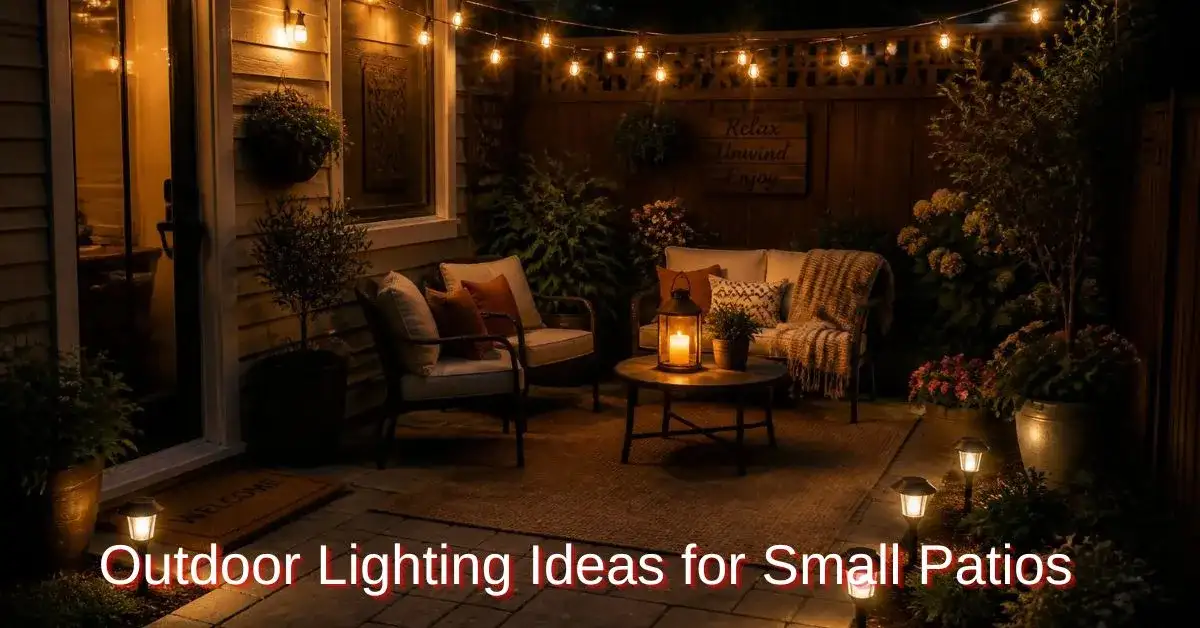
Outdoor lighting ideas for small patios work best when they layer three sources, overhead string lights, task lighting at the seating area, and low ground-level accents, instead of relying on a single strand of bulbs. A patio under 100 square feet can look washed out under one flat light source, no matter how nice the fixture is.
Most small patios end up lit by one strand of string lights and nothing else, which leaves half the space in shadow once the sun goes down. That happens because string lights are the easiest purchase, not because they’re the whole answer.
The mistake near the end of this guide shows up on patios with genuinely nice fixtures, and it’s rarely about the lights themselves.
Key takeaways:
- Layering three light sources, overhead, task, and ground-level, does more for a small patio than one bright strand of string lights.
- Warm-toned bulbs, around 2700K, read as inviting outdoors, while cool white light tends to feel harsh and clinical.
- Weatherproof ratings matter more on a small patio, since fixtures often sit closer to splash zones and foot traffic.
- Solar lighting works well for accents but usually can’t carry a patio’s main light source alone.
- A patio under 100 square feet typically needs just one overhead run, one task light, and two or three ground accents.
- Skipping a dimmer or on-off timer is the most common oversight, even on beautifully lit patios.
What makes outdoor lighting ideas for small patios work
Outdoor lighting works on a small patio when it comes from more than one height and source, rather than a single overhead strand doing all the work. A tight footprint amplifies shadows, so an uneven light source stands out more than it would in a larger yard.
Three factors decide whether patio lighting reads as finished: layering, since one light source alone leaves gaps; color temperature, since warm light flatters a small space while cool light flattens it; and weatherproof rating, since outdoor fixtures near a patio table face more splashes and humidity than string lights strung across a large yard. Get those three right and even a compact patio feels considered after dark.
Twelve outdoor lighting ideas that work on small patios
String lights strung overhead
A single run of warm-white string lights along the patio’s perimeter or overhead beams remains the fastest way to add ambient light to a small space. Use guide wire rather than relying on the string’s own weight if the run exceeds about 15 feet, since sag looks unintentional.
A single statement lantern on the table
One larger lantern, battery or candle-powered, placed at the center of a small bistro table adds task lighting without needing an outlet nearby. Choose a lantern with a warm glass or amber tint rather than clear glass for a softer look.
Solar pathway lights along the edge
Solar stake lights along a patio’s border mark the edge of the space and add a low ground-level layer without any wiring. They work best as an accent rather than a primary source, since output varies with how much sun they get during the day.
Wall-mounted sconces near the door
A pair of sconces flanking the door leading onto the patio adds architectural light and doubles as a safety feature at the threshold. Keep the finish consistent with any other exterior hardware for a cohesive look.
Tealight or LED candles in glass jars
Small candles or flameless LED versions in glass jars scattered along a ledge or table add flickering, low-level warmth that battery lanterns can’t quite replicate. Group them in odd numbers, three or five, for a more natural cluster.
A freestanding lamp post or pole light
A compact solar or plug-in lamp post gives a small patio a defined light source without mounting anything to the house. It works especially well as the anchor light in a patio with no covered structure to string lights from.
Uplighting on a single tree or plant
A small uplight aimed at one potted tree or tall plant creates dramatic shadow play against a fence or wall, adding depth a flat overhead light can’t. One well-placed uplight usually beats several scattered across a small space.
Rope lights along a railing or step edge
Low-profile rope or strip lighting along a railing or step edge marks a change in level, which matters for safety on a patio with any elevation change. Choose a warm color temperature to match the rest of the layering.
A pendant light over the seating area
If the patio is covered, a single pendant hung above the main seating cluster acts as a defined task light, similar to how a pendant works over an indoor dining table. Size it modestly; an oversized pendant overwhelms a small footprint.
Fairy lights woven through a planter or trellis
Miniature fairy lights tucked into a planter or trellis add texture-level detail without competing with the main overhead light. This works especially well on a patio that already has a vertical garden or climbing plant.
A fire pit or tabletop fire bowl
A small fire pit or tabletop fire bowl doubles as both a light source and a heat source, extending a patio’s use into cooler evenings. Keep it at least three feet from any furniture or overhanging fabric.
A dimmer or smart plug for control
Adding a dimmer switch or a smart plug to your main light source lets you shift from bright task lighting to a softer ambient glow without swapping fixtures. This single addition does more for flexibility than buying an extra light.
Ratings, budgets, and the details that matter
Pro tip: check the IP rating before buying any fixture for a patio without full cover. An IP44 rating handles splashes fine, but a fixture sitting directly in rain or snow needs at least IP65 to hold up over a season.
| Light type | Typical cost range | Weatherproof need | Best layer |
| String lights | 15 to 40 | IP44 minimum | Overhead |
| Solar pathway lights | 20 to 50 (set of 6) | Built-in, outdoor rated | Ground |
| Wall sconces | 30 to 90 (pair) | IP44 or higher | Accent or task |
| Tabletop lantern | 20 to 60 | IP44 for covered use | Task |
| Fire bowl or small fire pit | 60 to 200 | Outdoor rated by design | Ambient and heat |
The sky-table-ground method and a real example
I call this the sky-table-ground method: sky covers overhead string lights or a pendant, table covers task lighting at the seating area, a lantern or small lamp, and ground covers low accents, solar stakes or rope lighting along an edge. Hit all three heights and even a tiny patio feels layered instead of flat.
I applied this method to a patio measuring roughly 8 by 10 feet, working with a mid-range budget over one evening’s installation. We added one overhead string light run on guide wire, a single amber lantern on the bistro table, and four solar stakes along the planter bed. Total spend landed close to 110 dollars. The patio went from unusable after dark to the spot where we ate dinner most warm evenings for the rest of the season.
Won’t string lights look cluttered on such a small patio? Usually not, if it’s one clean run rather than several crossing strands. A single well-anchored line along the perimeter reads as intentional, while overlapping runs are what create visual clutter.
Is solar lighting bright enough to actually use? For accent and pathway lighting, yes. For a patio’s main light source, solar alone usually falls short on cloudy days or in shaded spots, so pair it with at least one plug-in or battery fixture for reliable brightness.
Common mistakes that leave a small patio poorly lit
Relying on one light source only
A single strand of string lights leaves the seating area and ground level in shadow. Fix: add at least one task light and one ground-level accent alongside the overhead run.
Using cool white bulbs outdoors
Cool white light can feel sterile against natural surfaces like wood decking or stone pavers. Fix: stick to warm-toned bulbs, around 2700K, across every fixture on the patio.
Skipping the weatherproof rating
Fixtures rated for indoor or covered use only will degrade fast if exposed to direct rain or snow. Fix: check the IP rating before buying, and choose at least IP65 for anything without overhead cover.
Overloading a single outlet or extension cord
Running string lights, a fire bowl, and a speaker off one extension cord risks tripped breakers and frayed cords. Fix: distribute plug-in fixtures across at least two outlets or circuits where possible.
Skipping a dimmer or smart control
Fixed-brightness lighting forces a choice between too bright for dinner and too dim for reading. Fix: add a simple dimmer switch or smart plug to the main fixture for flexibility across different evenings.
Quick checklist before you shop
- Check the IP weatherproof rating for any fixture without full cover
- Plan for three light layers: overhead, task, and ground-level accents
- Choose warm-toned bulbs, around 2700K, across every fixture
- Confirm outlet access or battery life before committing to a layout
- Add a dimmer or smart plug for flexible brightness control
FAQs
What is the best lighting for a small patio?
A layered mix works best: one overhead string light run, one task light at the seating area, and a couple of ground-level accents like solar stakes or rope lighting. Warm-toned bulbs around 2700K suit most small patios.
Do solar lights work well on a covered patio?
Not usually, since solar panels need direct sun exposure to charge fully. A covered patio blocks much of that light, so plug-in or battery fixtures tend to perform more reliably in shaded or covered spots.
How many string lights do I need for a small patio?
For a patio under 100 square feet, one run of roughly 15 to 25 feet along the perimeter or overhead beams is usually enough for ambient light. Add task and ground lighting separately rather than doubling up the string lights.
Is warm or cool light better for a patio?
Warm light, generally around 2700K, reads as more inviting outdoors and pairs better with natural materials like wood and stone. Cool white light tends to feel more clinical and can wash out a small space.
Can you use indoor lights on a covered patio?
Only if they’re rated for at least damp locations, since even covered patios face humidity and occasional wind-blown rain. Check the fixture’s rating label before installing anything not explicitly marked for outdoor or covered outdoor use.
Final thoughts
A small patio doesn’t need more lights, it needs light at more than one height. Start with the sky-table-ground method, add one layer at a time, and the space will feel usable well past sunset. For more outdoor styling ideas, browse the rest of the HomeDecorIdeas guides.