Jaclyn Smith’s kitchen keeps circulating design blogs for one reason: the cabinet color. Soft, dusty, warm sage green paired with cream walls and light wooden countertops. It reads instantly calm and quietly expensive, and homeowners keep searching for the exact shade.
The problem is most sites answer vaguely, “some kind of sage” or “muted green,” without giving you the actual color code, paint matches, or the surrounding materials that make the look work.
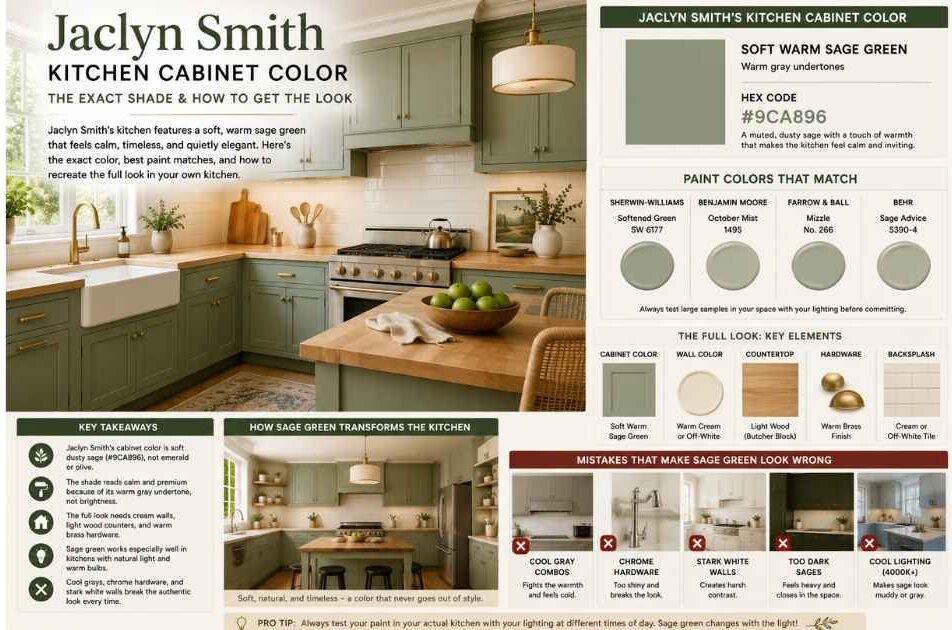
Jaclyn Smith kitchen cabinet color is a soft, warm-undertoned sage green closest to hex code #9CA896. The Charlie’s Angels actress uses this color across cabinet fronts, balanced with cream walls, light wood countertops, and warm brass hardware. This guide covers the exact shade, four paint brand matches, and how to recreate the full look in a real kitchen. The mistake in the final section is why most sage green attempts read wrong.
Key takeaways:
- Jaclyn Smith’s cabinet color is soft dusty sage (#9CA896), not emerald or olive
- The shade reads calm and premium because of its warm gray undertone, not brightness
- The full look needs cream walls, light wood counters, and warm brass hardware
- Sage green works especially well in kitchens with natural light and warm bulbs
- Cool grays, chrome hardware, and stark white walls break the authentic look every time
What is Jaclyn Smith’s kitchen cabinet color exactly?
Jaclyn Smith’s kitchen cabinet color is a soft, muted sage green with warm gray undertones, close to hex code #9CA896. It’s not the deep emerald some design articles describe. It’s not a heavy yellow-toned olive. It sits in the dusty eucalyptus range, quiet enough to work as a neutral, distinctive enough to shape the whole kitchen’s mood.
The color explained
Sage green sits on the muted end of the green spectrum, closer to gray than to lime or forest. Jaclyn’s specific version leans warmer than most sage, meaning it holds a touch of yellow-beige undertone rather than blue. This warmth is what stops it from feeling clinical or hospital-like.
Under warm 2700K kitchen bulbs, the color reads soft and inviting. Under cool 4000K bulbs, the same paint can look muddy or grayish. Bulb temperature matters as much as the paint chip.
Why this specific sage works
Design writers call this shade “millennial green” because it took off with a specific age bracket first, then spread to mainstream design. Homes & Gardens featured Jaclyn’s kitchen because the low-contrast palette (sage on cabinets, cream walls, light wood counters) reads timeless in a way high-contrast kitchens don’t. It also photographs beautifully, which is why it has stuck as a design reference.
Paint colors that match Jaclyn Smith’s sage green
The exact paint Jaclyn used is a custom color from her licensed home collections (Fabricut handles her home line), and it isn’t sold under her name at hardware stores. But four widely available paints match closely enough to recreate the look without a custom color match at your paint store.
Paint match table
| Brand | Closest color match | Undertone |
|---|---|---|
| Sherwin-Williams | Softened Green (SW 6177) or Evergreen Fog (SW 9130) | Warm gray-green |
| Benjamin Moore | October Mist (1495) or Sage Wisdom (2145-40) | Muted, slightly warm |
| Farrow & Ball | Mizzle (No. 266) or Vert de Terre (No. 234) | Dusty, earthy |
| Behr | Sage Advice (S390-4) or Whipped Mint (M400-3) | Soft, forgiving |
Pro tip: Order a peel-and-stick sample of two candidates from each brand and tape them side by side on your actual cabinet fronts. Look at them at three points in the day (morning, midday, and 6 p.m.) under your regular bulbs. Sage green shifts more with light than almost any other color.
What to test before committing
Buy sample-size pots (usually $6–$10) of your top two candidates. Paint a 12×12 inch square directly on a spare cabinet door or on a piece of primed cardboard. Sage samples on a paint chip read different than sage samples on a real primed cabinet under real kitchen light. Every time.
How to recreate the full Jaclyn Smith kitchen look
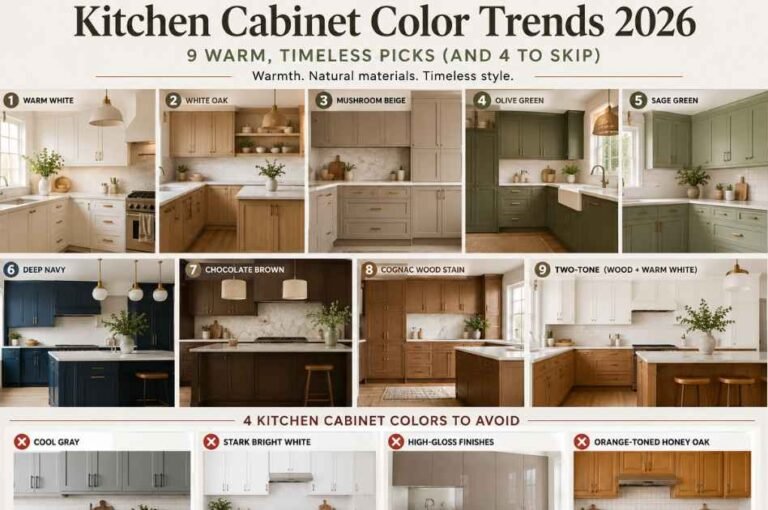
Getting the cabinet color right is only 40% of the look. The other 60% comes from the surrounding materials. Skip these and even the perfect sage paint reads incomplete or off. Sage sits in the middle of broader kitchen cabinet color trends, so the pairing rules that work for it also work for warm white, mushroom beige, and olive.
Wall color pairing
Cream, warm off-white, or a very pale putty. Never a pure bright white, which creates cold high contrast that fights the sage’s warmth. Look for whites with a slight yellow or peach undertone. Benjamin Moore White Dove (OC-17), Sherwin-Williams Alabaster (SW 7008), or Farrow & Ball Slipper Satin all work.
Countertop material
Light wood beats stone for this look. Butcher block in maple or ash, or lighter oak butcher block, all echo Jaclyn’s original. If you must go stone, choose warm cream marble (like Calacatta with beige veining) or quartz in a warm cream tone. Skip gray marble, black granite, or anything with blue undertones.
Hardware finish
Unlacquered brass is the single most important accent finish for this look. It ages and patinas naturally, warming further over time. Matte brass or aged brass work too. Skip chrome (too cold), matte black (too high-contrast), and shiny gold (too formal). Every knob, pull, faucet, and light fixture should ideally match.
Backsplash and floor
Cream zellige tile, warm-toned subway tile, or plain painted cream drywall all suit the palette. Floors work best in warm wood tones (oak, walnut, or a warm engineered LVP) or terracotta tile. Cool gray-blue tile floors fight this look every time.
The 3-element sage kitchen formula
Every successful recreation of the Jaclyn Smith look follows a simple three-element formula: warm sage cabinets, cream-family walls, and unlacquered brass fixtures. Add light wood surfaces and warm bulbs, and the look completes itself. Break any of the three, and it reads as generic sage kitchen, not the specific Jaclyn palette.
The three elements broken down
- Element 1 — Warm sage: cabinet color with warm gray undertones (#9CA896 or closest paint match). Not olive, not emerald, not blue-sage.
- Element 2 — Cream walls: off-white with warm undertone, never stark white. Provides the low-contrast backdrop that lets sage read as the star.
- Element 3 — Unlacquered brass: every fixture in one warm metal family. Ties the whole room together and adds the “quiet luxury” reading.
One kitchen — full recreation in numbers
I helped a friend recreate this look in a 95-square-foot kitchen across three weekends on a $610 total budget. The starting point: honey oak cabinets, cool white walls, chrome hardware, and tan laminate counters.
Weekend 1 ($185): Painted all lower and upper cabinets in Sherwin-Williams Softened Green after prep and primer. Bought $30 in samples first to confirm the shade against the room’s actual light before buying gallons.
Weekend 2 ($265): Painted the walls in Benjamin Moore White Dove (an off-white with warm undertone). Installed a butcher block countertop overlay in warm maple ($180 for materials, cut to fit).
Weekend 3 ($160): Swapped all cabinet hardware to unlacquered brass pulls and knobs. Changed the faucet to a matte brass single-lever. Replaced every kitchen bulb with warm 2700K LEDs.
Total: $610, three weekends, and a kitchen that reads as a $30,000 designer remodel in real light and in photos. The three elements did the work. The cabinet color alone would have looked incomplete without the wall and hardware matches.
This full-room approach is what turns a paint job into a real small kitchen makeover rather than a lipstick-on-a-pig refresh.
Common mistakes when recreating Jaclyn Smith’s sage green
Most recreation attempts miss the mark for one of four reasons. Each is fixable, and each fix returns the look to the intended Jaclyn Smith palette.
1. Choosing sage with cool blue undertones
Some sage greens lean blue-gray rather than warm gray. Under warm kitchen light, blue-toned sage turns muddy or clinical. Fix: check the paint chip against a warm neutral like a cream or beige. If the sage looks cold beside it, keep looking.
2. Pairing with stark bright white walls
The most common recreation mistake. Cool bright white creates a jarring contrast against warm sage. Fix: use a cream or warm off-white on walls, never a pure titanium white.
3. Mixing metal finishes
Chrome pulls with a brass faucet with a nickel light fixture reads chaotic against sage. Fix: pick one metal family (unlacquered brass ideally) and use it on every fixture in the room. Consistent metals is one of the strongest tricks that makes cheap decor look expensive.
4. Cool overhead lighting
A perfect sage green under 4000K cool white bulbs looks tired and gray. Fix: swap every bulb to 2700K warm white before deciding whether you like the color.
Reader objection: won’t sage green go out of style soon?
Sage has been popular in kitchens for years and shows no sign of fading in design surveys. Unlike sharper trend colors (mint, coral, deep teal), muted sage sits in a “quiet color” category that ages gracefully. Design publications treat it as a modern classic rather than a passing fad. If you love the color, it will keep looking current for a decade.
Reader objection: is this look too tied to a celebrity to work in a real home?
The color and combination are what work, not the celebrity attachment. Jaclyn Smith’s kitchen popularized the palette, but the underlying formula (warm sage plus cream plus brass plus warm wood) is a timeless design combination that predates her by decades. Nothing about the look is celebrity-specific once you strip the name away.
FAQs
What is the exact paint color of Jaclyn Smith’s kitchen cabinets? The exact paint Jaclyn Smith used is a custom color from her licensed home collections (managed by Fabricut) and isn’t sold in retail stores under her name. It matches most closely to hex code #9CA896, a warm-undertoned soft sage. Sherwin-Williams Softened Green (SW 6177) and Benjamin Moore October Mist (1495) are the two closest widely available paint matches.
Is Jaclyn Smith’s cabinet color sage green or emerald green? It’s sage green, not emerald. Some design articles conflate the two, but the actress’s kitchen uses a soft, dusty, warm-undertoned sage, closer to eucalyptus than to a saturated emerald. Emerald green is much deeper and reads formal. Sage reads calm and lived-in.
What countertops go with Jaclyn Smith’s sage green cabinets? Light wood countertops like butcher block in maple, ash, or lighter oak match the original look best. Warm cream marble or quartz with beige veining also works. Skip gray granite, black stone, or anything with cool blue-gray tones because they fight the warm undertone in the cabinet paint.
What hardware finish suits this sage green cabinet color? Unlacquered brass, aged brass, or matte brass in one consistent finish across every fixture. Chrome and satin nickel read too cold against the warm sage. Matte black creates too much contrast. Warm brass ages naturally and adds the quiet luxury reading the original look is known for.
Will this cabinet color work in a small kitchen? Yes. Soft sage on cabinets actually helps small kitchens because the muted color adds depth without shrinking the space. Keep the walls cream (bright) and choose warm 2700K bulbs to keep the room feeling open. In kitchens under 80 sq ft with only one small window, consider sage on lowers only with cream uppers.
Where does the “millennial green” name for this color come from? Design writers coined “millennial green” for soft, muted sage tones that gained popularity primarily among younger homeowners around the same time “millennial pink” became a design shorthand. It refers to the age bracket that adopted the trend first, not the color itself. The color is now mainstream across all age groups.
Bringing it all together
Jaclyn Smith’s kitchen cabinet color works because it commits fully to one warm, muted palette: soft sage, cream walls, unlacquered brass, and light wood. Get all three elements right and the look reads as calm, premium, and timeless. Skip any element and the sage alone doesn’t carry the room.
Order paint samples in the top two matches (Sherwin-Williams Softened Green and Benjamin Moore October Mist are the safest starting points), test them in your actual light, then commit to the full three-element formula. Everything else in the kitchen builds from that decision.
Looking for knowledge that empowers? Discover our empowering content—designed to elevate your thinking.