Cabinet color is the most expensive decorating decision most homeowners make. Get it wrong and you’re staring at $8,000 of paint or millwork every morning for the next ten years. Get it right and the kitchen feels current for a decade without a single change.
The palette everyone chose in the last cycle, cool gray with stark bright white, is now the tell of a dated kitchen. Buyers walk in and clock it instantly.
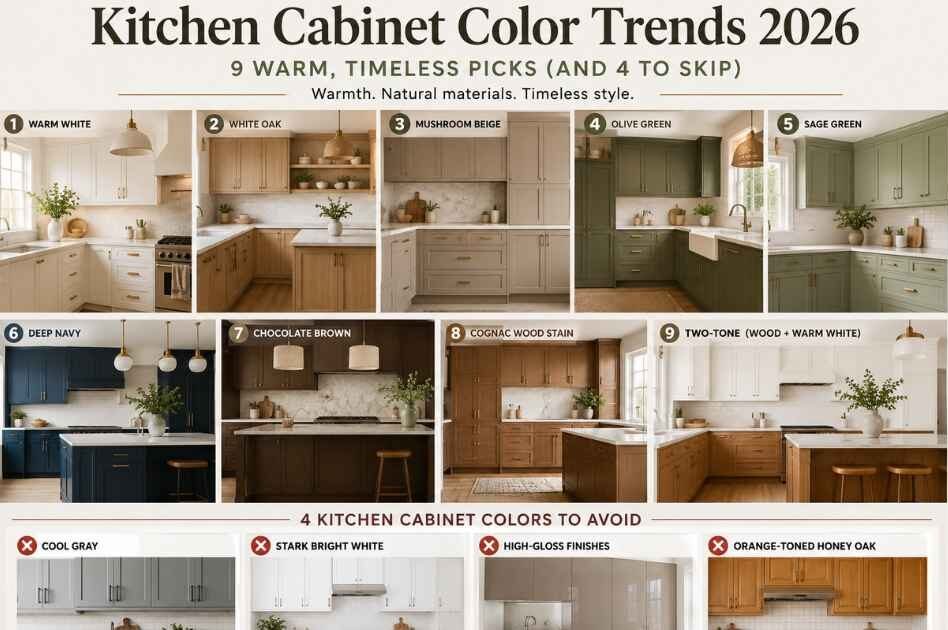
Kitchen cabinet color trends 2026 have pulled hard toward warmth: creamy whites, natural wood grain visible under matte finishes, earthy greens, and warm neutrals that make a room feel calm instead of clinical. This guide lays out the nine shades actually rising in real projects, how to pair them with your kitchen’s light and size, and the four colors to leave behind. The last mistake in the final section is the one I keep seeing in freshly renovated homes.
Key takeaways:
- Cool gray and stark bright white are the two most dated cabinet colors right now
- Warm white, white oak, and mushroom beige are the safest picks for resale value
- Matte finishes are replacing high-gloss across every color family
- Small kitchens handle deep colors on lower cabinets and islands only
- Two-tone kitchens (wood lowers plus warm white uppers) sit at the top of the trend
- Warm brass and matte black hardware both work; heavy chrome does not
The shift driving kitchen cabinet color trends in 2026
The move away from cool tones is not a passing fad. Warm palettes read as timeless because they mimic materials found in nature: sand, stone, moss, weathered wood. Cool grays and pure whites are pigments, not natural references, and the eye eventually reads them as flat.
Three shifts define the current cycle. Cool undertones are out. High-gloss is out. Single-color kitchens are giving way to layered two-tone schemes. The result is a kitchen that photographs beautifully but, more importantly, feels calm to stand in at 7 a.m. with a cup of coffee.
From cool to warm undertones
Warm whites carry a hint of yellow, cream, or peach. Cool whites carry blue or green. Under warm bulbs (2700–3000K, which most kitchens use), cool whites take on a hospital tinge. Warm whites soften and glow. Same paint chip, different room, entirely different feeling.
Nature-inspired palettes
Olive, mushroom, sage, cognac, deep navy: every trending color has a natural analog. That isn’t accidental. Homeowners have spent the past few years surrounded by screens, and the kitchen is where they crave the opposite feeling.
The 9 best kitchen cabinet colors trending now
Every color below is holding strong in NKBA design surveys, contractor order sheets, and paint manufacturer bestseller lists. Each entry includes what it pairs with and where it fails.
1. Warm white (creamy off-white)
The safest choice on this list. Warm white reads bright without the sterile edge of pure white, and it works with almost any hardware, countertop, and floor. Think cream, ivory, or soft chalk, never flat cool white with zero undertone.
Pairs well with: brass or matte black hardware, natural oak floors, quartz with warm veining.
Skip it when: your kitchen faces north with low natural light. A warm white can shift yellow. Test large samples on all four walls first.
2. White oak (natural timber)
Real or veneered white oak with a matte clear finish is the wood grain of the moment. It reads modern and organic at once, and it forgives more design mistakes than any painted cabinet.
Pairs well with: warm white walls, quartz counters, brass fixtures, cream or bone-colored zellige backsplash.
Skip it when: your existing floors are heavy orange or red oak. The clash reads immediately. Refinish the floors first or choose a different cabinet direction.
3. Mushroom beige (warm greige)
This is the color quietly replacing cool gray in every new build I’ve toured. It sits between beige and gray with a warm putty undertone. It hides fingerprints, ages well, and photographs like a much more expensive kitchen than it is.
Pairs well with: unlacquered brass, walnut open shelves, honed marble or quartz with beige veining.
Skip it when: paired with cool-toned floors like blue-gray tile. The mismatch fights the whole room.
4. Olive green (earthy moss)
A dusty, sophisticated green with brown undertones. Olive behaves like a neutral once installed and works especially well on full cabinetry in kitchens with strong natural light.
Pairs well with: warm wood floors, brass or aged bronze hardware, cream countertops, terracotta or unglazed tile.
Skip it when: your kitchen has cool fluorescent lighting. Olive turns muddy under the wrong bulbs. Swap to 2700K LEDs first.
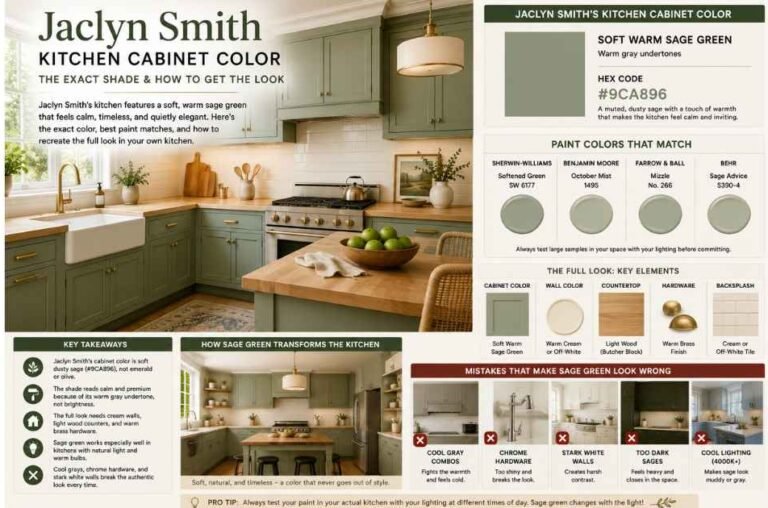
5. Sage green (soft eucalyptus)
Lighter and more airy than olive. Sage suits smaller kitchens where a saturated green would close in the room, and it reads calm rather than moody.
Pairs well with: warm white walls, light oak floors, honed marble, brushed nickel or brass.
Skip it when: your kitchen already has cool north-facing light and pale everything else. Sage on sage on sage reads washed out.
6. Deep navy (classic midnight)
Navy has aged into a modern classic. The current trend uses it on the island or lower cabinets only, never floor to ceiling in a small space.
Pairs well with: warm white perimeter cabinets, marble or quartz with subtle veining, brass or polished nickel hardware.
Skip it when: you have less than one uncovered window in the room. Navy needs light to sing.
7. Chocolate brown (espresso stained wood)
Rich, dark, and warm. Stained (not painted) is the winning finish. The wood grain has to show through, otherwise the space reads as dated laminate. Best used on an island or lower cabinets in larger kitchens, or on a full run in a well-lit space. It’s the classic anchor color in most traditional and farmhouse-style kitchens, where warm wood already sets the tone.
Pairs well with: cream walls, marble, warm brass, natural fiber pendants.
Skip it when: your kitchen is under 100 square feet with a single window. It will swallow the light.
8. Cognac wood stain (warm mid-tone)
The color competitor pages keep missing. Cognac is a mid-tone stain between honey oak and dark walnut, with red-brown warmth that reads far more expensive than either. Rift-cut white oak or walnut with a cognac stain sits at the highest end of the current cabinet market.
Pairs well with: cream or soft plaster walls, unlacquered brass, terracotta or Moroccan tile, black stone or soapstone counters.
Skip it when: you have red-toned floors or orange-toned countertops already. Cognac’s warmth needs cooler surrounding materials to balance it.
9. Two-tone (wood plus warm white)
Two-tone cabinets have moved from trend to standard. The strongest formula: wood lowers (white oak or walnut), warm white uppers, and a matching wood or navy island. This layout reads intentional in a way single-color kitchens rarely do.
Pairs well with: any warm hardware, quartz or marble counters, wood or stone floors.
Skip it when: you use three or more colors in a small kitchen. The space starts reading as chaotic. Two colors maximum in kitchens under 120 square feet.
How to choose a cabinet color for your kitchen
Color choice is not a mood-board decision. It’s a math problem set by three variables: kitchen size, natural light direction, and existing floor color.
The kitchen color pairing matrix
| Kitchen size | Natural light | Best cabinet colors | Colors to skip |
|---|---|---|---|
| Under 80 sq ft | Low / north-facing | Warm white, light oak, sage | Deep navy, chocolate brown |
| Under 80 sq ft | Bright / south-facing | Mushroom beige, sage, warm white | Cool grays only |
| 80–150 sq ft | Low / north-facing | Warm white uppers with navy or olive island | Full chocolate brown |
| 80–150 sq ft | Bright / south-facing | Any color on this list | None from the trending nine |
| Over 150 sq ft | Any | Chocolate brown, cognac, deep navy full runs | Stark white (feels cold at scale) |
Pro tip: Order full-size door samples from your cabinet supplier and tape them to every wall of the kitchen. Look at them at three points in the day, morning, noon, and 6 p.m. under your regular bulbs. What looks perfect at midday can turn sickly by dinner.
By kitchen style
Modern minimalist kitchens do best with white oak, warm white, or mushroom beige, because the material does the visual work. Farmhouse and traditional kitchens can handle deeper choices: navy, chocolate brown, olive green. Scandi and Japandi kitchens want cognac or matte white oak with black hardware. Matching the cabinet color to your kitchen’s overall design style matters more than picking the current trending shade.
The 60-30-10 cabinet color rule
Interior designers borrow this from clothing styling: 60% dominant color, 30% secondary, 10% accent. Applied to kitchens, it stops the chaos most two-tone attempts fall into.
How it works:
- 60% dominant: the perimeter cabinets (usually warm white or a light wood)
- 30% secondary: the island, a run of lower cabinets, or a pantry wall in a deeper trending color (navy, olive, chocolate brown)
- 10% accent: hardware, faucet finish, one shelf, or the range hood
Follow this and the kitchen reads considered without matching. Ignore it and you end up with the everything-competes-for-attention look that makes new remodels feel dated within a year.
One kitchen, real numbers
I recently helped a friend rework a 105-square-foot galley kitchen on a $2,800 painting budget over one weekend. The original: honey oak cabinets, cool white walls, chrome hardware. Total makeover time: 22 hours across Friday evening and Saturday.
We painted the uppers a warm white (dominant, 60%), the lowers a soft olive green (secondary, 30%), and swapped every knob and pull for unlacquered brass (accent, 10%). Countertops stayed. Floors stayed. One weekend, one paint upgrade, one hardware swap, and the kitchen photographed like a $30,000 remodel.
The reason it worked: the 60-30-10 split gave the eye a clear hierarchy. Painting everything olive would have felt heavy. Painting everything white would have felt basic. The ratio did the work.
Kitchen cabinet colors to avoid
Trends fade for reasons, and the reasons stay true even after the color leaves the front of every design magazine.
Cool gray (any shade with blue undertones)
Cool gray was the defining cabinet color of the last cycle and it now reads as flatly dated as almond appliances did decades ago. The fix if you’re stuck with it: repaint uppers only in warm white, keep the lowers gray for one more cycle, and swap chrome hardware for brass to warm the whole room.
Stark bright white (pure titanium white)
Different from warm white in ways paint chips make obvious under real kitchen lighting. Stark white throws cool blue undertones and reads sterile. Swap to a cream or ivory with a warm base pigment, same brightness, ten times the warmth.
High-gloss finishes
Any color goes wrong in high gloss right now. Matte, satin, and eggshell finishes have taken over across every trending shade. Gloss also shows every fingerprint, drip, and scratch, which matters in a room where hands touch cabinets thousands of times a year.
Orange-toned honey oak
The color that made every early-2000s kitchen look identical. If your existing cabinets are honey oak and the boxes are solid, refinishing with a cognac or white oak stain works beautifully. Painting them warm white is the second-best rescue, and often the highest-impact single change in any small kitchen makeover. Leaving them as-is is the worst option.
Reader objection: won’t dark cabinets make my small kitchen feel smaller?
Not usually, and often the opposite. Dark cabinets on lower units or a single wall create depth that pale everything cannot. The eye reads the dark wall as receding, which tricks the room into feeling deeper. Where it fails: dark cabinets floor to ceiling in a room under 80 square feet with only one small window. That configuration does close in. Keep the deep color on lowers or an island, and paint uppers a warm white.
Reader objection: isn’t warm white just cream?
Warm white and cream sit on a spectrum, and the difference is base pigment. Warm white is white pigment with a small drop of yellow or peach; it still reads as white, just softer. Cream is white with a much heavier yellow or beige base, and it reads clearly off-white or ivory. Both work in current kitchens. Cream leans more traditional, warm white more modern. If you want white-that-doesn’t-feel-cold-but-still-reads-as-white, warm white is the answer. Cream is a step further into ivory territory.
FAQs
What is the most popular kitchen cabinet color trending now?
Warm white and natural white oak are the two most-installed cabinet colors in recent design surveys. Warm white leads for resale value, and white oak leads for organic-modern kitchens. Both suit a wide range of homes and forgive design mistakes better than any saturated color.
Are white kitchen cabinets still in style?
Yes, but only warm whites. Stark cool whites read as sterile now, while creamy off-whites, chalk whites, and warm ivories are stronger than ever. If your current cabinets are a cool white, repainting in a warm off-white refreshes the room without the cost of new cabinets.
Are gray kitchen cabinets outdated?
Cool grays (with blue or purple undertones) are firmly on the way out. Warm grays like greige, mushroom, and taupe are the current version of the same neutral instinct. If you love the color family, choose a warm greige or mushroom beige instead of a true cool gray.
What cabinet color has the best resale value?
Warm white holds the highest resale value because it appeals to the widest range of buyers and photographs bright in real estate listings. Natural wood tones like white oak also hold strong. Bold colors like deep navy and chocolate brown add character but narrow your buyer pool, so save them for an island or lower cabinets in a two-tone scheme.
Do I need to repaint if my cabinets are still in good shape?
Painting existing cabinets rather than replacing them saves 60–80% of the cost of new cabinetry. Prep and finish matter more than the paint itself. If your cabinet boxes are solid wood or quality plywood, repainting in a trending warm color gives you a near-new kitchen for a fraction of the cost. Paired with new hardware and warm bulbs, it’s most of what a small kitchen budget refresh actually needs.
How long do painted kitchen cabinets last?
Well-prepped and properly finished painted cabinets hold up for 8 to 12 years before needing a refresh. The finish matters more than the color. Two-part urethane or professional-grade cabinet paint with a satin sheen resists chipping and yellowing far longer than standard wall paint applied to cabinet doors.
Bringing it together
The kitchen cabinet color trends worth following are the ones that stay livable for a decade, not the ones that photograph well for one season. Warm white, white oak, mushroom beige, olive green, and cognac wood cover almost every real kitchen currently being renovated well. Pair the color with your natural light and kitchen size, apply the 60-30-10 rule to your two-tone split, and skip the cool grays and glossy finishes that mark last cycle’s mistakes.
Pick your dominant color first, order full-size samples, and see them in your actual light before committing. Everything else in the room — the hardware, backsplash, lighting, and styling — follows from the color you land on.
Get inspired by breakthrough concepts—our innovative approaches offer solutions you haven’t considered.