You want a kitchen that feels warm, lived-in, and effortlessly charming — but every farmhouse renovation you’ve seen online looks like it cost a small fortune. It doesn’t have to. The farmhouse style is rooted in utility and honest materials, which means most of its best elements are genuinely affordable. This guide covers exactly how to get farmhouse kitchen decor on a budget without ripping out a single cabinet or hiring a contractor. And the mistake in the last section? It’s the one I see wrecking otherwise beautiful kitchens almost every time.
Key takeaways:
- Swapping cabinet hardware is the single highest-impact budget upgrade — under $50 for most kitchens
- Open shelving costs less than upper cabinets and doubles as decor display space
- Linen, burlap, and jute bring farmhouse texture for a few dollars each
- Warm white (not bright white) paint on cabinets reads as farmhouse; cool white reads as clinical
- Vintage thrift finds outperform brand-new “rustic” decor for both cost and authenticity
- A layered lighting setup changes the feel of a kitchen more than most decor changes
What is farmhouse kitchen decor — and why does it work on a budget?
Farmhouse kitchen decor is a design style built around natural materials, functional objects made beautiful, and a sense of easy, unhurried living. It favours wood, linen, stone, ceramic, and iron over synthetic finishes. It celebrates imperfection — a slightly uneven glaze on a stoneware crock, the grain in a pine shelf — rather than hiding it.
That’s exactly why it works on a tight budget. Unlike mid-century modern (which demands specific, often expensive furniture) or minimalism (which requires quality over everything), the farmhouse look actively improves with age, patina, and thrift-store provenance. A mason jar is more on-brand than a designer vase. A worn breadboard is better than a pristine one. The style rewards resourcefulness.
The highest-impact farmhouse kitchen upgrades (ranked by cost)
Not every change costs the same, and not every change delivers the same return. Here’s where to put your budget first.
Hardware swaps: the fastest farmhouse fix
Cabinet handles, pulls, and knobs are the most underrated lever in kitchen decor. A full set of matte black cup pulls or oil-rubbed bronze bin handles can shift a plain, builder-grade kitchen into something that reads distinctly farmhouse — and it takes an afternoon and a screwdriver, not a contractor.
For most kitchens, a complete hardware replacement costs between $30 and $80, depending on the number of cabinets and the style you choose. Matte black is the most durable finish in this category; it doesn’t show fingerprints the way brushed gold does and holds its look far longer than chrome. If you want warmth, look for aged brass or unlacquered copper — both develop a patina that actually improves over time.
Pro tip: When replacing hardware, buy two or three extra pieces. Discontinued styles disappear fast, and you’ll want spares if one breaks or a future cabinet gets added.
Open shelving: cheaper than cabinets, better for display
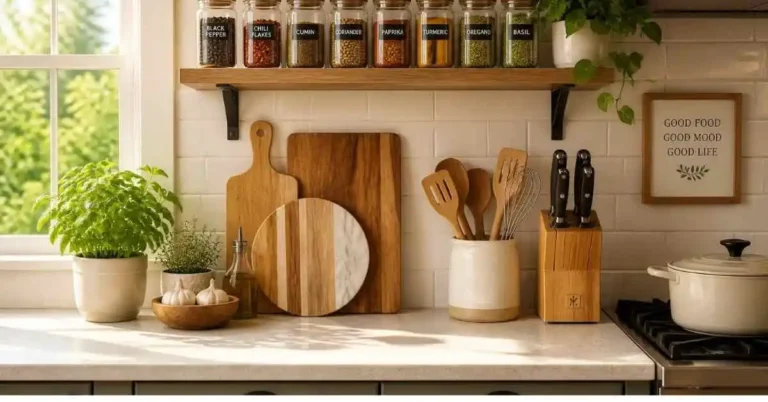
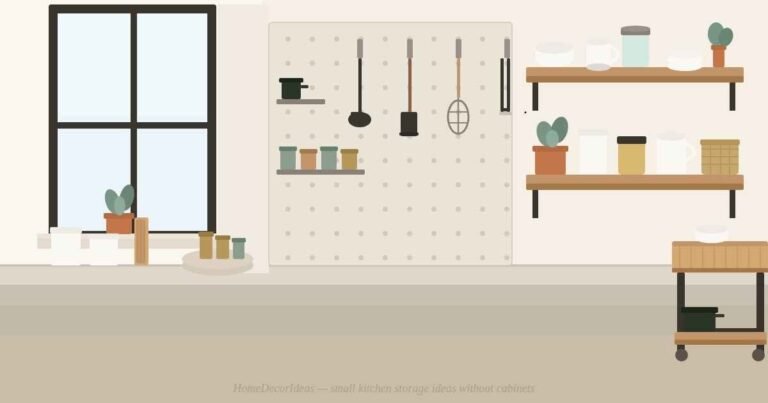
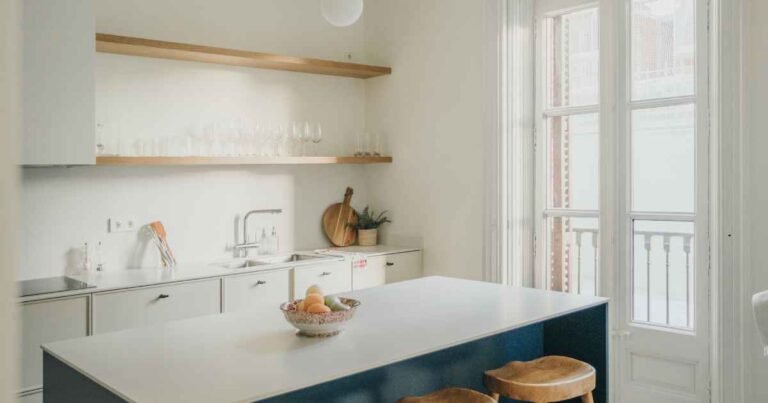
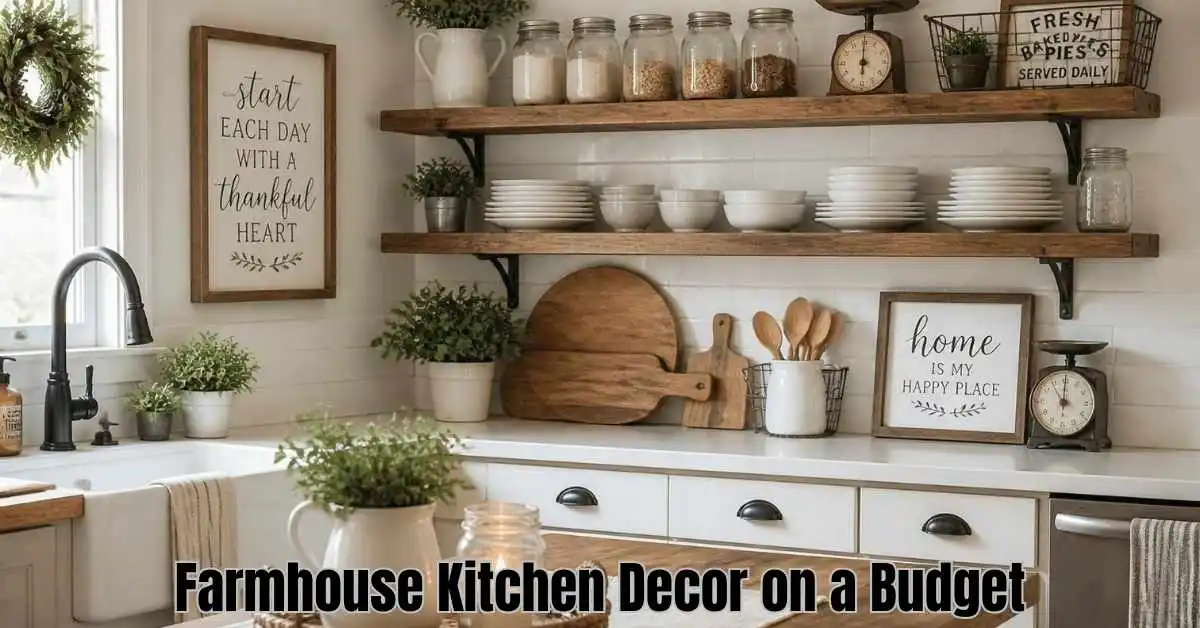
Replacing one or two upper cabinets with open wood shelves saves money on cabinetry and gives you a surface to style. For farmhouse kitchens specifically, open shelving is a core element — it’s where you put the white stoneware, the mason jars, the wooden cutting boards, and the dried herb bunches that make the style work.
A DIY floating shelf from a 1×10 pine board, stained in special walnut and mounted with visible iron pipe brackets, costs roughly $40–$60 per shelf and looks like a deliberate design choice, not a budget compromise. If you want a more polished finish, sand through 120-grit then 220-grit before staining; the surface takes colour more evenly and the result looks less DIY.
The key measurement: shelves should sit 12–14 inches apart vertically to fit standard plates and mugs without the space feeling cramped.
Cabinet paint: the most dramatic budget change
You don’t need new cabinets. You need the right paint colour and a quality brush.
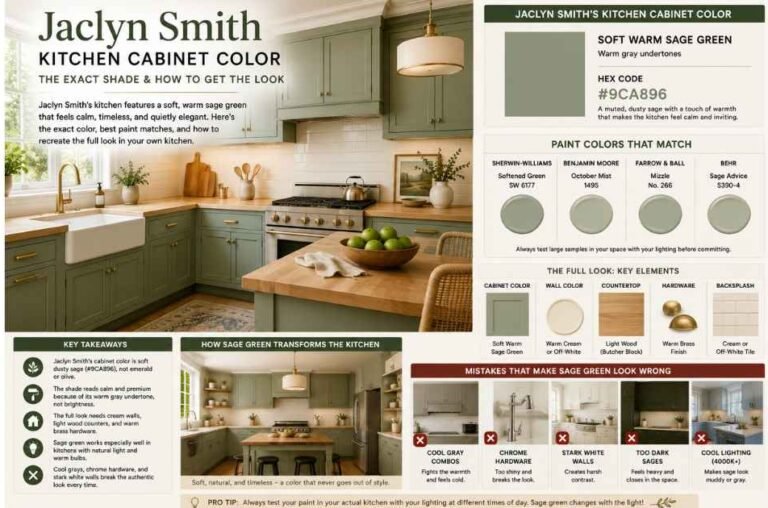
The farmhouse palette for cabinets runs from warm white to soft cream, dusty sage, muted navy, and pale slate. Avoid bright, cool whites — they photograph like a hospital and kill the warmth the style depends on. A colour like Benjamin Moore’s White Dove or Sherwin-Williams’ Alabaster reads warm and calm without tipping into yellow.
If the budget stretches, cabinet refacing — replacing only the door fronts, not the boxes — typically costs 30–50% less than full replacement and achieves a near-identical result. For a total DIY, repainting existing doors (remove them, sand lightly, prime with a bonding primer, then apply two coats of cabinet-specific alkyd paint) gives a hard, durable finish that holds up to daily kitchen use.
Lighting: the most overlooked farmhouse element
A single bright overhead light flattens a kitchen and wipes out the mood that farmhouse decor depends on. Layer your lighting sources: overhead (ideally a pendant with a cage, dome, or lantern silhouette), under-cabinet strips for task lighting, and at least one warm-toned lamp or candle grouping on the counter.
The bulb colour temperature matters as much as the fixture. A 2700K warm white bulb in a simple pendant does more for a farmhouse feel than a $200 fixture with a daylight (5000K) bulb inside it. I’ve restyled three kitchens where the single biggest transformation came from swapping the overhead bulb and adding a plug-in pendant — a two-hour job that costs under $40.
Budget farmhouse decor that costs almost nothing
The best farmhouse kitchen decor often costs very little. These ideas use what you already have or what you can find for next to nothing.
Everyday items as decor
Farmhouse kitchens are unpretentious by design. Your daily dishes, a row of mismatched coffee mugs, a wooden spoon tucked into a crock — these are genuinely on-brand. Displaying functional items as decor is not a workaround; it’s the point. A stack of white plates on an open shelf, slightly varied in size, looks intentional. A collection of Ball mason jars used for dry goods costs nothing if you already own them.
Dried botanicals and foraged greenery
Dried hydrangeas, eucalyptus, lavender bunches, and wheat stalks are some of the most effective farmhouse decor elements you can add to a kitchen — and many are free if you have a garden. Cut stems in late summer, hang them upside down for two weeks to dry, then arrange in a stoneware jug or galvanised metal bucket. The texture and muted colour they bring reads as expensive; the cost is essentially zero.
Thrift and flea market finds
Antique stores and flea markets are better farmhouse supply shops than any home goods retailer. A genuine vintage enamelware pot, a weathered wooden bread box, or a set of hand-thrown ceramic bowls found secondhand carries the patina and character that new “rustic” decor tries and fails to replicate. Budget about $20–$40 for a thrift haul and prioritise pieces in natural materials — ceramic, wood, iron, glass, linen — over plastic-based items styled to look rustic.
Printable farmhouse wall art
Simple black-and-white prints in thrifted frames cost almost nothing and fill wall space that would otherwise look bare. Look for botanical illustrations, vintage seed catalogues, or simple typographic prints. Frame consistency matters more than print style; a set of three matching frames at different sizes reads as deliberate.
Materials that define the farmhouse kitchen look
| Material | Best use | Budget range | What to avoid |
| Shiplap (real or peel-and-stick) | Accent wall, island cladding | Low–medium | Overuse on all four walls |
| Reclaimed/pine wood | Shelving, island top | Low | Unfinished wood near water/sink |
| Jute / sisal | Runner rug, basket liners | Very low | Light colours near high traffic |
| Linen | Curtains, hand towels, cushions | Low | Stiff synthetic “linen look” fabric |
| Matte ceramic / stoneware | Display, everyday dishware | Low–medium | High-gloss glazed ceramics |
| Rattan / wicker | Baskets, pendant shades | Low | Overly uniform, mass-produced shapes |
| Iron / matte black metal | Hardware, light fixtures, rails | Low–medium | Brushed chrome or polished nickel |
| Butcher block | Island top, small cutting section | Medium | As the primary countertop without sealing |
The Layered-Zone Method: a budget farmhouse framework
Most farmhouse kitchens that feel disjointed aren’t missing more decor — they’re missing structure. The Layered-Zone Method divides your kitchen into three visual zones and gives each one a distinct farmhouse job. Working zone by zone stops the “too much going on” effect that happens when budget decorating gets added all at once without a plan.
Zone 1 — The working surface (counters and backsplash). Keep it functional and purposeful. A wooden cutting board leaned against the backsplash, a crock of utensils, a small herb pot in a terracotta container. Nothing should be purely decorative here; everything earns its place by being used.
Zone 2 — The display layer (open shelves, upper cabinet tops, window ledge). This is where intentional styling lives. Stack white plates, arrange mason jars by height, add one or two small framed prints. Leave breathing room — 30–40% of each shelf surface should be empty to avoid the cluttered look.
Zone 3 — The atmospheric layer (lighting, textiles, botanicals). This zone does the most for the least money. A linen curtain panel diffusing afternoon light, a dried botanical arrangement, a jute rug underfoot, a warm-toned pendant — these elements set the emotional register of the room. No piece in this zone needs to be expensive; a single linen dish towel hung from the oven handle costs $8 and is immediately readable as farmhouse.
Mini case study: I restyled a 9×11 rental kitchen using this framework on a $130 budget over one Saturday. The working surface got a wooden board, a white ceramic crock, and a small cast-iron skillet displayed on the stove. The one open shelf got four mismatched thrifted stoneware bowls and two mason jars of dried herbs. The atmospheric layer got a $14 linen curtain panel (thrifted), a dried lavender bunch ($0, from the garden), and a plug-in warm-toned pendant ($34). The result looked like a $3,000 renovation. The hardware cost nothing — the existing pulls were brushed nickel, which I spray-painted matte black in an afternoon.
Cost breakdown: farmhouse kitchen decor by budget tier
| Budget tier | What it covers | Expected impact |
| Under $50 | Hardware swap (knobs/pulls) + one botanical arrangement + printable art | Immediate, noticeable |
| $50–$150 | Hardware + one linen textile + thrift haul + one pendant bulb swap | Strong room-shift |
| $150–$400 | Hardware + open shelving (one set) + cabinet paint (doors only) + lighting | Near-total transformation |
| $400–$800 | All of the above + a DIY kitchen island or butcher block countertop section | Structural, lasting |
Common farmhouse kitchen decorating mistakes — and how to fix them
Buying new “farmhouse” decor instead of real vintage pieces
Mass-market farmhouse decor — the galvanised metal signs, the “GATHER” lettering, the perfectly distressed crate — is immediately readable as imitation. It lacks the weight, the irregularity, and the patina of genuine vintage pieces, and it dates a room faster than almost any other decorating choice.
The fix is simple: shop thrift stores, flea markets, estate sales, and online secondhand platforms before buying anything new. A real stoneware crock found for $4 beats a factory-distressed reproduction at $40 every time. Genuine farmhouse decor looks genuine because it is.
Using too many textures without a material anchor
Farmhouse style embraces texture — linen, jute, rattan, wood, iron, ceramic — but only when those textures are anchored to a consistent colour story. When every surface is a different texture and a different tone, the result reads as cluttered rather than layered.
The material anchor rule: choose one primary surface material (almost always wood) and one primary colour anchor (almost always a warm white or cream), then let every other texture and colour relate back to those two. A jute rug relates to wood floors. An iron pendant relates to matte black cabinet pulls. Rattan basket liners relate to the woven texture in the linen curtains. Coherence creates calm.
Reader objection 1: “Won’t open shelves make my kitchen look messy?” Only if you skip Zone 2 discipline. The key is negative space: leave a third of each shelf empty, group items by height and material, and rotate what’s displayed seasonally so it never looks static. A shelf with four white bowls, two mason jars, and empty space behind them is calm and intentional. A shelf crammed to the edges is chaos regardless of how nice each individual item is.
Reader objection 2: “I’m a renter — can I actually do any of this?” Most of it, yes. Hardware swaps are reversible (keep the originals in a bag and reinstall before you leave). Peel-and-stick shiplap panels are removable. Freestanding shelving units require no drilling. Linen curtains hang from existing rods. Lighting pendants can be plug-in, not hardwired. The main no-go for renters is cabinet painting — but cabinet paint-over contact paper exists as a removable workaround for determined renters.
Reader objection 3 (the mistake I see most): Prioritising the backsplash over the lighting. A new tile backsplash is beautiful, but it costs hundreds of dollars installed and won’t do what a warm pendant bulb does in the same room for $8. Always fix the lighting first. It’s reversible, it’s cheap, and it changes everything that comes after.
FAQs
How do I make my kitchen look farmhouse on a budget?
Start with hardware (pulls and knobs in matte black or aged brass), add one linen textile, and swap any overhead bulb to 2700K warm white. These three changes cost under $70 combined and shift a kitchen’s feel immediately. Add open shelving and thrifted stoneware as the budget allows.
What colours are used in farmhouse kitchen decor?
The farmhouse kitchen palette runs from warm white and cream to dusty sage, faded navy, warm grey, and terracotta as accents. The key is warmth — cool greys and bright whites look clinical rather than cosy. Natural wood tones, linen beige, and muted greens anchor most farmhouse palettes.
Is shiplap necessary for a farmhouse kitchen?
No. Shiplap is one option for adding texture, but linen curtains, open wood shelving, and ceramic dishware achieve the farmhouse look without touching the walls. If you want shiplap on a budget, peel-and-stick options exist for renters and temporary applications.
What is the best flooring for a farmhouse kitchen?
Wide-plank wood or wood-look luxury vinyl in a warm oak or pine tone is the most on-brand choice. Engineered bamboo also works well — it has a vintage character and sits at a lower price point than solid hardwood. If the floor can’t be changed, a large jute or sisal runner brings farmhouse warmth without touching the existing surface.
How do I style open shelves in a farmhouse kitchen?
Group items by material and height. White stoneware and ceramic together, wooden pieces together, glass mason jars together. Leave 30–40% of each shelf empty. Add one small botanical or framed print per shelf for personality. Rotate the display every few months to keep it feeling intentional.
Can I get a farmhouse kitchen look in a rental?
Yes. Focus on removable changes: swap hardware (keep originals), hang linen curtains, add a freestanding shelf unit, use a plug-in pendant instead of a hardwired light, and style counters and open surfaces with thrifted farmhouse pieces. Peel-and-stick tiles and removable wallpaper can also add a farmhouse backsplash without permanent installation.
The farmhouse kitchen you want is closer than you think
Farmhouse kitchen decor on a budget is not about settling for less — it’s about understanding which changes matter most and where to spend your money first. A $12 hardware set and a $8 lightbulb will outperform a $200 “rustic” sign every time. Real vintage pieces outperform manufactured farmhouse decor. And layered textures anchored to a consistent material palette always beat random accumulation.
Start with the Layered-Zone Method, fix the lighting first, and add one element at a time. The style rewards patience and resourcefulness — which is exactly how it was designed to work.
For more room-by-room decorating guides built on real experience (not just pretty pictures), explore more at HomeDecorIdeas.it.com.