Guests coming tomorrow and you just realized your second bathroom has one towel, a sliver of soap, and no backup toilet paper. It happens. But the real discomfort isn’t the missing items — it’s the moment a guest has to knock on the door and ask for something basic. That moment costs more in social friction than any of those supplies would have.
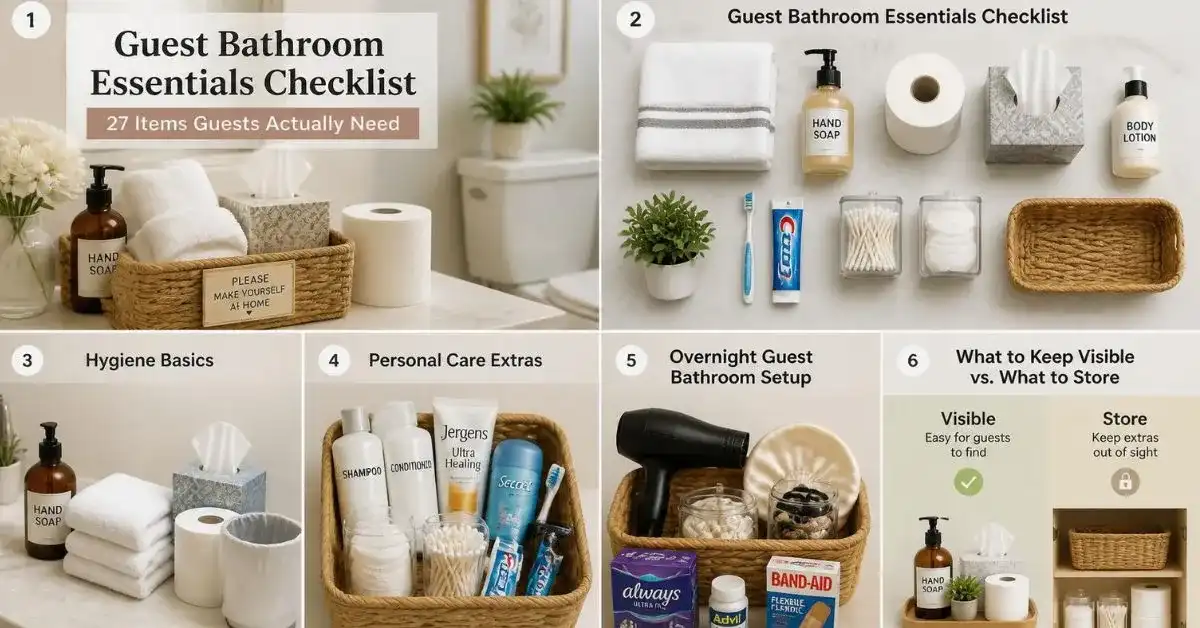
A good guest bathroom essentials checklist solves this before anyone arrives. This one covers 27 items organized by category and priority, so you can stock the space once and trust it to handle itself. The distinction between what guests can see immediately and what they’d have to ask for matters as much as the list itself — and the placement section is where most setups go wrong.
Key takeaways:
- A guest bathroom needs items in three zones: visible on the counter, accessible in an open basket, and stored for overnight stays
- Extra toilet paper should always sit on or beside the tank — never under the sink behind other things
- Stock one bath towel, two hand towels, and one washcloth per guest minimum
- Feminine hygiene products belong in a clearly visible spot, not behind a closed cabinet door
- A small open tray or basket on the counter signals to the guest that the items are there for their use
What does a guest bathroom essentials checklist actually cover
A guest bathroom essentials checklist is a complete inventory of toiletries, linens, and functional items that lets a guest use the space independently without asking the host for anything. The goal isn’t luxury — it’s self-sufficiency. A well-stocked guest bathroom handles both a quick afternoon visitor and someone staying two or three nights, with the same physical setup.
Day guests vs overnight guests: why it matters
A day guest needs hand soap, a clean hand towel, and accessible toilet paper. That’s the actual minimum. Overnight guests need more: shower products, dental items in case they forgot theirs, and personal care products that feel particularly awkward to request — feminine hygiene, pain reliever, deodorant. Setting up for both is possible with the same bathroom. It just requires thinking carefully about what’s visible versus what’s stored.
Why “just ask if you need anything” doesn’t work
Telling a guest to ask sounds hospitable. In practice, most people won’t — not for a spare toothbrush, not for pain reliever, and especially not for feminine products. The more personal the item, the more likely a guest is to quietly do without rather than knock on a door. Stocking the bathroom removes that decision entirely, which is the more considerate move.
The guest bathroom essentials checklist
Here are all 27 items, organized into four categories by type and use. Each category has a priority level — meaning how quickly a guest needs to be able to find it — which the display section below turns into a specific placement. Use this as a working reference and go through the categories in order.
Hygiene basics
These seven items are the non-negotiable core. No guest bathroom should be without all of them, regardless of the length of the stay.
- Hand soap: A pump-style liquid soap is more hygienic than a shared bar. Refill it before any guest arrives, even if it seems nearly full.
- Bath towels: One per guest, freshly laundered. Fold them or hang them in a visible spot so the guest knows they’re intended for use, not on the host’s regular rotation.
- Hand towels: Two per guest for any stay longer than a few hours. A single damp hand towel by the second visit is a small detail that registers.
- Washcloths: One to two per guest. Many people don’t use them, but guests who do will feel awkward asking.
- Toilet paper: One roll on the holder, plus two or three extras visible nearby — on the tank, in a basket beside the toilet, or in a standing holder. Never under the sink.
- Facial tissues: A small box on the back of the toilet or on the counter.
- Trash can with liner: A small bin within reach of both the toilet and the vanity. A liner that doesn’t require guests to dig around underneath it.
Personal care extras
These eight items address what guests most commonly forget or run out of during a visit.
- Shampoo and conditioner: Travel-size bottles feel deliberate and personal. Make sure they’re at least half full — a nearly empty bottle is worse than no bottle at all.
- Body wash: Separate from hand soap. A fresh bar of soap in a clean dish also works, but it should be new for each guest rather than a shared household bar.
- Hand lotion: A small pump bottle beside the sink. Many people apply lotion after every hand wash and won’t have their own when visiting.
- Cotton rounds: A small open pot or jar on the counter.
- Cotton swabs: A small jar or dispenser. Used far more often than most hosts expect.
- Dental items: A few sealed disposable toothbrushes and a small tube of toothpaste. Forgetting a toothbrush is one of the most common overnight oversights.
- Disposable razor: One or two for guests who may have left theirs at home.
- Travel-size deodorant: Not necessary for day visits, but appreciated for any stay longer than one night.
Overnight and extended stay additions
These seven items separate an adequate guest bathroom from a comfortable one for stays of two or more nights.
- Hair dryer: Not every guest travels with one. Store it on a hook under the sink or in a clearly visible spot — guests shouldn’t have to search for it after a shower.
- Hair ties and bobby pins: A small dish or jar on the counter. Guests with long hair will quietly appreciate these.
- Feminine hygiene products: Tampons and pads — both types — in a visible open basket. This is the item guests most need and feel most reluctant to ask for. It should never be in a closed cabinet.
- Shower cap: One or two for guests who don’t want to wet their hair.
- Makeup remover wipes: Individually sealed wipes or a small stack near the mirror.
- Pain reliever: Ibuprofen, paracetamol, or both. A small labeled jar on a shelf or in the open basket.
- Adhesive bandages: A small tin or a few loose ones in the basket. They take up almost no space.
Comfort and ambiance
These five items shift the bathroom from functional to welcoming. None of them are strictly necessary, but they’re each worth the small effort.
- A good mirror: The main bathroom mirror usually covers it. A small magnifying mirror on the counter adds real utility for makeup, grooming, or contact lenses.
- Adequate lighting: If the overhead light is harsh or dim, a warmer bulb or a small plug-in light changes how the whole room feels. Soft, warm light at around 2700K is worth the five-minute swap.
- Light scent: A reed diffuser, a candle, or a room spray with a clean neutral scent. I steer toward unscented or very lightly scented — heavy florals in a small bathroom can feel overwhelming rather than welcoming.
- A small tray or open basket: Groups the counter items into a purposeful arrangement. It signals to the guest that these things are there specifically for them.
- A hook or towel bar at accessible height: Somewhere logical to hang a towel while showering that isn’t draped over the toilet or wedged onto a door hinge.
How to stock, display, and store guest bathroom items
Buying the right 27 items and hiding half of them behind a closed cabinet door is one of the most common guest bathroom setup failures. What goes on the counter, what goes in an open basket, and what goes into storage isn’t a small detail — it determines whether a guest can actually use what you’ve provided without asking.
What to keep visible vs what to store
The core rule: anything a guest would feel embarrassed to ask for should be visible and reachable without opening a cabinet. Anything personal but not embarrassing can go in an open basket they can see into. Anything situational belongs in a clearly findable stored spot.
| Item | Where it belongs |
| Hand soap | On the counter, always |
| Extra toilet rolls | On the tank or in an open basket beside the toilet |
| Hand and bath towels | Visible bar, ring, or folded on a shelf |
| Facial tissues | Counter or top of the toilet tank |
| Cotton swabs, cotton rounds, lotion | Open tray or jar on the counter |
| Dental items, razor | Open basket on the counter |
| Feminine hygiene products | Open basket, clearly visible |
| Pain reliever, bandages | Labeled jar on a shelf or in the open basket |
| Shampoo, conditioner | Shower shelf or caddy |
| Hair dryer | Hook or clear spot under the sink |
| Hair ties, bobby pins | Small dish on the counter |
How many of each to stock
Quantities catch people off guard more than the item list itself.
- Bath towels: 1 per guest, plus 1 spare
- Hand towels: 2 per guest per day for multi-night stays
- Washcloths: 1–2 per guest
- Toilet paper: 1 roll on the holder, 2–3 extras visible nearby
- Shampoo and conditioner: enough for at least two washes each
- Feminine products: 4–6 each of pads and tampons as a baseline
Pro tip: Before any guest arrives, do a five-minute walkthrough of the bathroom as a stranger. Open nothing. Just look around. Whatever you can’t immediately see or reach without asking someone — move it. This single habit catches most placement problems before anyone shows up.
Guest bathroom budget breakdown
| Category | Budget tier | Mid-range | Premium |
| Towel set (bath + 2 hand) | $15–$25 | $30–$55 | $65–$120 |
| Basic toiletries (soap, lotion, swabs, shampoo) | $15–$30 | $30–$50 | $50–$80 |
| Overnight extras basket | $15–$30 | $30–$50 | $50–$90 |
| Ambiance (scent, tray, lighting) | $10–$20 | $20–$40 | $40–$80 |
| Total setup | $55–$105 | $110–$195 | $205–$370 |
The Three-Zone Guest Bathroom System
Most of the awkward knocking-on-doors in a guest situation comes not from items being missing but from guests not knowing where they are. The Three-Zone System is a simple organization method that maps every item to how quickly a guest needs to find it — without hunting, without opening cabinets, and without asking.
Setting it up takes five steps:
- Clear the counter and the under-sink area of non-guest items — cleaning products, bulk supplies, anything household
- Place Zone 1 items (hand soap, folded towels, toilet paper with visible extras, tissues) in immediately visible positions
- Fill an open basket with Zone 2 items: cotton swabs, cotton rounds, lotion, dental items, razor, feminine hygiene products, pain reliever, bandages
- Store Zone 3 items (hair dryer, spare washcloths, shower cap) in the most accessible spot under the sink or on a visible shelf, facing outward
- Sit on the toilet, stand at the mirror, scan the room. Anything that takes more than a glance to find — move it
Zone 1 — Always visible: Hand soap, folded towels, toilet paper extras, tissues. These belong on the counter, the tank, or a visible shelf. A guest should spot them within two seconds of walking through the door.
Zone 2 — Clearly accessible: An open basket or shallow tray on the counter or tank containing cotton swabs, lotion, dental items, razors, feminine products, pain reliever, and hair ties. The basket should look inviting — not like a utility drawer pulled from a stock cupboard.
Zone 3 — Stored but findable: Hair dryer, extra towels, spare products. These should be locatable in under 30 seconds without opening more than one door. A labeled bin or a hook inside the cabinet door works well for the hair dryer specifically.
Mini case study: Before a long weekend with family — two adults, two nights, one 5×8 guest bathroom — I built the full setup with a $52 run to a pharmacy and a discount store. One afternoon. Zero requests during the entire stay. The near-miss: the pain reliever was stored behind a stack of spare washcloths in the cabinet instead of in the Zone 2 basket. One guest had a headache the second night and didn’t want to wake anyone to ask. Moving it to the basket costs nothing and takes ten seconds. I haven’t stored it anywhere else since.
Guest bathroom setup mistakes to avoid
Getting the checklist right is only half the work. These errors don’t involve buying the wrong things — they involve putting the right things in the wrong places. Each has a direct fix that takes under five minutes.
Putting the backup toilet paper under the sink
Extra rolls hidden behind cleaning products under the sink is the single most common guest bathroom mistake, and the one with the most immediate consequences. A guest who runs out of toilet paper and can’t find a backup has to call out or make an awkward shuffle to the vanity.
Fix: Move all spare rolls to a floor-standing holder, an open basket beside the toilet, or directly on the tank — somewhere clearly visible from a seated position.
Buying items and storing them behind a closed door
Purchasing hand lotion, cotton swabs, feminine products, and dental items — then putting all of them in a closed medicine cabinet — means most guests won’t find or use them. People don’t open medicine cabinets in someone else’s home without being told to. It feels intrusive even when they need something badly.
Fix: Everything intended for the guest lives in an open basket or a visible tray, never behind a closed door. A closed cabinet signals private storage. An open basket signals this is for you.
Sharing household storage with guest items
A guest bathroom that doubles as everyday household storage — cleaning products, bulk refill bottles, spare batteries — reads as a utility closet. Guests feel like they’re rummaging through someone’s personal things.
Fix: Before guests arrive, move non-guest items to another bathroom or hallway cupboard. Keep the counter, the tank top, and the under-sink area guest-exclusive.
Objection: My guest bathroom is tiny — I don’t have room for all of this. A 5×8 bathroom handles this entire list. Zone 1 and Zone 2 items consolidate into one small tray on the counter. Zone 3 items fit in a clear bin under the sink, facing outward. A wall hook or an over-door hook adds towel storage without taking any floor or counter space. The list is longer than the space requirements.
Objection: Maintaining this full-time seems expensive. The toiletry items — cotton swabs, razors, travel bottles — cost under $30 for the initial setup and very little to replenish. Feminine hygiene products keep indefinitely. Pain reliever has a long shelf life. The main recurring cost is laundering towels and replacing soap, which amounts to a few dollars per visit at most.
FAQs
What should I stock in a guest bathroom?
Start with the seven hygiene basics: hand soap, one bath towel and two hand towels per guest, toilet paper with visible extras, facial tissues, and a trash can. Then add personal care items (shampoo, lotion, cotton swabs, dental items) and overnight additions (feminine products, pain reliever, hair dryer) scaled to how long guests are staying.
What do you put in a guest bathroom basket?
An open guest basket should hold cotton swabs, cotton rounds, a sealed disposable toothbrush, a small toothpaste, a razor, hand lotion, feminine hygiene products, pain reliever, and a few adhesive bandages. Keep it open and visible — a lidded basket defeats the purpose because guests won’t look inside without being invited to.
Do you need travel-size toiletries for a guest bathroom?
Travel sizes work well because they feel deliberate and don’t require guests to pour from a household bottle. But full-size products in a pump dispenser work just as well, as long as they’re clearly set aside for guest use and not shared with everyday household routines.
How often should you restock a guest bathroom?
Check and restock after every guest visit: swap towels for laundered ones, refill soap dispensers, confirm toilet paper is at full stock. Check expiry dates on pain reliever and first aid items once or twice a year.
How do you set up a guest bathroom in a small space?
Limit the counter to one small tray grouping Zone 1 and Zone 2 items together. Mount a hook on the back of the door for towels. Keep Zone 3 items in a clear bin under the sink, facing outward so they’re visible without digging. The Three-Zone System scales down to any footprint without losing anything.
Pulling it together
A guest bathroom essentials checklist isn’t about overstocking — it’s about removing every moment where a guest has to ask for something or quietly go without. The 27 items above cover every scenario from a half-hour afternoon visit to a multi-night stay. Stock them once, arrange them across three zones, and the bathroom handles itself.
The single most useful next step: spend five minutes in your guest bathroom, open nothing, and see what you can or can’t immediately find. Whatever is hidden — move it.
For more room-by-room hosting guides and practical setup advice, HomeDecorIdeas covers guest bedroom checklists, entryway essentials, and everything that makes hosting feel considered rather than scrambled.