Storage ottomans promise to solve two problems at once — extra seating and hidden storage — but most buying guides skip the part that actually determines whether one works in a small space: the dimensions. A 35-inch square ottoman that looks compact in a product photo takes up as much floor area as a small armchair. A 15-inch cube that fits anywhere holds barely more than a shoebox. The best storage ottomans for small spaces are the ones sized correctly for the room and matched to the right use case — coffee table replacement, foot rest, extra seating, or bedroom bench — before style enters the conversation. This guide covers what to measure, how to match shape to function, and how to compare upholstery without getting burned by a fabric choice that looks great at purchase and embarrasses you six months later. The mistake in the last section is the one that generates the most returns.
Key takeaways:
- Leave at least 18 inches of clearance between a storage ottoman and surrounding furniture — tighter than that and the lid can’t open fully or the space feels blocked
- Cube ottomans (15–18 inches square) suit corners, bedrooms, and beside armchairs; rectangular bench ottomans (30–48 inches wide) work as coffee table replacements in small living rooms
- Foldable fabric ottomans store flat when not needed — ideal for studios and multi-purpose rooms; rigid upholstered frames stay out permanently
- Weight capacity matters if the ottoman will double as seating: aim for 250 lbs minimum for a single adult, 500+ lbs if two people will sit on it simultaneously
- Performance fabrics (polyester-blend or solution-dyed microfiber) outperform plain linen and cotton velvet in high-use positions; reserve natural-fiber options for low-traffic rooms
- An ottoman used as a coffee table should sit 1–2 inches below the seat height of the adjacent sofa — typically 16–18 inches tall
What a storage ottoman actually does in a small space
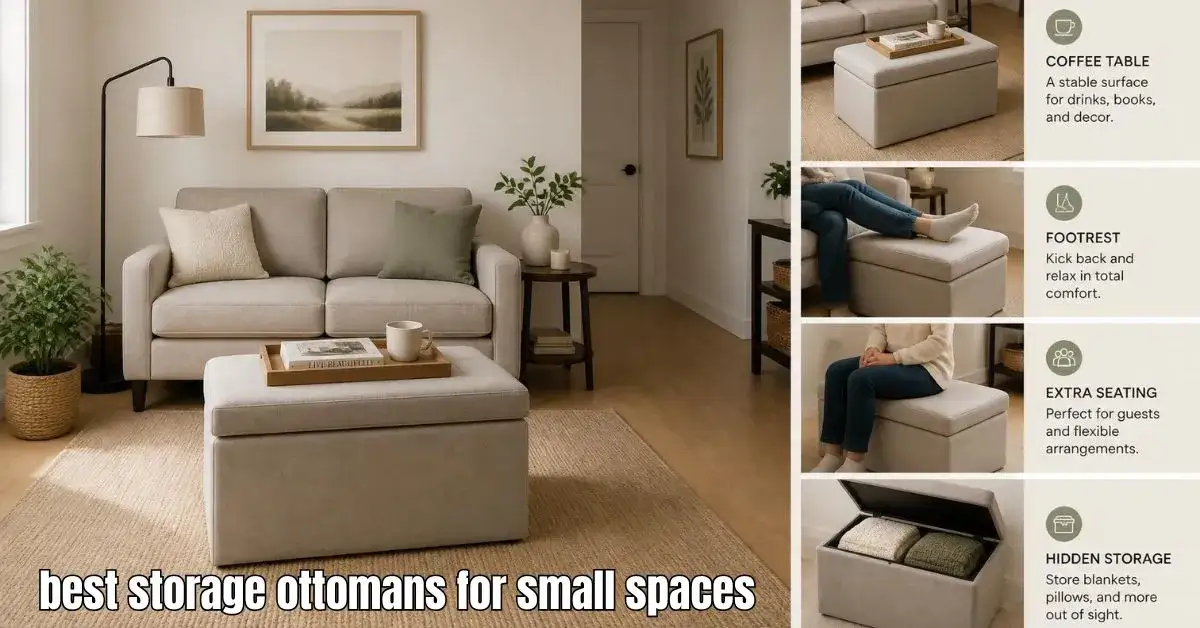
A storage ottoman in a small space functions as concealed storage, occasional seating, a footrest, and sometimes a surface — all from a single piece that’s smaller than the alternatives it replaces. It’s not a chest of drawers, it’s not a coffee table, and it’s not a bench in the traditional sense. It occupies the living room center or bedroom foot or entryway corner and does more jobs per square foot than almost any other furniture piece.
That versatility is also the source of confusion. An ottoman chosen as a footrest will disappoint as a coffee table. One chosen for maximum storage capacity in a small cube footprint will feel cramped when guests try to use it as seating. The right choice starts with identifying the primary job — the function the ottoman performs most of the time — and letting everything else follow.
The four jobs a storage ottoman can do
A storage ottoman can serve as a coffee table replacement (placed in front of a sofa at seat height, used as a surface with a tray), a footrest (positioned in front of a single chair or end of a sofa), additional seating (pulled out for guests and sat on directly), or a bedroom bench (placed at the foot of the bed to hold folded blankets, extra pillows, or clothing). Most ottomans do two of these four jobs well. Very few do all four equally well, and buying one that promises all four often means getting none of them right.
Shapes and sizes: which storage ottoman works where
Shape and footprint determine whether a storage ottoman actually fits a small space or simply fits through the door. Before choosing a shape, measure the intended floor area and mark the ottoman’s footprint with tape. Walk around it. Open a simulated lid. If you feel cramped, the ottoman is too large.
Cube ottomans (15–20 inches square)
Cube ottomans are the most versatile shape for small spaces because their equal dimensions work as side tables, footrests beside armchairs, and supplemental seating. A standard cube runs 15–18 inches square and 15–18 inches high. Interior storage, once the frame and foam lid are subtracted, typically measures 12–14 inches square and 10–12 inches deep — enough for folded throw blankets, a few paperbacks, or a set of board games.
A 17-inch cube tucked beside an armchair uses less floor space than a lamp table and eliminates the lamp table entirely if a floor lamp is used instead. Two matching cubes under a console table in an entryway create shoe storage that disappears when guests arrive.
Limitation: cube ottomans hold less than they appear to. The interior dimensions are significantly smaller than the exterior. If storage capacity is the primary goal, a bench ottoman with the same exterior width stores considerably more.
Rectangular bench ottomans (30–48 inches wide)
A rectangular ottoman at 30–48 inches wide and 15–18 inches deep works as a small-space coffee table replacement when it’s positioned 16–18 inches in front of a sofa at matching seat height. Add a rigid serving tray on top for drinks and remotes, and the ottoman functions as both a table surface and hidden storage below.
At 43 inches wide, a bench ottoman spans roughly two-thirds of a standard 72-inch loveseat — the right visual proportion. At 48 inches, it reads as a primary table for a small sofa. The interior of a 43×15-inch bench typically holds 25–35 gallons of items, significantly more than a cube at similar height.
For a bedroom, a bench ottoman 30–36 inches wide at the foot of a queen bed uses space that would otherwise be wasted while holding off-season pillows, extra blankets, or folded clothing.
Pro tip: Measure the depth of the bench ottoman carefully, not just the width. A 48-inch-wide bench that’s 20 inches deep takes up substantially more floor area than a 48-inch bench that’s 15 inches deep. In a small living room, those 5 inches make a real difference in traffic flow.
Round ottomans (18–28 inches diameter)
Round ottomans work in spaces where a corner or awkward angle makes rectangular furniture feel forced. A 24-inch round ottoman at 15–17 inches high functions as a footrest or coffee table for two chairs facing each other at an angle — situations where a rectangular ottoman would feel directional and stiff.
Round ottomans hold less than rectangular ones of comparable price because the circular interior wastes more structural space. A 24-inch round typically stores 15–20 gallons. Choose round for visual softness and placement flexibility; choose rectangular when capacity or surface area matters more.
Foldable fabric ottomans
Foldable storage ottomans — typically rectangular, covered in linen-look fabric over a collapsible frame — fold flat to a few inches of thickness when empty. This is the genuine small-space advantage: they disappear into a closet or under a bed when not in use, then set up in under a minute with no tools.
Their limitation is rigidity. A foldable ottoman with an MDF bottom panel supports up to 660 lbs according to most manufacturers’ static ratings, but the frame feels less stable than a solid wood-framed upholstered piece and flexes noticeably when used as a step or sat on repeatedly over time. Use foldable ottomans for storage and occasional light seating; don’t rely on them as primary daily seating.
How to choose upholstery for a storage ottoman
Upholstery is where most storage ottoman purchases go wrong. The fabric visible in a product photo and the fabric that holds up to 18 months of daily use are often very different things.
Match the fabric to the room’s traffic level
Performance fabrics — solution-dyed polyester blends, microfiber, and performance velvet — resist stains, crush less under repeated use, and clean with a damp cloth. These are the right choice for any ottoman in a high-traffic living room, a family space with kids or pets, or an entryway. Tight-weave performance fabrics also resist snags from pet claws better than looser weaves.
Plain linen and natural-fiber cotton velvet look beautiful and feel soft but stain easily, crush at contact points within months of daily use, and typically carry a “dry clean only” care code that makes spot cleaning a real problem. Keep these fabrics for low-traffic bedrooms or formal rooms where the ottoman is more accent piece than workhorse.
Faux leather (PU leather or bonded leather) wipes clean in seconds and works well in entryways and kitchens. Genuine top-grain leather ages well but costs significantly more. Avoid bonded leather on any piece that will see frequent use — bonded leather peels at seams and contact points within a few years, and there’s no repair once it starts.
Upholstery fabric comparison
| Fabric type | Durability (daily use) | Stain resistance | Pet / kid household | Cleaning |
| Performance polyester blend | Excellent | Excellent | Best choice | Damp cloth / spot clean |
| Performance velvet | Very good | Very good | Good | Damp cloth / spot clean |
| Microfiber | Very good | Very good | Good | Damp cloth / spot clean |
| Faux leather (PU) | Good | Excellent | Good (no fur snag) | Wipe clean |
| Cotton velvet | Fair | Poor | Not recommended | Often dry-clean only |
| Plain linen | Fair | Poor | Not recommended | Water-spots; dry clean |
| Genuine leather | Excellent | Very good | Good (wipe clean) | Wipe + condition |
Color and pattern for small spaces
Dark solid upholstery (charcoal, navy, forest green) reads as a deliberate accent piece and hides everyday marks well. Light solid upholstery (cream, warm white, pale linen) reads as more airy and spacious but shows marks faster. A medium warm neutral — a warm putty, soft taupe, or greige — is the most practical choice for a central piece in a small room because it reads quietly against most sofa and rug combinations without disappearing.
Patterned upholstery on a storage ottoman used as a coffee table in a small room is a large risk. A bold pattern on the visual center of a small living room dominates the space and limits future furniture choices. Save pattern for accent pieces at the room’s edge.
Sizing guide, storage capacity, and what it actually fits
Most buyers focus on the ottoman’s exterior dimensions and forget to check what the interior actually holds once the frame, foam, and lid structure are subtracted.
Storage ottoman size and capacity comparison
| Shape | Typical exterior dims | Interior capacity | Fits (examples) |
| Small cube | 15–17 in sq × 15–17 in H | 8–12 L (2–3 gal) | Remote controls, a book, one small blanket |
| Standard cube | 18–20 in sq × 17–18 in H | 20–30 L (5–8 gal) | 2–3 folded throws, board game, shoes |
| Round (small) | 18–20 in diameter × 15–17 in H | 15–20 L (4–5 gal) | Small items, one folded blanket |
| Round (medium) | 24–28 in diameter × 15–17 in H | 25–40 L (7–10 gal) | 2–3 throws, pillows, light seasonal items |
| Bench (compact) | 30–36 in × 15 in × 15 in H | 40–60 L (10–15 gal) | Blankets, pillows, magazines, light gear |
| Bench (standard) | 43–48 in × 15–18 in × 16–18 in H | 100–150 L (25–40 gal) | Full set of bed pillows, seasonal items |
| Foldable bench | 43 in × 15 in × 15 in H (folded flat) | ~130 L (35 gal) | Bulky items; collapses for storage |
A quick checklist before buying any storage ottoman:
- Measure the floor footprint with tape and walk around it — does 18+ inches of clearance remain on all sides?
- Check whether the lid is hinged (stays attached, opens to one side) or lift-off (removes completely) — hinged is easier for daily-access items
- Verify the weight capacity if it will double as seating — minimum 250 lbs for one adult
- Check the interior dimensions, not just exterior — most product pages list both
- Confirm the upholstery care code: W (water clean) is easier than S (solvent only)
- If foldable, check the assembled height matches your sofa’s seat height if used as a footrest (should be 1–2 inches below seat height)
The Footprint-Function-Fabric method for storage ottoman buying
Every storage ottoman purchase that goes wrong can usually be traced to a decision made in the wrong order. I call the correct sequence the Footprint-Function-Fabric method, and it reframes the buying process as a set of filters rather than a simultaneous comparison of every variable at once.
Footprint first: Measure the space the ottoman will occupy. Mark it on the floor with painter’s tape and live with that outline for a day. Add 18 inches of clearance on each passable side. This filter eliminates more than half the options on any product page immediately, which is useful — most people who feel overwhelmed by the choice are trying to evaluate style, size, and function simultaneously. Footprint narrows it first.
Function second: Identify the primary job. Coffee table replacement? Rectangular bench at seat height. Bedroom foot bench? Narrower bench at 30–36 inches. Flexible seating for a studio? Foldable cube or bench that stores flat. Corner accent beside a chair? Cube or round. Once the function is clear, the shape and dimensions follow logically, and there are usually only two or three categories left to compare.
Fabric third: Only after footprint and function are settled does fabric enter the decision. At this stage, assess the room’s traffic level (high, medium, or low), whether there are kids or pets, and whether the ottoman will be a daily surface contact point or an accent piece. Match the fabric category to that profile using the table above.
The case study: a 320 sq ft studio apartment, $94 total, one decision
A studio with a loveseat, a small desk, and no room for a separate coffee table or storage chest. The existing setup: a large floor basket holding blankets that ate the only useful corner. A dedicated shoe rack that blocked the entry. Two end tables beside the loveseat that took up proportionally too much floor area.
Footprint assessment: a tape outline showed the floor in front of the 60-inch loveseat could hold an ottoman 36 inches wide and up to 16 inches deep without blocking movement to the desk. Function assessment: primary use was coffee table replacement with storage underneath, secondary use occasional extra seating for one person.
Solution: a 36×16-inch rectangular bench ottoman with hinged lid, performance-fabric linen-look upholstery in warm putty, and tapered wood legs at 17 inches tall — 1 inch below the loveseat’s seat height. Interior: approximately 50 liters, which absorbed the entire floor basket’s contents plus the entry shoe rack’s contents in a single compartment.
Total cost: $94. Floor space reclaimed: the basket corner (4 square feet) and the shoe rack zone (3 square feet). Three pieces of furniture replaced by one in seven square feet total. The studio gained a visible path from the entry to the desk that hadn’t existed before.
Common mistakes when buying storage ottomans for small spaces
Choosing a lift-off lid for daily-access storage
A lift-off lid (the entire top lifts away as a separate piece) requires somewhere to set it down every time you open the ottoman. In a small space, that somewhere is usually the floor or the sofa cushion — which means the lid gets in the way constantly. Hinged lids fold back on themselves and stay attached. For anything accessed daily, a hinged lid is significantly more practical.
Fix: check the product’s “lid type” specification before buying. If it says “removable lid” or “lift-off top,” that’s a lid you’ll need to put somewhere every time. If it says “hinged lid” or “flip-top hinge,” the lid stays on the ottoman when open.
Buying by exterior dimensions without checking interior capacity
An 18-inch cube ottoman with a 2-inch thick padded lid, 1.5-inch foam walls, and a 1-inch MDF base has an interior cavity of roughly 12–13 inches square and 10–11 inches deep. That’s about 10–12 liters, or the equivalent of roughly three folded hand towels. It’s useful but not the storage solution that the exterior dimensions suggest.
Fix: look for the interior dimensions in the product specifications, not just the overall size. If they’re not listed, use this rough rule: subtract 3–4 inches from each exterior dimension to estimate the interior.
“Won’t an ottoman make a small living room feel more cramped?”
An ottoman sized correctly for the space and used in place of a coffee table actually reduces visual clutter because upholstered surfaces read as softer and less visually dense than glass, wood, or metal tables. A rectangular ottoman with a tray on top takes up the same floor space as the coffee table it replaces, but reads as quieter in the room.
Where this backfires: an ottoman that’s too large for the space — more than two-thirds of the sofa’s width — dominates the room rather than completing it. Keep the ottoman’s width at 60–70% of the adjacent sofa’s length for the right visual proportion.
“Won’t the upholstery get dirty and stain?”
It depends entirely on the fabric. A performance-fabric ottoman in a household with kids and a dog holds up to spills wiped within a few minutes with almost no visible mark. A plain linen ottoman in the same household will stain permanently on first contact with coffee or red juice.
Fix: if the ottoman is in a high-traffic position and children or pets are present, only consider performance fabrics or faux leather. The price difference between performance and standard upholstery at the budget-to-mid-range level is usually $15–$30 — a small premium against the cost of replacing a stained piece.
FAQs
What size storage ottoman is best for a small living room?
For a small living room with a 72-inch sofa or loveseat, a rectangular ottoman 36–48 inches wide and 15–18 inches deep reads proportionally right when placed in front of the sofa. Width should be 60–70% of the sofa’s length. Leave at least 18 inches between the ottoman and surrounding furniture for comfortable movement.
Can a storage ottoman replace a coffee table in a small space?
Yes, and it often works better. A bench ottoman at seat height (16–18 inches tall) with a rigid serving tray on top functions as a coffee table with the added benefit of hidden storage underneath. The upholstered surface is also softer and quieter visually than glass or hard-topped tables in tight spaces.
How much weight can a storage ottoman hold?
Most upholstered storage ottomans with solid wood or MDF frames support 250–300 lbs for seated adults. Foldable bench models with reinforced MDF bases are sometimes rated up to 660 lbs static weight. Always check the specific product’s weight capacity if the ottoman will serve as regular seating — ratings vary across a brand’s product line.
What is the best storage ottoman upholstery for families with pets or kids?
Performance polyester blends and microfiber are the most practical choices. Both resist stains, wipe clean with a damp cloth, and resist pet claw snags better than loose-weave fabrics. Faux leather wipes clean instantly but can crack at seams over time. Avoid plain linen and natural cotton velvet — both stain easily and typically carry dry-clean-only care codes.
How do I use a storage ottoman in a small bedroom?
Place a 30–36-inch bench ottoman at the foot of the bed to hold folded throws, extra pillows, or seasonal items. It uses floor space that would otherwise be empty and adds a layer of intentional styling to the room. A 17-inch height reads right at the foot of a standard bed with a mattress and box spring; for a lower platform bed, a 15-inch ottoman sits better visually.
Should I choose a hinged or lift-off lid?
For daily-access storage, always choose a hinged lid. It stays attached to the ottoman when open, so you don’t need to set it somewhere every time. Lift-off lids are fine for seasonal or infrequently accessed storage where the top is removed entirely for an extended period.
Conclusion
The best storage ottomans for small spaces are the ones chosen in the right order: footprint first, function second, fabric third. Get those three decisions right and the specific style almost selects itself from whatever remains.
Start by measuring the intended floor space, marking it out, and verifying 18 inches of clearance on the sides people pass. Then identify the primary job — coffee table, foot bench, extra seating, or bedroom storage. Only then compare upholstery based on the room’s actual traffic level, not on the product photo.
For more small-space furniture guides covering everything from sofa sizing to entryway storage solutions, the HomeDecorIdeas.it.com library covers the full range of decisions that turn a cramped room into a considered one.