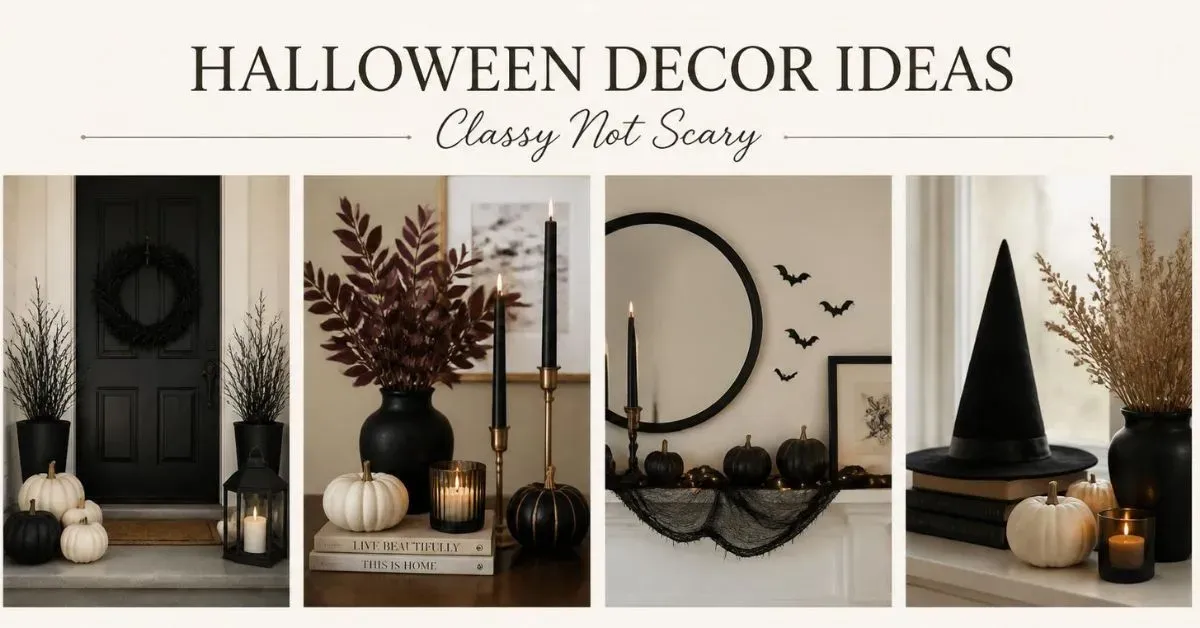
Most Halloween decor lands in one of two camps: cartoonishly cute or actually unsettling. Neither fits if you want a home that feels like October without looking like a costume shop ransacked your living room.
Halloween decor ideas classy not scary work by drawing from the season’s atmosphere rather than its props. Candlelight, dark botanicals, graphic silhouettes, and materials with real visual weight — iron, brass, velvet, dried lunaria, ceramic — create a mood that reads as moody and deliberate, not frightening. And it works alongside your existing decor rather than replacing it. The single decision that separates a sophisticated setup from a cluttered one is covered in the last section, and it costs nothing to fix.
Key takeaways:
- Classy Halloween decor uses atmosphere — candlelight, dark botanicals, moody palettes — rather than explicit seasonal props
- The palette (black, cream, deep burgundy, aubergine, aged brass) does more work than any single object
- One carefully placed sculptural piece reads better than five items of equivalent quality crowded together
- Matte finishes, natural materials, and real or preserved botanicals separate elegant from cheap
- The Three S’s — Silhouette, Substance, Subtlety — work as a repeatable test before buying anything
What makes Halloween decor classy rather than scary
Classy Halloween decor creates atmosphere through restraint, material quality, and implied darkness rather than shock or graphic imagery. It borrows the season’s gothic mood — candlelight, bare branches, shadows — without announcing “Halloween” directly. A well-executed elegant setup feels atmospheric and adult; a guest might call it “moody” or “dramatic” before they’d call it seasonal.
The difference between atmosphere and alarm
Atmospheric decor works on mood. A cluster of pillar candles in iron holders, a bare branch arrangement, a raven silhouette against a pale wall — these suggest something dark and seasonal without stating it. Alarming decor works on surprise: jump-scare figures, graphic gore, hyper-realistic horror props. The first makes a room feel like October. The second makes it feel like a venue.
Classy doesn’t mean stripping out all Halloween references. A single decorative skull in matte ceramic, a framed gothic botanical print, or a dark candle arrangement reads as Halloween. The difference is intent: each piece earns its place through visual weight, not its ability to provoke a reaction.
The palette that does most of the work
Color sets the mood before any object gets a chance to. These palettes work consistently for sophisticated Halloween:
- Black and cream with warm candlelight — the cleanest, most editorial option
- Charcoal and aged ivory with brass or iron accents
- Deep burgundy and black with natural wood tones
- Aubergine and smoky grey with silver details
- Matte black and terracotta with cream — earthier but still restrained
All of these exclude bright orange as a primary tone. Orange signals Halloween immediately, which is exactly what you want if the goal is playful and festive. But it also narrows the interpretation — the arrangement can only mean one thing and has to come down November 1. Use it as a single accent at most: one real pumpkin among cream and black ones, or a dried orange slice scattered through a botanical arrangement.
Classy vs what to avoid: a direct comparison
| Go with | Skip | Why it works |
| Matte white, black, or burgundy pumpkin | Bright orange plastic pumpkin | Matte finish in a restricted palette reads as deliberate, not seasonal |
| Single ceramic or marble skull | Pile of foam skulls | Weight and material; one considered piece over scattered props |
| Iron or aged brass candleholders | Orange plastic candleholders | Material signals quality before anything else |
| Dried lunaria or dark florals | Neon plastic cobwebs | Natural materials lift everything around them; synthetic ones pull everything down |
| Black linen or velvet table runner | Orange and black plastic tablecloth | Fabric texture lifts the entire surface without effort |
| Gothic botanical print in a proper frame | Printed plastic Halloween poster | A real frame makes any print look considered |
| Single raven or crow sculpture | Bag of plastic bats | One sculptural piece carries more weight than a scatter of multiples |
13 classy Halloween decor ideas that aren’t scary
Each of these ideas works as a standalone piece or in combination with one or two others. Every suggestion below includes a specific material, placement note, or detail that separates the elegant version from the forgettable one. Nothing on this list requires a dedicated Halloween shopping trip if you already own a few basic home decor pieces.
Matte-finish pumpkins in a restricted palette
Skip orange and work in white, black, deep burgundy, or cream. Matte-finish pumpkins in these tones read as deliberate decor objects rather than seasonal props. Cluster three on a mantel or console — one large, one medium, one small — with stems intact or replaced with dark wire stems from a craft store. A real grocery store pumpkin takes matte black spray paint in about 20 minutes and costs almost nothing. Two faux matte-finish pumpkins alongside one painted real one, and most people won’t spot the difference.
Pillar candles clustered in iron or brass holders
Three to five pillar candles in varying heights, held in iron or aged brass candleholders, is the single most efficient way to create a Halloween atmosphere without anything explicitly seasonal. The warm flicker, the gathered shadows, the faint scent of burning wax — it all reads as October. Work in three heights: roughly 4-inch, 7-inch, and 10-inch columns in cream or matte black. Set them on a wooden or stone tray to protect the surface from wax and to give the arrangement a defined footprint.
Dried lunaria and bare branches in a tall vase
Lunaria — the dried silver dollar plant — has papery, translucent seed pods that catch candlelight in a way that actually feels otherworldly. A bundle of lunaria stems mixed with bare branches in a matte black or ceramic vase, placed on a mantel or console, holds its shape for weeks and costs very little. If lunaria isn’t available locally, dried honesty stems or bleached pampas grass produce a similar translucent, haunted quality in low light.
A single raven or crow sculpture
One raven placed deliberately on a mantel, shelf, or newel post does far more than a flock of plastic birds. Choose one in matte black resin, cast iron, or hand-painted ceramic. A raven’s silhouette alone communicates the season. Two work on a wide mantel (54 inches or more) at opposite ends with significant negative space between them. More than two shifts the register from dramatic to decorative in a way that doesn’t serve the elegant approach.
Gothic botanical prints in leaned frames
A botanical print in black and white or sepia — a dark moth, a skull flower, a bare branch with roosting birds — leaned in a simple black frame against the wall on a mantel or shelf gives a Victorian apothecary quality without any alarm. Available as digital prints online for under $10, printed at home or at a copy shop, and displayed in a frame that already exists. Leaning rather than hanging means no wall damage and easy removal after the season.
Deep velvet accents
A velvet cushion, table runner, or throw in aubergine, deep burgundy, or black adds texture that reads as luxurious rather than themed. Velvet absorbs light differently than cotton or linen — it has a slightly shadowed quality that suits a moody October palette without trying. A single velvet cushion among existing bedding, or a velvet runner down a dining table, signals the season through material rather than motif.
A single ceramic or marble skull
One skull in matte white ceramic, grey stone, or polished marble functions as a sculptural object rather than a Halloween prop. Set it on a stack of dark-spined books or on a small stone tray. The material is the entire argument: real weight, real surface texture, and enough restraint to display year-round. Avoid painted or printed skulls with detailed surface finish — the elegance comes from the form, not the elaboration.
A black iron or brass spider web piece
A cast-iron or aged brass spider web in a clean geometric form — as a wall hanging, a trivet, or a window ornament — uses the season’s motif without its cheapness. The architecture of a metal web reads as design object rather than prop. This works only in iron, brass, or black powder-coated metal; plastic or neon versions have none of the same effect.
Moon and celestial motifs
A crescent moon in brass or matte black, a selenite sphere on a dark stone tray, or a simple star map printed and framed in a clean format uses the celestial associations of the season without any direct horror reference. A brass crescent moon wall piece (available in most home stores in the $15–$30 range) reads as stylish year-round and particularly fitting in October.
Dark florals in tall vases
Black-dyed dried roses, deep burgundy amaranth, or near-black dahlias — fresh or preserved — in a tall dark vase look striking without any explicit Halloween reference. The tone of the flowers and the contrast against a cream wall or dark surface does all the seasonal signaling. A stem of preserved black calla lily mixed with dried grasses and branches achieves a similar effect at lower cost.
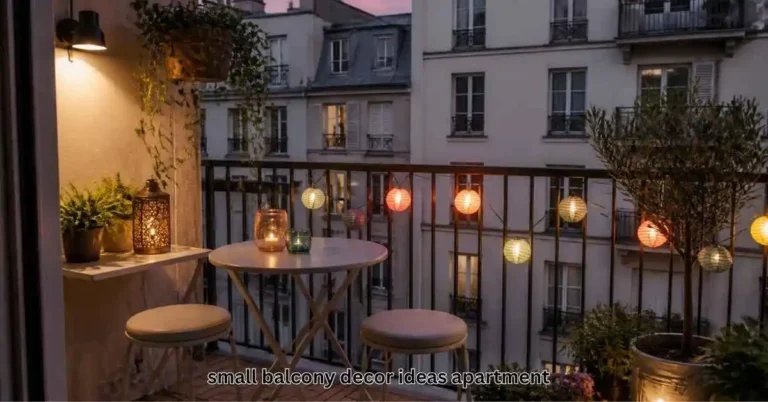
Iron lanterns with flickering flame
Two or three iron lanterns of varying heights — placed on a floor beside a fireplace, a front doorstep, or on a wide console — create a dramatic gathering of light. The flicker matters: use pillar candles or a high-quality battery-operated LED candle that mimics the motion. Avoid lanterns with plastic panes or chrome finishes; the material breaks the spell.
Moss and stone as a base layer
A flat tray of preserved moss, a few grey river stones, and one or two dark pillar candles reads as gothic garden — earthy, aged, slightly unsettling in a quiet way. This works as a table centerpiece or a mantel base layer under taller objects. Preserved moss from a craft store holds indefinitely without water or light and costs very little for a tray’s worth.
A monochrome Halloween tablescape
A dining table dressed entirely in black and cream — black linen napkins, white or cream plates, black tapered candles in slim brass holders, a central arrangement of dried dark florals or bare branches — reads as dramatic and deliberate. Add one seasonal detail: a small white pumpkin beside each place setting, or a scattering of black walnuts and grey river stones down the center. Keep the plate and glassware as usual — the textile and floral decisions carry everything.
Styling elegant Halloween decor by room and budget
Classy Halloween decor works differently depending on where it’s placed. An entryway sets the first impression from six feet away and needs bold silhouette rather than detail. A dining table functions through a meal and can’t obstruct sightlines. A mantel holds the most compositional layers and rewards the most intentional arrangement.
Entryway
Two iron lanterns flanking a front door, a tall branch arrangement in a dark urn, and a dried botanical wreath in black ribbon or dark preserved leaves sets a complete mood. Keep the palette tight: black, cream, and one metal tone. Guests read this display from a distance, so silhouette matters more than surface detail.
Mantel
A mantel holds the most objects. Work in three height levels: a tall back anchor (leaned print, raven, or branch arrangement), medium-height middle objects (candlesticks, pumpkins), and low front accents (skull, stones, moss tray). Limit the palette to three tones. Leave at least 20% of the shelf surface empty — the negative space is part of the composition.
Dining table
A Halloween tablescape should function during a meal. Keep the central arrangement either low (under 10 inches) for across-table sightlines, or narrow (a single tall taper or branch) so it doesn’t obstruct. Black tapered candles in slim holders and a low cluster of dark botanicals do the most for the least interference with conversation.
Pro tip: Before placing any Halloween piece, hold it at arm’s length and look at its outline alone — not its subject matter. Does the shape have visual weight and authority? A ceramic skull does. A foam skull doesn’t. The silhouette test catches most bad purchases before you make them.
Budget breakdown for classy Halloween decor
| Element | Budget approach | Mid-range | Premium |
| Pumpkin cluster (3 pieces) | $10–$20 (real + matte spray paint) | $25–$45 (quality faux) | $50–$90 (artisan ceramic) |
| Candle arrangement | $15–$25 (discount iron holders) | $30–$50 (aged brass + quality wax) | $60–$100 (designer brass + hand-poured candles) |
| Botanical arrangement | $10–$20 (dried from craft store) | $25–$40 (lunaria + branches) | $55–$100 (preserved florals) |
| Velvet accent | $12–$20 (cushion or runner) | $25–$45 (quality velvet piece) | $50–$120 (designer piece) |
| Skull or raven sculpture | $15–$25 (basic ceramic) | $30–$55 (quality resin or iron) | $65–$150 (artisan or marble) |
| Full setup, one room | $55–$95 | $105–$180 | $215–$450+ |
The Three S’s: a framework for classy Halloween decor
The Three S’s — Silhouette, Substance, Subtlety — are a repeatable evaluation method for any Halloween purchase. Apply all three before buying anything. A piece that passes all three is almost always worth the money; a piece that fails any one of them usually ends up looking like what you were trying to avoid.
Applying the Three S’s to any new piece:
- Stand back and look at the shape from 6 feet away. Does it have a strong, clean silhouette that reads clearly at a distance?
- Examine the primary material. Is it iron, ceramic, velvet, dried botanical, real wax, or stone — something with inherent texture and visual weight?
- Ask: does this piece imply something gothic or seasonal, or does it declare it explicitly?
Before buying any Halloween piece, check:
- Clean silhouette that reads from across the room (Silhouette)
- Primary material is iron, ceramic, natural botanical, velvet, or real wax (Substance)
- Implied rather than declared Halloween identity (Subtlety)
- Would it survive in the display past November if you removed one motif?
- Is it one focused piece rather than a prop-table scatter?
Silhouette: A piece should read clearly from across the room by its shape alone. A raven on a perch, a crescent moon, bare branches in a vase, a single skull — all have strong silhouettes. A pile of plastic spiders, a smear of fake cobwebs, a generic ghost shape — none of them do. The silhouette test is the fastest filter.
Substance: Material is what separates a $15 discount store find that looks deliberate from one that looks cheap. Matte ceramic, aged iron, real dried botanical, actual wax — these have inherent texture and weight. Plastic and foam have neither, regardless of price or how they’re arranged.
Subtlety: A sophisticated piece invites the viewer’s imagination rather than directing it. A gothic botanical print suggests something dark without showing anything graphic. A bare branch arrangement in a dark vase feels like October without stating it. Explicit props — spray-blood finishes, glow-in-the-dark plastic, printed gore — state rather than imply. That’s fine for a costume party and wrong for an elegant home display.
Mini case study: I styled an entryway console and front doorstep for October with $67 of materials: dried lunaria from a craft store ($12), a bag of dark bare branches from a garden center ($9), matte black spray paint for two gourds I already owned ($6), grey river stones ($8), three black pillar candles ($14), and a single cast-iron candleholder ($18). No orange, no plastic, no artificial webs. Two guests asked whether it was “an autumn arrangement or actually Halloween” — and when I said it was specifically for October, one of them said it was the first time they’d seen it not look cheap. Every single purchase ran through the Three S’s first. That was the only filter.
Mistakes that undercut classy Halloween decor
Getting the ideas right is half the work. These specific errors are what move a setup from sophisticated to cluttered — and every one has a fix that costs nothing.
Using too many different motifs at once
A raven, a skull, a spider web, a moon, a pumpkin, a bat, and a witch hat in the same arrangement doesn’t read as Halloween — it reads as a prop table. Every motif competes for attention and none of them land.
Fix: Choose one primary motif and one supporting element. The raven or the skull, supported by candles, branches, or stones. Everything else comes from texture and palette, not additional iconography.
Choosing cheap materials even at low prices
Plastic and foam register as costume shop regardless of how they’re arranged. A foam skull beside a quality iron candleholder pulls the entire arrangement down to the level of the foam — not up to the level of the iron.
Fix: Buy one well-made piece rather than three inexpensive ones. A single matte ceramic skull on a stone tray looks considered. Three foam skulls in the same space do not.
Making orange the primary color
Bright orange announces Halloween immediately, which is the point if you want obvious festivity. But it also closes off every other interpretation — the display has one meaning, one context, and one deadline.
Fix: Use orange as one accent at most: a single real pumpkin in a primarily black-and-cream arrangement, or dried orange slices in a botanical display. Remove orange entirely and the decor transitions to late-autumn styling with almost no changes.
Objection: Won’t this just look like autumn decor with no Halloween feel? The Halloween effect comes from specific motifs and mood — not color. A raven, a ceramic skull, or a gothic print signals October clearly, even against a cream-and-black palette. The atmosphere — gathered candlelight, bare branches, a slight deliberate darkness — reads as Halloween even without a jack-o’-lantern in sight. What the objection is really pointing at is whether “Halloween” means the holiday’s atmosphere or its explicit iconography. Classy decor delivers the atmosphere; what you’re trading is the iconography.
Objection: Isn’t classy Halloween decor just more expensive? Some pieces cost more than their foam equivalents — a ceramic skull, a velvet runner. But the total setup often costs less, because you’re buying fewer things. A raven sculpture, three pillar candles in an iron holder, and a bundle of dried lunaria runs $40–$55 and covers a mantel. Filling the same space with a dozen $5 drugstore items costs more, takes longer to arrange, and doesn’t look better. Restraint is cheaper than it seems.
FAQs
What is classy Halloween decor?
Classy Halloween decor creates a gothic, atmospheric mood through restraint and material quality rather than explicit props or horror imagery. It relies on candlelight, dark botanicals, iron and ceramic objects, and a tight palette — black, cream, deep burgundy, or aubergine — to make a space feel like October without anything frightening.
How do you decorate for Halloween without it being scary?
Focus on the gothic atmosphere rather than the horror iconography. Pillar candles in iron holders, dried botanical arrangements, a single raven or ceramic skull, and dark velvet accents all read as Halloween without anything unsettling. Avoid detailed gore, jump-scare props, and anything designed to provoke shock.
What colors make Halloween decor look sophisticated?
Black, cream, aged ivory, deep burgundy, aubergine, and charcoal form the core palette. Brass and iron add metallic warmth. Bright orange reads as casual and festive; use it as a single accent or omit it entirely for the most sophisticated result.
How do you make Halloween decorations look expensive?
Material is the main lever. Iron, ceramic, real or preserved botanicals, velvet, and real wax candles all read as quality independent of what they cost. Restraint is the second lever: one well-placed piece looks more considered than five items of the same quality crowded into the same space.
Can you keep elegant Halloween decor up past October?
Most of it transitions easily. A dried botanical arrangement, iron candleholders, velvet accents, and bare branch vases shift into late-autumn styling without much adjustment. Remove any explicitly Halloween motifs — the skull, the raven, the gothic print — and the rest of the display functions as November decor with almost nothing changed.
Pulling it together
Halloween decor ideas classy not scary come down to a handful of consistent decisions: atmospheric palette over orange, natural materials over plastic, one or two motifs over a prop-room collection, and implied darkness over declared horror. The Three S’s — Silhouette, Substance, Subtlety — give you a filter for every purchase so you’re not guessing at the shop.
Start with what you already own. A pair of iron candleholders, a ceramic bowl, a dark vase, and a craft store run for dried lunaria and branches takes most mantels or consoles most of the way there.
For more ideas on seasonal styling that works across the full autumn, Home Decor Ideas covers mantel arrangements, October tablescapes, and room-by-room guides that follow the same approach through every month.