Styling a console table entryway comes down to three layers working together: one functional catchall for keys and mail, one tall anchor object, and enough open surface left that the table doesn’t read as cluttered the moment you walk in. Most entryway tables fail not because the objects on them are wrong, but because everything sits at the same height and the same size, so the eye has nowhere to land. Below is the exact layering order I use, a size chart matched to table length, and the one habit that turns a styled table back into a dumping ground within a week.
Key takeaways:
- Layer objects at three different heights so the table reads as intentional, not random.
- Keep one dedicated tray or bowl for keys and mail so loose items don’t spread across the whole surface.
- Leave roughly a third of the table’s surface empty for visual breathing room.
- A console table under 36 inches long usually holds three to four objects well, not more.
- A mirror or art piece above the table anchors the whole vignette, but isn’t strictly required.
- Fresh or faux greenery softens a table full of hard-edged objects like trays and books.
What a well-styled console table needs
A console table needs a functional layer for everyday items, a decorative layer for visual interest, and enough negative space to keep the whole surface from feeling packed. Skipping any one of these three usually shows up fast, either as clutter or as a table that looks staged rather than lived in.
The functional layer
This is whatever the table actually needs to catch day to day: a tray for keys, a small bowl for loose change, or a shallow basket for mail. Without this layer, those items end up loose on the table surface within days, undoing any styling work.
The decorative layer
Books, a vase, a small sculpture, or a framed photo add personality and give the eye something to focus on beyond function. These pieces work best grouped in twos or threes rather than spread evenly across the table.
Negative space
The empty surface between objects matters as much as the objects themselves, since it’s what keeps a styled table from reading as crowded. A good rule of thumb is leaving close to a third of the table clear at any given time.
How to style a console table entryway step by step
Styling a console table works best as a sequence, starting with function and building up in height and texture, rather than placing decorative objects first and squeezing the functional pieces in around them.
- Clear the entire surface. Start from nothing, even if the current setup already has a few things you plan to keep, so you can build the layout with intention rather than working around existing clutter.
- Place the functional catchall first. Set a tray or shallow bowl near one end of the table, close to where you naturally set things down when you walk in.
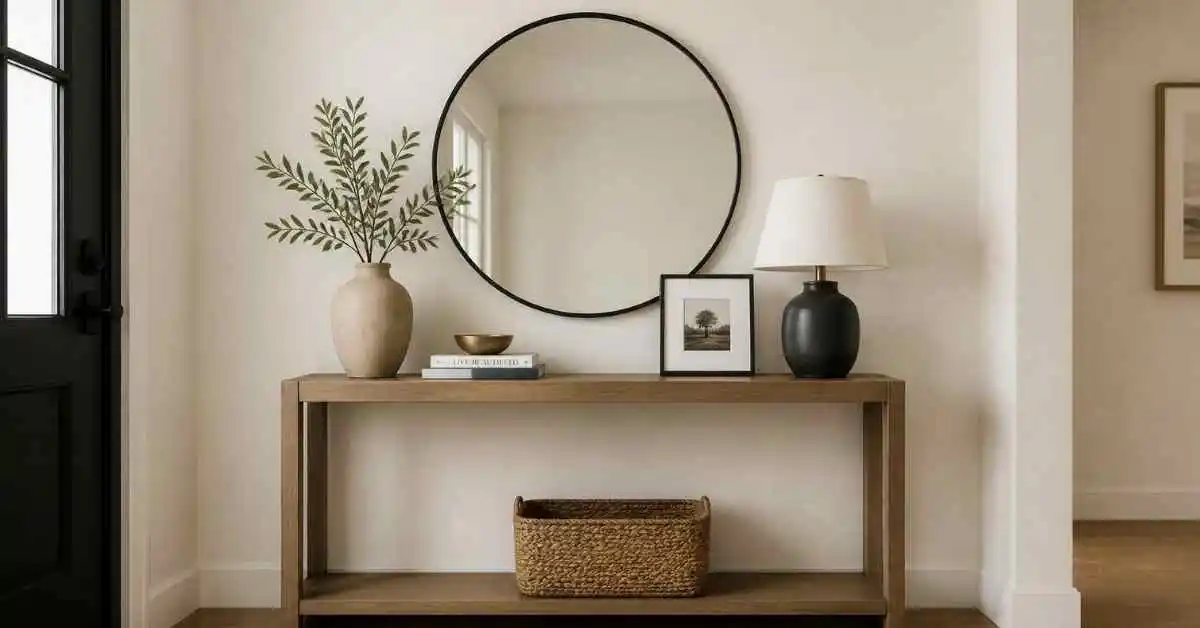
- Add a tall anchor piece. A lamp, a tall vase, or a piece of art leaned against the wall gives the table a visual high point, ideally 18 to 24 inches tall on a standard-height console.
- Layer in a mid-height object. A stack of two or three books or a medium vase sits between the tall anchor and the tray, filling the middle height range.
- Add texture with greenery or a small object. A trailing plant, a small woven basket, or a ceramic dish softens the harder lines of the tray and books.
- Step back and check from the entry door. The table should read clearly from a few feet away, with the tall piece visible first and the smaller details noticeable only up close.
Sizing your console table styling to the table length
The number of objects that work on a console table scales with its length, and cramming too many pieces onto a short table is the fastest way to make an entryway feel cluttered rather than welcoming.
| Console table length | Recommended object count | Best functional piece |
| Under 36 inches | 3 to 4 objects | Small tray or single bowl |
| 36 to 48 inches | 4 to 5 objects | Tray plus a small basket |
| Over 48 inches | 5 to 6 objects, grouped in twos and threes | Tray, basket, and one larger decorative object |
Pro tip: Group objects in odd numbers within each height cluster, like three books instead of two, since odd groupings tend to look more natural than perfectly even ones.
The high-mid-low triangle
Most entryway styling advice stops at “group in odd numbers.” The high-mid-low triangle goes further: pick one tall object, one mid-height object, and one low, flat object, then arrange them so a line connecting their tops forms a rough triangle rather than a straight row.
I restyled a 42-inch console table in a rental entryway over one evening, using a lamp as the tall point, a small stack of books as the mid-height point, and a low ceramic tray as the flat base of the triangle. The table had looked like a random pile of mail and shoes for weeks before that. Once the triangle was in place, family members started using the tray for keys within the first few days, without being asked.
This method loosens up on a very narrow table, under about 30 inches long, where there often isn’t room for three distinct height clusters. In that tight a space, drop to two clusters, a tall anchor and a single low tray, rather than forcing a third element in.
Common console table styling mistakes
Placing everything at the same height
A row of objects all roughly the same size reads as flat and unintentional, even if each piece is attractive on its own. Introduce at least one clearly taller and one clearly lower object to break up the line.
Skipping the functional catchall
Without a dedicated tray or bowl, keys, mail, and loose items end up scattered across the whole table within the first week. Add one catchall before placing any decorative objects.
Won’t a catchall tray just become another mess?
It can, but only if it’s the wrong size for what actually needs a home there. A tray sized for keys and a couple of small items, sorted every few days, stays tidy far longer than one left open-ended for anything that lands on the table.
Do I need a mirror above every console table?
Not necessarily. A mirror or art piece helps anchor the vignette and adds light in a dim entryway, but a tall lamp or a leaning piece of art can do the same visual job if wall space above the table isn’t available.
| Habit | Skip this | Do this instead |
| Height | Place all objects at the same height | Build a high-mid-low triangle across the table |
| Function | Style the table with no catchall | Add one tray or bowl before anything decorative |
| Grouping | Space objects evenly across the whole length | Cluster pieces in twos and threes with gaps between |
| Surface | Fill every inch of the table | Leave close to a third of the surface empty |
FAQs
How many items should be on a console table?
For a table under 36 inches, three to four objects usually work best. Longer tables can hold five or six, as long as they’re grouped in clusters rather than spread evenly across the surface.
What goes well on top of a console table in an entryway?
A tray for keys and mail, a tall lamp or vase, a stack of books, and a small plant cover the functional and decorative bases most entryways need.
Should a console table have a mirror above it?
It helps but isn’t required. A mirror adds light and depth to a dim entryway, though a leaning art piece or a tall lamp can anchor the space just as well without one.
How do I keep my entryway console table from getting cluttered?
Give every loose item, keys, mail, and sunglasses, one dedicated tray or bowl, and sort it every few days rather than letting items accumulate loosely across the surface.
What size console table fits a small entryway?
A table under 36 inches long generally fits a small entryway well, leaving enough walking clearance on either side without overwhelming the space.
Styling a console table entryway comes down to building height variation, giving loose items a real home, and leaving enough open surface for the eye to rest. Start with the tray, add your tall anchor, and build the triangle from there. For more entryway styling ideas like this one, HomeDecorIdeas.it.com has a growing library worth exploring.