Most living room walls fail the same way. They either sit blank because everything you tried looked wrong, or they get crammed with small frames that add clutter without impact. You want the walls to work as hard as the sofa, but most guides online tell you to buy more art without saying what size, where, or how many.
The best home decor ideas for living room walls start with one rule: pick a scale that matches the wall, then layer everything else around it. A single oversized piece, a well-planned gallery, or a mix of textures and mirrors can carry a room, but only if the anchor is sized right. Everything else follows the anchor.
Below are 12 tested ideas, a framework you can apply to any blank wall, and one mistake I still see in almost every living room I visit.
Key takeaways:
- Wall art should be 55 to 65 percent of the width of the sofa or console below it.
- Hang art with its center at 57 to 60 inches from the floor, not higher.
- Gallery walls work best when built around one dominant anchor image.
- Mirrors, shelves, and textiles all count as wall decor and add more depth than framed prints alone.
- The Wall Trio Method anchors any blank wall with just three visual weights.
What actually works on living room walls
Wall decor works when three fundamentals line up: the anchor piece is scaled to the wall, the hanging height matches sightline at 57 to 60 inches, and the negative space between pieces reads as intentional. Most failed walls miss on scale first, then height, then spacing.
Scale first, style second
A 24 by 36 inch print above an 84-inch sofa always looks lost. Aim for one anchor piece or gallery cluster that covers 55 to 65 percent of the sofa or console width beneath it. This one habit prevents the two most common wall decor mistakes: undersized art and misjudged proportion.
Height matters more than most people think
Center your art at 57 to 60 inches from the floor. Above a sofa, this typically means the bottom edge sits 8 to 10 inches above the back cushions. Hanging higher makes the room feel top-heavy and the sofa look stranded, even when the piece is the right size.
12 home decor ideas for living room walls that actually work
These are the 12 wall decor ideas I return to in almost every living room I style, in the order I usually apply them. Start with the anchor, then layer texture, then add supporting pieces. Order matters more than style variety.
Hang one oversized statement piece above the sofa
For the biggest single-move impact, one large piece scaled at 55 to 65 percent of the sofa width will always outperform three medium prints hung in a row. A 40 by 60 inch canvas above an 84-inch sofa anchors the room instantly. Choose an image with room to breathe. Busy patterns fight the furniture below them and shrink the wall’s perceived scale.
Build a gallery wall around one anchor image
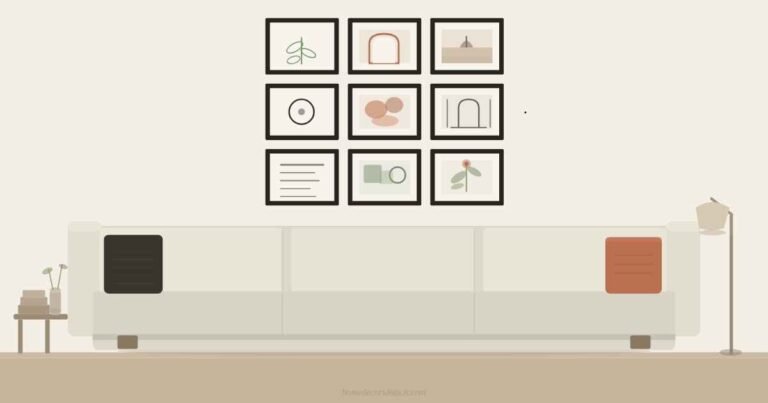
Pick one large piece 24 by 36 inches or bigger as the anchor, then arrange 5 to 8 smaller frames around it. Keep 2 to 3 inches between each frame for the intentional-not-crowded look. Mix landscape and portrait orientations to keep the eye moving. Gallery walls fail when every piece is the same small size and evenly spaced.
Lean a full-length mirror against the wall
A mirror 60 inches or taller, leaned casually against the wall opposite a window, doubles perceived light and adds vertical scale. Leaning works better in rentals since there’s no drilling required. Choose a warm brass, matte black, or natural wood frame that complements your other metals. Avoid ornate carved frames in modern rooms since they date fast.
Install two or three floating shelves
Long shelves 8 to 10 inches deep, spaced 12 to 15 inches vertically, give you a rotating display for books, ceramics, small art, and plants. Match the shelves to your wood tones or paint them the wall color for a built-in look. Two shelves usually beats three in a small room. Keep 60 percent styled, 40 percent negative space.
Add symmetrical wall sconces flanking the sofa
Mount sconces 60 to 66 inches from the floor, 8 to 12 inches out from each end of the sofa. Sconces at eye level add warm shadow depth that overhead lighting can’t. Choose fixtures with 2700K warm bulbs and matte metal finishes. In rentals, plug-in sconces with cord covers work without drilling into ceilings.
Hang a textured woven or textile piece
Jute, rattan, macramé, or a large woven tapestry adds warmth and softens acoustics in echoing rooms. Aim for a piece at least 24 by 36 inches, hung so the top edge sits at 65 inches from the floor. Textiles work especially well above sofas in modern minimalist rooms where framed art can feel cold or clinical against hard finishes.
Paint one accent wall in a saturated color
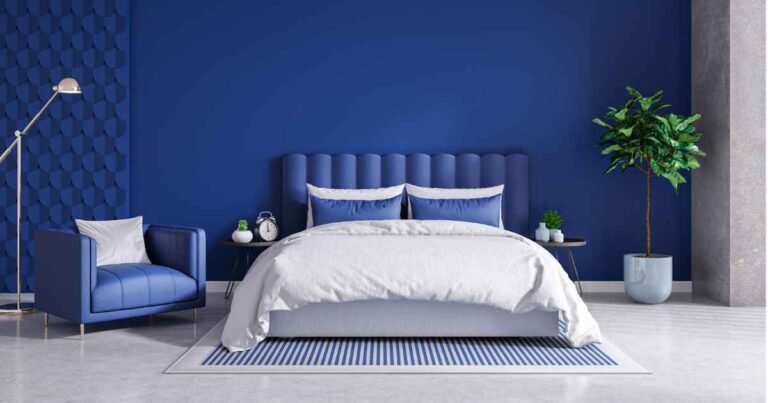
Deep forest green, terracotta, navy blue, or a warm mustard can turn a boring wall into the room’s focal point. Paint the wall that anchors the sofa or media unit, not a random one. Match the trim to the wall color for a continuous look, or leave it white for contrast. Test in a two-foot square first.
Wallpaper one high-visibility wall
Pick the first wall you see when entering the room. A small-scale geometric, botanical, or textured grasscloth pattern reads as intentional and dresses the whole space. In rentals, peel-and-stick wallpaper installs in one afternoon and removes cleanly without residue. Avoid busy patterns in rooms under 12 feet wide since they’ll close the space in visually.
Install a picture ledge for rotating art
A picture ledge 4 inches deep, mounted 60 to 65 inches from the floor, lets you swap art in and out without new nail holes. Layer 3 to 5 pieces of different sizes and lean them against each other. This is the easiest way to change wall decor over time without recommitting to new placements or filling in old holes.
Hang a large tapestry or fabric panel behind the sofa
A woven tapestry or fabric panel 60 by 80 inches or larger, hung so the bottom edge sits 10 inches above the sofa back, softens hard architecture and cuts room echo. Natural linen, cotton, or wool blends read premium against most sofa fabrics. Avoid glossy synthetic fabrics since they cheapen the whole room instantly, no matter the color.
Cluster small vintage objects sculpturally
Old plates, straw hats, woven baskets, or brass mirrors grouped in an asymmetrical cluster read as collected, not decorated. Aim for 5 to 9 objects at similar scale, mounted with 2 to 3 inches of space between each. Vintage clusters work best above consoles or in unused corners, not directly above the sofa where they’d compete with the anchor.
Add architectural molding or board-and-batten paneling
Adding vertical or grid-pattern trim to one wall creates instant architectural interest without art at all. Board-and-batten works especially well in rentals with peel-and-stick millwork strips that install with adhesive. Paint the paneled wall the same color top to bottom for depth, or contrast with the ceiling for drama. This one move dresses a plain builder wall permanently.
Sizing, budgets, and the numbers that matter
Most living room wall mistakes come down to numbers, not taste. Choose art two inches too small for the wall behind it and the piece looks orphaned. These two tables give the numbers I check before recommending a single frame to a reader.
Art size by wall or sofa width
| Wall or sofa width | Art anchor size | Gallery cluster size | Hanging height (center) |
|---|---|---|---|
| 60 to 72 in (loveseat or small wall) | 24 x 36 in | 48 x 36 in cluster | 57 in |
| 72 to 84 in (standard sofa) | 30 x 40 in or 40 x 60 in | 60 x 40 in cluster | 58 in |
| 84 to 96 in (large sofa) | 40 x 60 in or 48 x 72 in | 72 x 48 in cluster | 60 in |
| 96 in and above (sectional) | 48 x 72 in or larger | 84 x 60 in cluster | 60 in |
Where your budget lands
| Budget tier | Prioritize | Realistic impact | Time to install |
|---|---|---|---|
| Under $50 | Peel-stick wallpaper strip, thrifted frames, new nails | Focal wall, gallery starter kit | One evening |
| $50 to $200 | One medium art piece, floating shelves, warm bulbs | Anchor plus texture | One weekend |
| $200 to $500 | Large statement art, quality framing, wall sconces | Full anchor treatment | One weekend |
| $500 to $1,000 | Custom framing, oversized mirror, professional paint | Magazine-level result | Two weekends |
Pro tip: Buy the anchor piece first, then work outward. Most people start with small frames and try to build up, which leads to unbalanced walls with no clear focal point. Anchor first, then scale everything around it.
The Wall Trio Method
Every well-decorated living room wall breaks into three visual weights. Nail all three and the wall reads as designed. Miss one and the wall looks either sparse or overstuffed. This framework works for blank walls, sofa walls, and TV walls equally well.
Anchor: the dominant piece
The largest visual weight on the wall: one big piece of art, a mirror, a tapestry, or a shelving unit. The anchor sits at the wall’s optical center and does 60 percent of the visual work. If the anchor is missing or too small, no amount of secondary decor rescues the wall.
Bridge: the mid-scale accents
Bridges connect the anchor to the surrounding wall space. Sconces, small framed prints, floating shelves with objects, or a picture ledge. Each bridge piece should be 25 to 40 percent of the anchor’s size. Bridges do the storytelling. They add layer, texture, and personal touch without overwhelming the anchor.
Whisper: the small detail
Whispers are the smallest accents that complete the composition. A small vintage plate, a tiny sconce, a botanical print no larger than 8 by 10 inches, or a single hook holding a hat. Whispers add human warmth. Skip them and the wall feels sterile. Use too many and the wall feels cluttered.
Case study: filling a blank 12-foot wall for $180
I filled a 12-foot blank living room wall over one weekend on a $180 budget. Anchor: a $75 thrifted 40 by 60 inch framed print, centered at 60 inches from the floor. Bridges: two $30 floating shelves flanking the print, styled with books and ceramics. Whispers: three $15 miniature botanical prints leaning on the shelves. The wall went from empty billboard to the room’s focal point. The anchor did most of the work, but the bridges and whispers made it read as intentional instead of stark.
Weekend one checklist:
- Buy or thrift the anchor piece first, since it determines everything else
- Measure the wall width and calculate 55 to 65 percent for anchor size
- Hang the anchor centered at 57 to 60 inches from the floor
- Add 2 to 3 bridge pieces at 25 to 40 percent of anchor size
- Finish with 3 to 5 whispers to complete the composition
Common living room wall decor mistakes (and how to fix them)
Some mistakes come up in almost every living room wall consult I do. Most aren’t about taste. They’re about assumptions people carry over from smaller rooms or Pinterest photos that don’t translate to real spaces.
Mistake 1: Hanging art too high
Fix: art’s center should sit at 57 to 60 inches from the floor. Above a sofa, the bottom edge should sit 8 to 10 inches above the back cushions. Hanging higher makes the room feel top-heavy and disconnected from the seating below.
Mistake 2: Choosing art too small for the wall
Fix: aim for the anchor piece to cover 55 to 65 percent of the sofa or console width beneath it. A 24 by 36 inch print above an 84-inch sofa always looks lost, no matter how well it’s framed. When in doubt, go one size larger.
Mistake 3: Overcrowding a small wall with too many small pieces
Fix: consolidate. Small walls need one strong piece or a tight gallery, not scattered mini-frames. If a wall is under 48 inches wide, use one anchor piece and skip the bridges and whispers entirely.
Won’t a gallery wall look cluttered in a small living room?
Usually the opposite. A tight gallery with 2 to 3 inches of spacing and a clear anchor image reads as intentionally curated, not chaotic. Where it backfires: on walls under 4 feet wide, where multiple frames compete for tight space. On those walls, one strong piece wins every time. Space between frames is the enemy, not the frame count.
Isn’t hanging one big piece safer than a gallery wall?
Sometimes, but not always. One large piece works when the wall has clean lines and the sofa or console below is simple. Gallery walls actually work better above cluttered furniture or in rooms with lots of texture, because the eye needs multiple stopping points. Pick based on the room’s existing visual complexity.
FAQs
These are the questions readers ask most often about home decor ideas for living room walls when starting from a blank space.
What can I put on my living room walls besides pictures? Mirrors, floating shelves, textile hangings, woven baskets, wall sconces, plate collections, wooden panels, and architectural molding all count as wall decor. The best walls combine two or three types instead of relying on framed art alone. Texture beats more prints every time in a small living room.
How high should you hang art in a living room? Center art at 57 to 60 inches from the floor, which is museum-standard height. Above a sofa, the bottom edge should sit 8 to 10 inches above the back cushions. Any higher and the piece disconnects from the seating below and makes the ceiling feel lower than it actually is.
How do you decorate the empty wall behind a couch? Start with one anchor piece 55 to 65 percent of the sofa width. Add two flanking sconces or a pair of floating shelves for depth. Skip small scattered frames since they compete with the anchor. A single mirror, tapestry, or large print behind the sofa outperforms three tiny prints every time.
What size art should go above a sofa? Aim for the art or gallery cluster to be 55 to 65 percent of the sofa’s width. For an 84-inch sofa, that means a piece 46 to 55 inches wide. Going smaller makes the piece float. Going larger closes the wall in. Wider furniture supports proportionally wider art or clusters.
Should living room wall colors match the furniture? Not exactly. Wall colors should complement, not mirror, the furniture below. If your sofa is warm beige, a soft greige or muted sage wall reads intentional. If your sofa is cool gray, a warm off-white or dusty terracotta creates contrast without conflict. Perfect matching flattens the room’s depth.
Where to start
The best home decor ideas for living room walls come down to scale before style. Right anchor size. Right hanging height. Right balance between statement pieces and negative space. Once those line up, the wall does what a well-decorated wall should do: anchor the room and give the eye somewhere to rest. Start with the Wall Trio Method, pick your anchor this weekend, and let the bridges and whispers follow. HomeDecorIdeas has room-by-room guides if you want to go deeper on any of these fixes.