The best floor lamps for reading book put light exactly where your eyes need it — steady, shadow-free, and aimed at the page rather than the ceiling. Get it right and you can read for two hours without eye fatigue. Get it wrong and you’ll end every session early with a vague headache and no idea why.
Most buying guides treat this as a style question. It isn’t. The real problem is matching lamp type to the shape of your book. An arc lamp that works beautifully in an open corner is almost useless in a shallow alcove. A torchiere that looks stunning fills the space with ambient mist instead of reading light. This guide covers nine floor lamp types by how they actually perform under reading conditions, explains the four specs that matter, and walks through the placement method I use in every book I’ve styled. The mistake I flag at the end is the one I see most often — and it’s the kind of thing that makes you blame the chair.
Key takeaways:
- Target 450–800 lumens at reading height for comfortable, sustained reading
- Color temperature of 2,700K–3,000K (warm white) is easier on the eyes than cool white above 4,000K
- Adjustable arms and gooseneck designs give the most directional control
- Pharmacy-style lamps suit tight corners; arc lamps suit larger, open books
- Open-bottom shades direct light onto the page; globe and diffused shades scatter it
- Place the lamp on your non-dominant side so your hand doesn’t cast a shadow across the text
What makes a floor lamp good for reading?
A good reading-book floor lamp delivers steady, directed light onto the page without bouncing glare back into your eyes. Four specs determine whether it does that job or just decorates the corner.
Brightness and lumens
For reading, 450–800 lumens at page level is the working target. Below 450 and you’re squinting; push past 1,000 without a dimmer and you’ll fatigue within the hour. A dimmable lamp with a ceiling of 800–1,000 lumens handles both — full brightness for reading, lower for the evenings when you want the book to feel atmospheric rather than functional.
Color temperature
Color temperature, measured in Kelvin, controls how a light feels rather than how bright it is. Warm white at 2,700K–3,000K sits close to traditional incandescent — amber-toned, cozy, easy on the eyes during long sessions. Cool white at 4,000K and above is sharper and more alert; it works in a home office but fights everything a reading book is supposed to do. On LED packaging, “soft white” or “warm white” maps to the 2,700K–3,000K range.
Adjustability
A shade fixed at shoulder height usually sends its beam across the room instead of down onto the book. An adjustable arm, gooseneck neck, or swiveling shade lets you aim the light at reading height — typically 40–48 inches from the floor for someone seated in a standard armchair. Adjustability also future-proofs the lamp: if the furniture moves, the light can follow.
Shade direction
Open-bottom shades — the classic drum, bell, or tapered cone shape — funnel light downward onto the reading surface. Diffused globes and frosted cylinders scatter light softly in every direction. For a reading book, you want the former. A semi-opaque linen or white fabric shade is a reasonable middle ground: it softens the look without losing enough output to matter.
Which floor lamp type suits your reading book?
The right lamp type depends mainly on how much floor space your book has, how the chair sits within it, and how much directional control you need. These nine types are ordered from most to least useful for sustained reading, not by looks or price.
1. Pharmacy-style adjustable lamps
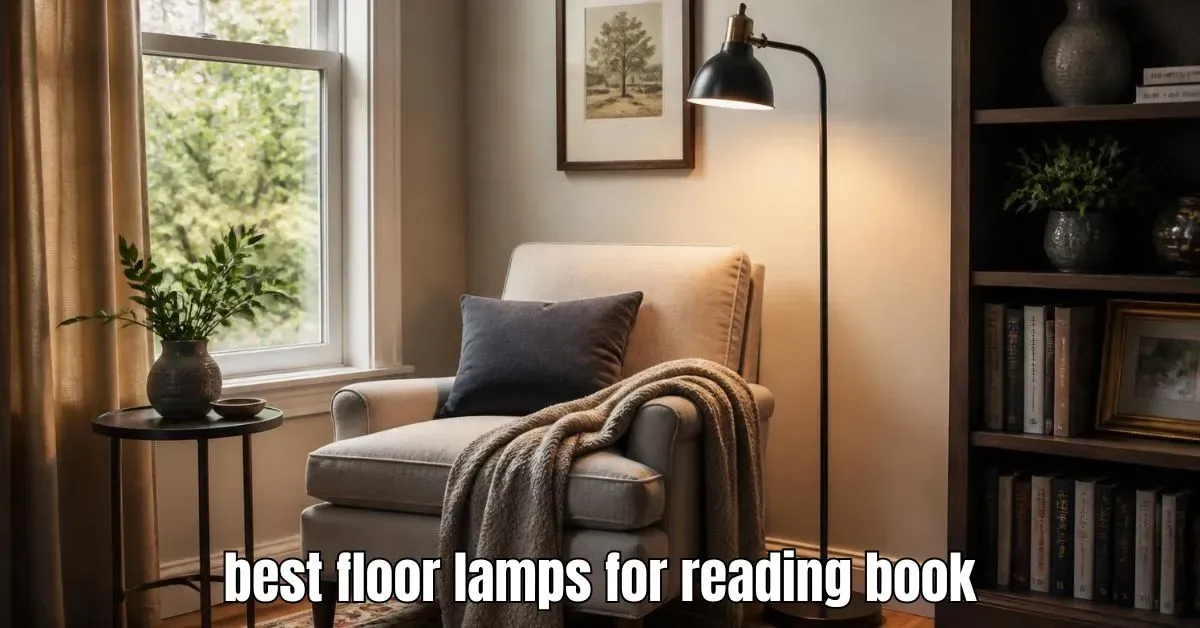
The most purposefully designed reading lamp there is: a slim column, a jointed arm, and a small pivoting shade that points wherever you aim it. The footprint is often under 10 inches across, so it fits into corners where nothing else goes. Pharmacy lamps come in matte black, antique brass, and brushed nickel, which means they work across traditional, transitional, and modern interiors without compromise. For any book under 5 feet wide, this is the default right answer.
2. Gooseneck floor lamps
A flexible metal neck bends into any angle and holds it — more positional freedom than almost any other lamp type. That flexibility suits readers who shift position frequently, change reading distance, or use the same lamp for reading and other close work like knitting or drawing. Quality matters here. Cheap goosenecks lose tension over time and droop. Mid-range and above holds for years.
3. Arc floor lamps
An arc lamp extends a curved arm 60–72 inches over the seating area, positioning the shade roughly above the reader. They work well when the arc places the shade over your shoulder rather than directly overhead — a centered overhead position can bounce glare off glossy pages. Most arc lamps need a weighted base (marble, concrete, or counterweighted steel) to prevent tipping, and many have a base footprint of 14 inches or more. Best suited to books with real floor space.
4. Swing-arm floor lamps
A horizontal arm pivots on a vertical pole, letting you pull the shade close for reading or push it back when you want ambient light instead. The arm extends 20–30 inches on most models — enough to clear a standard chair arm. It’s a practical choice for books that double as television spots, since you can reposition the lamp without moving the base.
5. Tree and multi-arm lamps
Two or three adjustable heads on a single column, usually a mix of upward- and downward-pointing spots. They solve the one-outlet-per-book problem by stacking ambient and task light on one plug. The trade-off is footprint: a multi-arm lamp with splayed legs takes meaningful floor space. Measure your book’s available floor area before ordering any model with a wide base.
6. Torchiere lamps
The shade faces upward, bouncing light off the ceiling for wide, indirect coverage. As a standalone reading lamp, a torchiere falls short — the reflected light is too diffuse to support sustained text reading. As a fill layer alongside a directed lamp, it works well. The soft ambient wash reduces contrast between the bright page and the dark surrounding room, which genuinely lowers eye fatigue over long sessions. Pair it, don’t rely on it.
7. Tripod floor lamps
Three wide legs and usually a globe or open-top shade. The aesthetic is strong; the reading utility is limited. Tripods scatter light rather than direct it, and the wide stance claims more floor space than the output justifies. Use one as a decor anchor in a larger book alongside a pharmacy lamp. Don’t make it the primary reading source.
8. Plug-in arc shelf lamps
A hybrid that’s become genuinely useful in compact books: an arc lamp with a small built-in shelf near the base for a book stack, phone, or drink. Good for spaces where surface area is a real constraint. Quality varies considerably — look for an open-bottom shade rather than a globe, and confirm the underside of the shade clears your head when seated (most sit at 60–65 inches to the shade bottom).
9. LED column and cylinder lamps
Slim, architectural cylinders that emit warm ambient light through a frosted tube or open ends. Clean looking, space-efficient, and genuinely pleasant in a contemporary book. But like torchieres, they don’t concentrate reading light. Best for books used primarily for audio listening, casual phone reading, or low-intensity browsing where atmosphere matters more than intensity.
Floor lamp types compared
| Lamp type | Best book size | Directional output | Base footprint | Relative cost |
| Pharmacy-style | Small to medium | Excellent | Small | Budget to mid |
| Gooseneck | Any | Excellent | Small | Budget to mid |
| Arc lamp | Medium to large | Good | Large | Mid to high |
| Swing arm | Medium | Very good | Small to medium | Mid |
| Tree / multi-arm | Medium to large | Good | Medium | Mid |
| Torchiere | Any (as fill only) | None | Small | Budget to mid |
| Tripod | Any (as decor) | Poor | Large | Mid |
| Arc shelf | Small to medium | Moderate | Medium | Mid |
| LED column | Any (as mood) | None | Small | Mid |
How to choose the right lamp for your book size and style
The lamp you choose should fit the physical constraints of your book first, then your decor second. Getting those two criteria backwards is how good lamps end up unused.
Corner books: A 90-degree corner with an armchair suits a pharmacy lamp or swing arm placed to one side, base against the wall. The shade needs to extend at least 12 inches past the chair arm to hit the page rather than the lap. Keep the lamp base clear of any walkway past the chair.
Window seat books: At night, a dark window acts as a mirror. Any bright light source sitting to your side reflects straight back into your eyes. Position the lamp on the opposite side from the window. An arc lamp at one end of the window seat, arm extending along its length, handles this layout naturally.
Alcove and built-in books: A recessed alcove is often too shallow for a standard floor lamp. An arc lamp placed just outside the opening — arm reaching inward — solves this without any wall work. A plug-in swing-arm sconce on the alcove’s side wall does the same job and keeps the floor completely free.
| Decor style | Lamp finishes that work | Shade materials |
| Modern / minimalist | Matte black, brushed steel | White drum, frosted glass |
| Scandinavian | Warm wood, brass | Linen, white paper |
| Traditional | Antique brass, aged bronze | Cream fabric, pleated |
| Industrial | Matte black, raw steel | Metal, exposed bulb |
| Boho / eclectic | Rattan, bamboo | Woven natural fiber |
| Mid-century modern | Walnut, gold, chrome | Enameled metal, glass |
The Reading Triangle Method
“Put the lamp beside you” is advice that’s half-right. Most reading-lamp discomfort doesn’t come from brightness; it comes from a poor angle relationship between the light source, the page, and the reader’s eyes. The Reading Triangle Method is a three-point placement check that takes about two minutes and removes most causes of glare and shadow before you open a book.
Step 1 — base position: Place the lamp base level with or slightly behind the rear leg of your chair, on your non-dominant side. Right-handed readers: lamp to the left. This keeps your dominant hand from casting a shadow on the page when you turn or annotate.
Step 2 — shade height: Set the shade so the bottom sits at approximately eye level when you’re seated — usually 40–48 inches from the floor, depending on your chair. Too low and the bare bulb enters your peripheral vision. Too high and the beam skips the reading surface entirely and hits the floor beyond your knees.
Step 3 — shade angle: Tilt the shade so the center of the beam hits the center of a book held at your natural reading distance, roughly 14–18 inches from your face. Test this with a real book held in your reading hand, not a visual estimate from across the room.
When these three points align cleanly — base behind the chair, shade at eye level, beam on the page — glare disappears and your eyes stop having to compensate between the light source and the text.
Pro tip: If you can see the bright interior of the shade from your normal seated reading position, the shade is angled too high or the lamp is positioned too far forward. A 10-degree tilt adjustment fixes this in under 30 seconds and corrects nine out of ten reading-lamp glare complaints before they require any further changes.
Case study
I restyled a friend’s 9-foot reading corner in one afternoon. She had an arc lamp positioned directly to her right at a fixed 54 inches — above eye level — with the beam hitting the top third of her book instead of the center. Moving the base 18 inches behind the chair back, dropping the shade angle 15 degrees, and replacing a 4,000K bulb with a 2,700K equivalent cost nothing and took under 20 minutes. That night she read two full chapters in the chair without stopping. Before the adjustment, neck tension had been ending her reading sessions at 30 minutes.
Placement checklist
- Lamp base level with or just behind the rear chair leg, non-dominant side
- Shade bottom at 40–48 inches from the floor when seated
- Beam centered on reading surface at your natural arm’s length
- No direct line of sight to the bare bulb from your seated position
- Color temperature 2,700K–3,000K for reading sessions over 30 minutes
- Dimmer accessible without getting up
Mistakes that ruin reading lamp performance
Most floor lamp frustrations in a reading book come down to placement and specification, not the lamp itself. These two mistakes account for the bulk of the complaints, and both are fixed without spending anything.
Placing the lamp directly behind your head
A lamp centered behind the chair creates an uneven halo on the page — brighter at the edges than the center — while the reader’s head casts a partial shadow across the text. It feels like the lamp is on but isn’t quite working. The fix is simply to move the base to the side and slightly behind, never centered directly back.
Skipping the dimmer
A fixed-brightness lamp forces you to choose between bright enough to read and dim enough to relax in the same book. A dimmable LED, or a lamp that accepts a dimmable bulb, solves this. If your lamp has no dimmer circuit, a smart plug with built-in dimming adds the function to most existing lamps for a small outlay.
“Won’t a bright reading lamp kill the cozy book atmosphere?” Not if the color temperature is right. The clinical feeling people associate with reading lamps almost always comes from cool-white or daylight-spectrum bulbs at 4,000K and above, not from the brightness level itself. A 600-lumen 2,700K warm-white lamp feels no harsher than a bedside lamp — it’s targeted, not clinical. Swap the bulb before replacing the lamp.
“Is an arc lamp too bulky for a small reading book?” Usually it’s the base, not the arm, that’s the limiting factor. Some arc lamps have a rectangular marble base measuring 12 by 18 inches — significant in a tight corner. But plenty of arc lamps use a weighted disc or compact tripod base under 10 inches across. Check the base dimensions listed in the product specifications before ordering; the arm overhang rarely causes the clearance problem people expect.
FAQs
How many lumens do I need for a reading book lamp?
Target 450–800 lumens reaching the page surface. Bulbs lose some output through the shade, so leaning toward the higher end is sensible. If the lamp is dimmable, a ceiling of 1,000 lumens gives you headroom to dial it down to your comfort level for longer sessions.
What color temperature is best for reading at night?
Warm white at 2,700K–3,000K works best for an evening reading book. Temperatures above 4,000K feel clinical and can also interfere with the body’s wind-down before sleep. On LED packaging, “soft white” or “warm white” maps reliably to this range.
How tall should a floor lamp be for a reading book?
Column height matters less than shade height. The bottom of the shade should sit at roughly eye level when seated — usually 40–48 inches from the floor. Look for telescoping poles or adjustable arms if your chair sits notably higher or lower than a standard 18-inch seat height.
Are LED floor lamps better for reading than halogen?
LED is better in nearly every practical way for a reading book. Halogen bulbs generate significant heat, which is uncomfortable in a close armchair corner and a fire risk near fabric shades. LED runs cool, uses far less energy, lasts much longer, and is available in accurate 2,700K warm-white versions. For comfortable color rendering, look for an LED with a CRI (color rendering index) of 90 or above.
Can a floor lamp be the only light source in a reading book?
It can, but adding some low-level ambient fill helps. A single directed lamp in a dark room creates strong contrast between the bright page and the surrounding darkness, which causes cumulative eye fatigue over long sessions. A dimmed table lamp elsewhere in the room, or even a few candles, softens that contrast without competing with the reading light.
Conclusion
The right floor lamp for a reading book comes down to three decisions: the lamp type that fits your book’s shape and floor space, the specs that support comfortable reading (warm white, dimmable, 450–800 lumens at page level), and placement using the Reading Triangle Method. Get those three right and the book becomes what it’s supposed to be.
For most readers in most corners, a pharmacy-style adjustable lamp covers all of it without fuss. If the book has space for something more dramatic, a properly positioned arc lamp is hard to beat — the arm does real work, not just decorative work.
If you’re building out the full corner, Home Decor Ideas covers armchair sizing, small reading book layouts, and layered lighting guides that are worth reading before you start moving furniture.