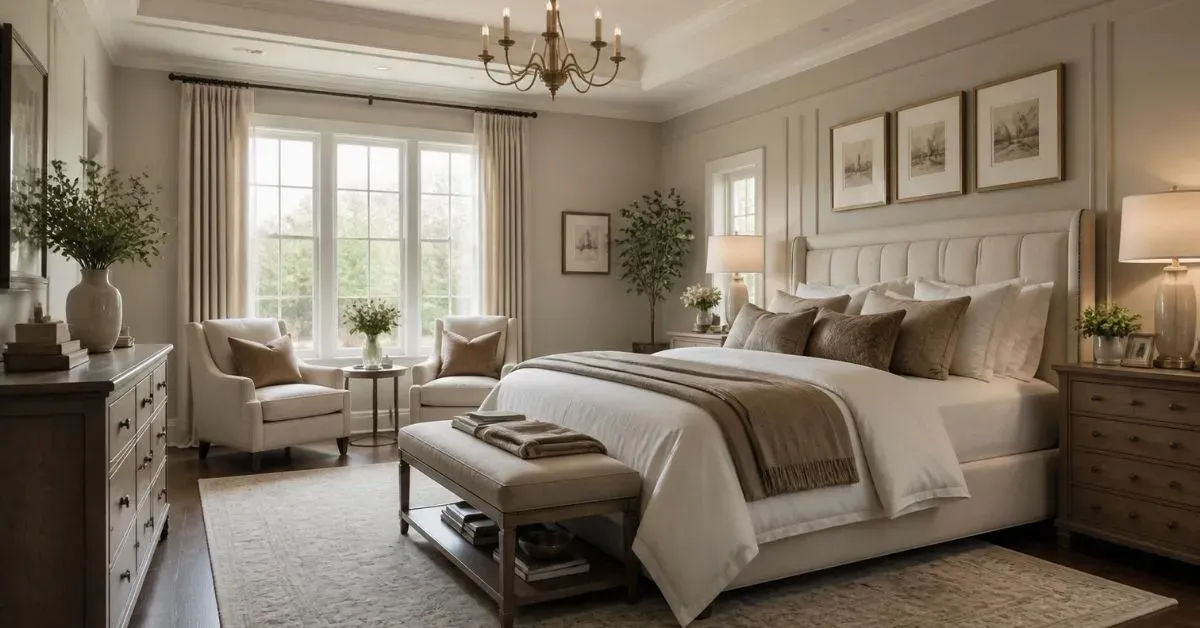
Transitional style bedroom ideas for couples work by blending traditional silhouettes with modern lines around one shared neutral base, which is exactly why the style suits two people with different tastes better than a single strict style would. The usual bedroom conflict, one partner wants classic and tailored, the other wants clean and modern, doesn’t have to end with one side compromising on everything. Below are seven transitional ideas that give both tastes real room, a chart matching furniture choices to each partner’s lean, and the one rule that keeps a mixed-style bedroom from looking like two separate rooms pushed together.
Key takeaways:
- Transitional style pairs traditional shapes, like curved headboards, with modern materials and clean lines.
- A neutral base color lets both partners layer in personal texture without clashing.
- Nightstands don’t need to match exactly; similar height and tone hold a room together better than an identical set.
- Mixing matte black and warm wood hardware reads as intentional, not mismatched, when it repeats at least twice in the room.
- One shared anchor piece, usually the bed, should reflect both partners rather than one person’s taste alone.
- A single bold texture, like a chunky knit throw or a bouclé bench, keeps an otherwise neutral room from feeling flat.
What transitional style actually means for a shared bedroom
Transitional style sits between traditional and modern, borrowing classic silhouettes and pairing them with simpler lines, neutral colors, and mixed materials. In a shared bedroom, this middle ground gives each partner a place to see their own taste without either style dominating the room.
Silhouette
Traditional furniture tends toward curves, turned legs, and detailed trim, while modern furniture favors straight lines and flat surfaces. Transitional pieces usually keep one traditional detail, like a curved headboard, paired with simplified legs or a matte finish that reads as current.
Color palette
A transitional bedroom generally starts with a neutral base, a warm greige or soft oatmeal rather than a stark white or a heavily saturated color. This neutral foundation gives both partners room to add personal color through bedding, art, or a single accent chair without a full repaint.
Texture mix
Rather than matching every fabric, transitional rooms rely on contrast: a smooth linen duvet against a chunky knit throw, or a matte ceramic lamp beside a woven rattan nightstand. This mix is what keeps a neutral palette from reading as boring.
Transitional bedroom ideas for couples that blend both tastes
The ideas below each give a traditional-leaning partner and a modern-leaning partner something to recognize as their own, without either side feeling like the room ignored them.
Upholstered headboard with clean tufting
A curved or wingback-shaped headboard gives the traditional partner a familiar silhouette, while a bouclé or linen fabric in a neutral tone and minimal, evenly spaced tufting keep it from reading as ornate. Aim for a headboard height around 48 to 54 inches for a queen bed, tall enough to feel substantial without overwhelming a smaller room.
Intentionally mismatched nightstands
Choosing two nightstands with different silhouettes but matching height and a shared wood tone lets each partner pick a piece they actually like. A turned-leg wood nightstand on one side and a simple boxy one on the other still reads as a set once both sit at the same 24-inch height with similar finishes.
Layered neutral bedding with one bold texture
A base of crisp white or oatmeal linen sheets, plus a neutral duvet, keeps the bed calm, while a single chunky knit throw or a textured lumbar pillow adds visual interest without introducing a second color story. This works well when one partner wants simplicity and the other wants texture.
Mixed metal hardware repeated twice
Pairing matte black drawer pulls with warm brass or brushed gold reads as a deliberate choice rather than a mismatch, as long as both metals show up at least twice in the room, once on furniture and once on lighting or mirror frames. I think matte black hardware tends to age better than brushed gold in daily use, since it hides fingerprints and small scratches more easily.
Symmetrical lamps with one modern fixture
A matching pair of traditional-shaped lamps on either nightstand gives the room symmetry, while a single modern pendant or a sculptural floor lamp elsewhere in the room adds a contemporary note. This lets a traditional-leaning partner keep the classic symmetry they want at the bed itself.
A shared reading corner with two chair styles
Pairing a slightly curved slipper chair with a simpler modern accent chair in the same fabric family gives each partner their own seat without the corner feeling disjointed. Keep both chairs in the same neutral tone family so the shape difference reads as variety, not mismatch.
A gallery wall mixing eras
Combining a vintage-framed print with a simple modern black frame in the same wall grouping bridges both tastes visually, especially when the mat color and frame width stay consistent across pieces. This works particularly well above a dresser or on the wall opposite the bed.
Budgeting furniture choices across both partners’ tastes
Matching furniture to each partner’s lean doesn’t mean buying two of everything; it means choosing a transitional middle ground for shared pieces and letting smaller accent items reflect each person separately.
| Bedroom element | Traditional-leaning pick | Modern-leaning pick | Transitional middle ground |
| Headboard | Tufted wingback | Flat upholstered panel | Curved shape, minimal tufting, matte fabric |
| Nightstands | Turned-leg wood | Boxy lacquered | Matching height, mixed silhouettes, shared tone |
| Lighting | Symmetrical traditional lamps | Sculptural floor lamp | Symmetrical lamps plus one modern accent fixture |
| Hardware | Warm brass | Matte black | Both metals repeated at least twice |
Pro tip: Buy the bed frame and mattress first, since it’s the piece both partners use daily and the one most worth investing in together. Smaller accent pieces are easier and cheaper to adjust later if one partner’s taste shifts.
The one-anchor method
Most shared-bedroom advice suggests splitting the room down the middle, his side and her side. The one-anchor method works differently: pick a single large piece, almost always the bed, that both partners agree on fully, then let every other choice in the room take its cue from that one anchor’s finish and tone.
I designed a transitional bedroom for a couple who disagreed on nearly everything else over three weekends on a moderate shared budget, starting only with a curved bouclé headboard they both liked. Every other decision, the nightstand finish, the lamp shape, the throw texture, got measured against whether it matched the headboard’s warmth and simplicity. The room came together faster once that one agreement existed, and neither partner felt like they’d lost the negotiation on the rest.
This method works less well when neither partner can agree on any single anchor piece yet. In that case, start smaller: agree on the bedding color first, then let that shared decision guide the anchor piece instead.
Common mistakes in shared transitional bedrooms
Buying two of everything to keep things fair
Doubling up on matching furniture for the sake of equality usually results in a room that looks like a hotel rather than a home. Let smaller pieces vary while keeping shared items, like the bed and rug, unified.
Choosing a strict style instead of a blend
Committing fully to one partner’s preferred style, whether traditional or modern, usually means the other partner stops feeling at home in the room within a few months. A genuine blend, not a compromise where one side wins, holds up better over time.
Won’t blending two styles just look mismatched?
Usually not, as long as elements repeat. A metal finish, a fabric texture, or a silhouette that shows up at least twice in the room reads as intentional variety rather than a random mix of unrelated pieces.
Doesn’t transitional style mean the room ends up bland or too neutral?
It can, if texture gets skipped. A neutral color palette needs contrast in fabric and material, like a woven rattan piece against smooth linen, to avoid feeling flat. Color isn’t what carries a transitional room; texture is.
| Habit | Skip this | Do this instead |
| Furniture | Buy matching pairs of everything | Choose one shared anchor, then vary smaller pieces |
| Style choice | Pick one partner’s preferred style fully | Blend traditional shapes with modern materials |
| Color | Rely only on neutral colors for interest | Add contrast through texture, not just color |
| Hardware | Use one metal finish everywhere without repetition | Repeat two finishes at least twice each |
FAQs
What defines transitional style in a bedroom?
Transitional style blends traditional furniture shapes, like curved headboards, with modern materials and simplified lines, usually set against a neutral color palette that lets both classic and contemporary elements sit together comfortably.
How do you decorate a bedroom for two people with different styles?
Start with one shared anchor piece, usually the bed, that both partners genuinely like, then let smaller accent pieces vary in style as long as they share a consistent color tone or material.
Do nightstands need to match in a transitional bedroom?
Not exactly. Matching height and a shared wood or metal tone matter more than identical shape, which lets each partner choose a nightstand style they personally prefer.
What colors work best for a transitional bedroom?
Warm neutrals like greige, oatmeal, and soft taupe work well as a base, since they’re calm enough to let both traditional and modern accent pieces stand out without clashing.
Can a transitional bedroom include bold colors?
Yes, usually through a single accent, like a chair, an art piece, or a throw pillow, rather than across the whole room. This keeps the shared neutral base intact while still adding personality.
Transitional style bedroom ideas for couples work because they don’t ask either partner to give up their taste entirely. Pick one shared anchor piece, blend traditional shapes with modern materials around it, and let texture do the work color alone can’t. For more shared-space design ideas like this one, Home Decor Ideas has a growing library worth exploring.